0:15
Welcome to your daily update with Army
0:18
Recognition, bringing you the last
0:20
defense and security news across land,
0:27
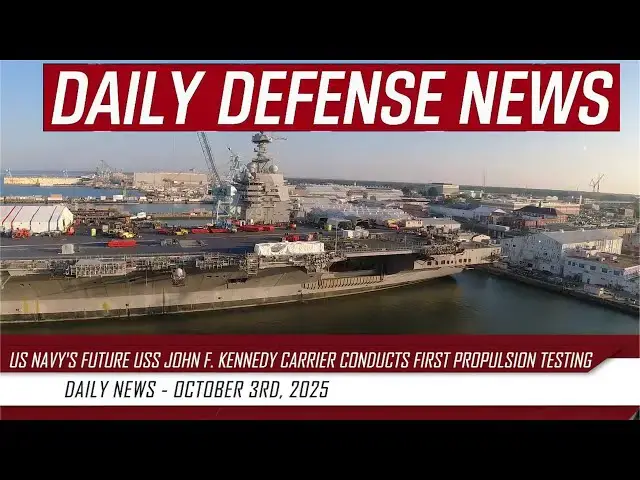
Today we'll look at the future US Navy
0:30
aircraft carrier USS John F. Kennedy
0:33
which has complete its first nuclear
0:35
propulsion testing. Huntington Eagles
0:38
industry the leading US naval chip
0:41
builder and parent company of Newport
0:43
News chip building confirmed that the
0:46
USS John F. Kennedy conduct initial
0:49
propulsion test on the James Rivers.
0:52
Shipyard crew maneuvered the carry with
0:54
tugboats and returned into the pier for
1:00
This mark a key program milestone while
1:03
commissioning delays indicates that the
1:06
US Navy could face nearly a year with
1:10
one fure carrier after the USS Nimnit
1:16
Construction of the USS John F. Kennedy.
1:18
The second Ford class aircraft carrier
1:21
began after contracts were awarded in
1:23
2009. Key milestones included ke laying
1:26
in 2015, island installation in 2019,
1:30
and forward catapult and bow completion
1:33
that same year. A singlephase delivery
1:35
plan replaced the original uh dualphase
1:38
strategy, ensuring the carrier would be
1:41
fully equipped from the start for F35C
1:44
operations and the enterprise air
1:46
surveillance radar. Progress has been
1:48
steady but delayed largely due to two
1:52
complex systems. The advanced arresting
1:55
gear and advanced weapons elevators. The
1:58
AG which uses electromagnetic systems to
2:01
safely recover a wider range of aircraft
2:04
remains under certification in 2025. The
2:07
AWE intended to speed up weapons
2:11
delivery via electromagnetic motors has
2:14
faced similar issues echoing challenges
2:17
seen on the USS Gerald R. Ford. The
2:21
Kennedy also features a new radar
2:23
configuration. Instead of the Ford's
2:25
dualband radar, it uses the ANSPY3X
2:30
band paired with the ANSPY6
2:33
V3 Sband radar. The SPY6 offers digital
2:37
beam forming and 360° coverage with up
2:40
to 35 times the sensitivity of earlier
2:43
systems while reducing long-term costs
2:46
and aligning with Ali Burke class
2:48
destroyers. Powered by two Beal A1B
2:50
nuclear reactors, more powerful and
2:53
efficient than those on Nimits class
2:55
carriers, the ship displaces about
2:57
100,000 tons, spans 337 m, and can
3:01
exceed 30 knots. It will carry over 80
3:04
aircraft with surge capacity for up to
3:07
90. Defensive systems include Sea
3:09
Sparrow and rolling airframe missiles,
3:12
failanks, CIWS, and heavy machine guns.
3:15
Initially budgeted under a $3.35 billion
3:19
fixedpric contract and a $941 million
3:22
cost plus edition in 2015, CVN79 was
3:26
launched in October 2019 and christened
3:29
that December. However, delays have
3:31
pushed delivery from July 2025 to March
3:34
2027. Once commissioned, it will replace
3:37
USS Nimmitz and serve into the 2050s.
3:40
Meanwhile, future Ford class ships
3:42
Enterprise and Doris Miller are already
3:44
under construction. The legacy USS John
3:47
F. Kennedy, decommissioned in 2007, is
3:50
now being dismantled, closing one
3:53
chapter as a new era begins.
3:56
Stay with us for daily updates on key
3:58
development in defense and security
4:01
covering the top stories across land,