

- Details
- Written by: Vandenbosch
- Category: 2024
- Hits: 6530










On July 22, 2024, Rostec delivered new batches of modernized mobile mortars, including the 2S12A "Sani" mobile mortar systems, 2B11 towed mortars, and 2B24 light mortars, to the Russian Ministry of Defense. The corporation is increasing the production of these models following the state order requirements.
Follow Army Recognition on Google News at this link
Rostec delivered new batches of modernized mobile mortars to Russian forces. (Picture source: Russian MoD)
The "Sani" complex features a high-mobility transport vehicle based on the "Ural" platform, capable of traveling 1,000 kilometers. It carries a 120 mm 2B11 mortar, which can be unloaded using an electric winch. Due to their mobility, "Sani" systems can be used as "roaming" mortars with constant position changes. This strategy helps to mislead the enemy about the fire system and the number of forces present.
The 82 mm 2B24 mortar is lightweight and intended for infantry units, including mountain infantry. The 2B24 is easy to use and highly effective against personnel, shelters, and lightly armored vehicles.
The 2B11 is a 120 mm mortar designed by the Soviet Union, which entered service in 1981 and is still in use today. It has been employed in conflicts such as the Soviet-Afghan War and the Russo-Ukrainian War. Manufactured by Motovilikhinskiye Zavody Special Engineering and Metallurgy JSC, this mortar is an example of effective and robust mobile artillery.
The 2B11, weighing 210 kg, is operated by a team of five people. It uses various types of ammunition, including explosive, smoke, illuminating, and incendiary shells, each weighing approximately 16.8 kg. With a caliber of 120 mm, the mortar is mounted on a two-wheeled transport chassis, the 2F510, and is often moved by a GAZ-66 4x4 truck.
This mortar offers a firing elevation range of 45 to 80 degrees and a traverse of ±5 degrees without repositioning the bipod. Its rate of fire reaches 15 rounds per minute, with an effective firing range from 0.46 km to 7.18 km. The sights used for firing are of the MPM-44M type. The 2B11 is known for its high accuracy and its ability to provide flexible and powerful artillery support on the battlefield.
"We have delivered a new batch of 'Sani' mortar systems, 2B11 towed mortars, and 2B24 light mortars to the Ministry of Defense. All the supplied artillery pieces have proven their reliability and effectiveness in combat conditions. Rostec is ramping up the production of these mortars following the state customer's requirements," said Bekhan Ozdoev, Industrial Director of the Conventional Armaments, Ammunition, and Special Chemistry Complex at Rostec.
Rostec's recent delivery of advanced mobile mortars underscores the corporation's commitment to meeting the evolving needs of the Russian military. By increasing the production and modernization of these artillery systems, Rostec is enhancing the operational capabilities of Russian forces, particularly in the challenging contexts of the Ukrainian conflict.
Read more: Rostec Delivers New Batch of Mobile Mortars 2S12A Sani to Russian Forces in Ukraine

- Details
- Written by: Jérôme Brahy
- Category: 2024
- Hits: 7495
On July 22, 2024, the UK Ministry of Defence (MoD) announced the first successful test fire of a High-Energy Laser Weapon System (HELWS) from a British Army's Wolfhound 6x6 armored vehicle. This test, conducted at the Defence Science and Technology Laboratory (Dstl)’s range in Porton Down, saw the laser weapon neutralize targets at distances exceeding one kilometer. This vehicle-mounted high-energy laser weapon represents a development in the UK Ministry of Defence’s Land Laser Directed Energy Weapon (LDEW) Demonstrator program, providing operational potential on the battlefield.
Follow Army Recognition on Google News at this link
This test of a High-Energy Laser Weapon System (HELWS), conducted at the Defence Science and Technology Laboratory (Dstl)’s range in Porton Down, saw the laser weapon neutralize targets at distances exceeding one kilometer. (Picture source: UK MoD)
The lightweight and portable high-energy laser system from Raytheon UK, also known as the High-Energy Laser Weapon System (HELWS), is the first laser weapon integrated into a land vehicle to be fired in the United Kingdom. This capability demonstrator will allow the Ministry of Defence, along with the British Army, to evaluate the utility of laser-directed energy weapon (LDEW) systems against modern threats. The next phase of testing will involve trials with British Army personnel later this year to further assess the system’s capabilities in real-world scenarios. The system is described as low-cost, easy to operate, and capable of tracking multiple targets and engaging them at the speed of light.
Dstl Chief Executive Dr. Paul Hollinshead OBE MBA noted that this milestone advances the adoption of directed energy weapons. Working with DE&S and industry to develop new capabilities, the aim is to prepare the armed forces to detect, disable, and destroy future threats. Team Hersa, combining Dstl’s technical expertise with DE&S’s acquisition skills, is managing the delivery of the demonstrators to ensure the UK Armed Forces can utilize this capability quickly.
Matt Cork, Dstl Programme Lead, highlighted the collaboration between Dstl, DE&S, and industry, which enabled the rapid development of the laser demonstrator. He indicated that the successful testing marks an important moment in enhancing the British Army's future operational capabilities. The technology provides a means to address aerial threats and enhance protection for forces.

The lightweight and portable high-energy laser system from Raytheon UK, also known as the High-Energy Laser Weapon System (HELWS), is the first laser weapon integrated into a land vehicle to be fired in the United Kingdom. (Picture source: UK MoD)
Developed with UK suppliers including Raytheon UK, Frazer-Nash, NP Aerospace, LumOptica, Blighter Surveillance Systems, and Cambridge Pixel, the laser system showcases advanced technology in modern warfare. It operates with a command and control system and can be integrated with broader battle management radar and surveillance systems. The weapon can be mounted on various platforms to meet different operational needs.
James Gray, Chief Executive and Managing Director of Raytheon UK, mentioned the successful firing of the first laser weapon integrated on a land vehicle in the UK. He pointed out that the Raytheon high-energy laser weapon system can track, engage, and defeat targets while mounted on a vehicle. Gray anticipates further experiments by the British Army to confirm the technology's readiness for battlefield deployment.
The Wolfhound 6x6 armored vehicle, used as the platform for this trial, is part of the British Army's Tactical Support Vehicle program. Designed for high levels of protection and versatility, it supports frontline troops by transporting cargo under its armored chassis. Its design allows for the integration of various equipment, making it suitable for experimental defense projects like the high-powered laser weapon, demonstrating the practicality and potential effectiveness of this technology in real-world military applications.
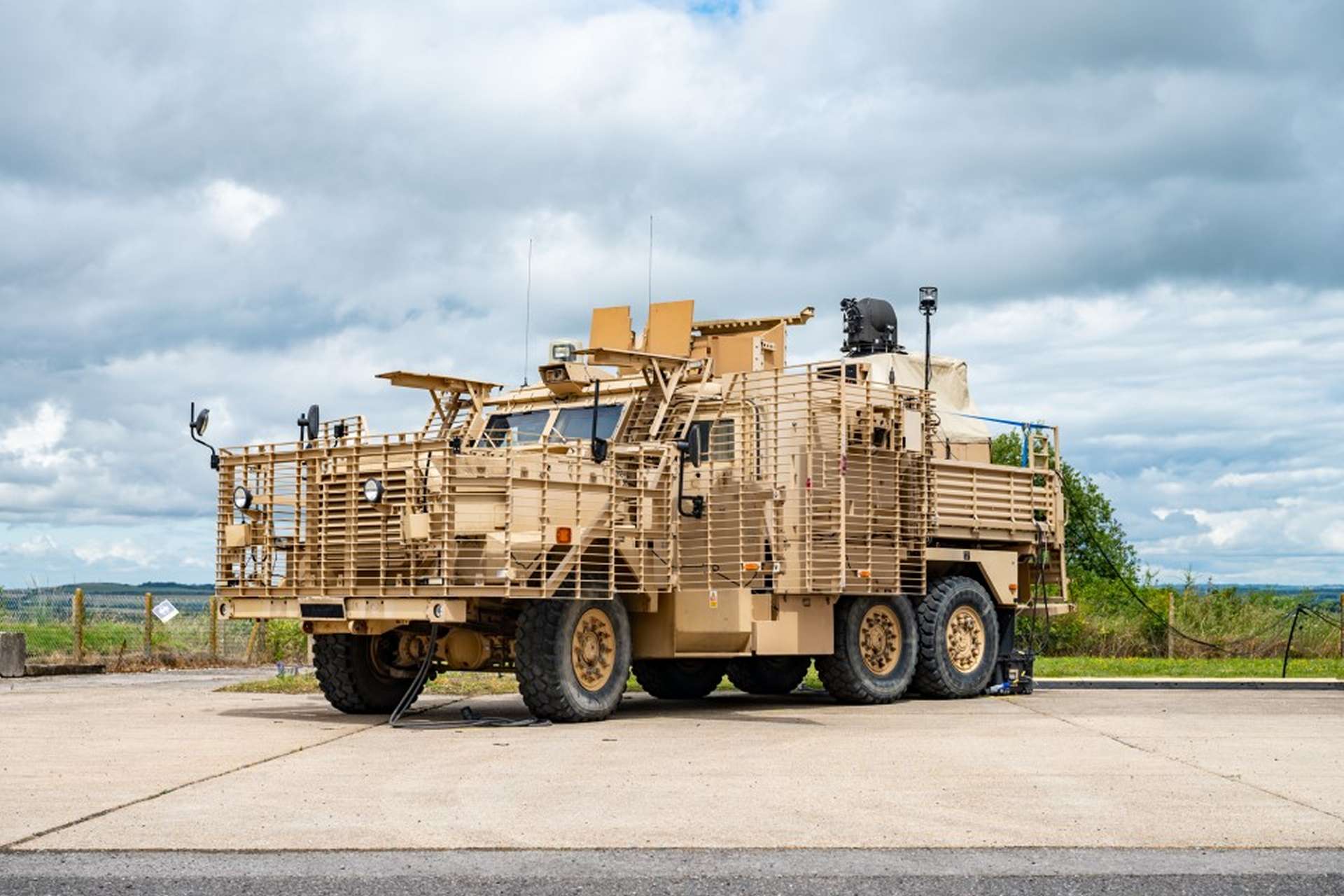
The Wolfhound 6x6 armored vehicle, used as the platform for this trial, allows for the integration of various equipment, making it suitable for experimental defense projects. (Picture source: UK MoD)
As previously revealed by Army Recognition on February 29, 2024, Raytheon UK has contributed significantly to this technological advancement, bringing its High-Energy Laser Weapon System to the UK in partnership with several British suppliers. The system’s integration, completed in Coventry at NP Aerospace, includes a radar from Blighter Surveillance Systems and a command-and-control framework developed by Raytheon UK in Harlow. Following drone tracking trials, the system underwent live-fire acceptance tests at Dstl Porton Down before its deployment with the British Army.
Raytheon UK's laser system is versatile and portable, capable of being mounted on various platforms and interfacing with other air defense systems based on operational needs. Eight high-energy laser weapons have been delivered to the U.S. Army, demonstrating efficacy against over 400 targets across 25,000 operational hours.
The DragonFire Laser Directed Energy Weapon program, led by Dstl on behalf of the British MoD, represents another development in British laser technologies. This program uses a highly concentrated beam of light to neutralize threats, providing a cost-effective and efficient alternative to conventional ammunition. With a focus on countering hostile unmanned aerial vehicles (UAVs), the technology offers a potential solution for defense operations.
As reported by Army Recognition on April 12, 2024, the British Ministry of Defence is expediting the deployment of the DragonFire laser system, with plans to make it available to Ukraine before 2027. The system, which can hit a target as small as a pound coin from a distance of one kilometer, is undergoing further development and testing. Its operational cost-efficiency, at approximately £10 per firing, makes it a viable option for various military applications. Future plans include extending its application across different military platforms such as Royal Navy warships and potentially Royal Air Force aircraft.

The operational cost-efficiency of such laser weapon systems, at approximately £10 per firing, makes it a viable option for various military applications, mainly to shoot down enemy drones. (Picture source: UK MoD)

- Details
- Written by: Halna du Fretay
- Category: 2024
- Hits: 2000
On July 22, 2024, the Pentagon unveiled an update to its Arctic strategy, adopting a "monitor-and-respond" policy to address the growing cooperation between China and Russia and the challenges posed by climate change. This update comes as the region is increasingly viewed as a battleground for global strategic competition.
Follow Army Recognition on Google News at this link
A U.S. Air Force F-15 during North American Aerospace Defense Command’s Artic air defense exercise, Amalgam Dart 20-05, August 20, 2020. (Picture source: US DoD)
Defense Secretary Lloyd J. Austin III highlighted the Arctic as a "venue for strategic competition," necessitating an enhancement of American military capabilities in the region. Deputy Defense Secretary Kathleen H. Hicks pointed out that the melting ice is creating larger shipping lanes and increasing access to the Arctic. Despite the ongoing war in Ukraine, Russia remains active in the region, and China is asserting itself as a "near-Arctic" nation by promoting the area as a "global commons" to influence Arctic governance in its favor.
The strategy also notes that while Russian and Chinese interests are not fully aligned, the conflict in Ukraine has brought them closer together, leading to increased military cooperation in the Arctic, including more joint exercises. Deputy Assistant Secretary of Defense for Arctic and Global Resilience, Iris A. Ferguson, reported that Chinese and Russian warships have been conducting exercises off the coast of Alaska in recent months, prompting the U.S. to keep a "watchful eye." This vigilance is part of an ongoing modernization effort, as the harsh conditions and unique location of the Arctic make maintaining equipment and infrastructure particularly challenging.
To enhance domain awareness in the region, the strategy calls for the Pentagon to invest in new technologies such as improved radars, new satellites, and better communication networks. Hicks has expressed interest in developing new unmanned platforms for domain awareness missions to reduce the operational burden on human personnel in harsh conditions.
Ensuring the durability of these unmanned systems is crucial, whether through longevity or cost-effectiveness, given their consumable nature. This requires extensive research, development, and testing, focusing on exploring the capabilities of unmanned systems. Ferguson noted that many issues affecting manned systems in the Arctic could also impact drones, particularly due to weather conditions and connectivity challenges. The strategy emphasizes testing and research to ensure these platforms can operate effectively.
The Pentagon plans to maintain its current investments in both manned and unmanned ISR (Intelligence, Surveillance, Reconnaissance) platforms for the Arctic while conducting a needs analysis for future unmanned platforms.
To prepare for potential crises in the Arctic, the Pentagon intends to continue regular exercises and develop regional expertise. The strategy includes regular exercises with an Air Force presence, such as Northern Edge by the U.S. Indo-Pacific Command, Noble Defender by Northern Command, and Arctic Challenge by European Command. These are designed to enhance expertise, in addition to operations like supporting NATO’s Air Policing mission in Iceland and providing airlift and refueling capabilities to U.S. and allied aircraft in the Arctic region.
Air Force leaders have emphasized the need to improve training in the Arctic. In 2023, Major General David S. Nahom, head of Alaskan Command, highlighted training deficiencies during the AFA’s Air, Space, & Cyber Conference, noting that the current training does not adequately prepare personnel for the demanding Arctic conditions.
A unique Arctic capability of the Air Force is its LC-130, equipped with skis for landing on ice. Known as the "Skibird," this fleet has been updated over the years, though some legislators are calling for a renewal after decades of service. Beyond the LC-130, the Air Force maintains a strong presence near the Arctic with F-16 and F-35 fighters, KC-135 tankers, and HH-60 helicopters stationed at Eielson Air Force Base in Alaska, with plans to expand this fighter presence.
By the 2030s, the United States and its Arctic allies aim to operate over 250 advanced multi-role combat aircraft that could be deployed for Arctic operations. This reflects the alignment of U.S. allies and partners in the region, with the majority expected to deploy the F-35, according to Ferguson.
This updated Arctic strategy underscores the Pentagon's commitment to collaborating with allies and partners to ensure the Arctic remains a secure and stable region where American homeland defense and national interests are actively protected.
Read more: US Updates Arctic Strategy in Response to Sino-Russian Cooperation

- Details
- Written by: Halna du Fretay
- Category: 2024
- Hits: 2633
A marine commando has developed the FUSHYB, a dual-purpose rifle designed for precision shooters. This development echoes numerous innovations from military bases during World War I, such as Lieutenant Roland Garros' propeller synchronization gear and the 60mm portable pneumatic howitzer, the "Sauterelle d’Imphy." These practical inventions were often created by the soldiers themselves.
Follow Army Recognition on Google News at this link
The FUSHYB is a "hybrid rifle" conceived by a non-commissioned officer from the Marine Commando "Hubert," based in Saint-Mandrier-sur-Mer (Var), specializing in underwater action and maritime counter-terrorism (Picture source: Premier Maitre Johann)
In the late 1980s, the Ministry of the Armed Forces institutionalized this approach with the creation of the "Participatory Innovation Mission" (MIP), recently renamed the "Participatory Innovation Cell" (CIP) under the Defense Innovation Agency (AID). These projects aim to deliver significant capability gains at low costs. One such project is the "Auxylium" smartphone, which has become essential for urban operations, replacing tactical radios. The FUSHYB, mentioned in AID's 2023 report, might follow this path.
The FUSHYB is a "hybrid rifle" conceived by a non-commissioned officer from the Marine Commando "Hubert," based in Saint-Mandrier-sur-Mer (Var), specializing in underwater action and maritime counter-terrorism. According to AID, this "two-in-one" rifle is designed for snipers, combining firepower and range with precision and discretion. Although the caliber is not specified, it resembles the VCD-10 by Lebel Defense, a rifle chambered in 7.62×51 NATO.
AID explains that "recent operations have shown the usefulness of having a rifle offering these two essential capabilities in a single system." Practically, the weapon allows the use of supersonic ammunition in semi-automatic mode for firepower and range, and subsonic ammunition in manual bolt-action mode for precision, discretion, and silence.
In 2023, AID supported 27 new projects from participatory innovation, totaling 1.89 million euros, a modest but significant investment to encourage innovation within the armed forces.
Besides the FUSHYB, several other innovations received AID's support. Fifteen have matured enough for large-scale deployment. Among these is the RapidEagle, a drone interceptor developed by Thales, Squadrone System, InPixal, and Aviation Design, intended to secure the 2024 Paris Olympic and Paralympic Games. This interceptor uses a net to capture malicious drones in flight, with precise terminal approach facilitated by an infrared camera and artificial intelligence algorithms.
Other notable innovations include the drop-deployable dismantlable mule (MLD) and the equipment recovery bag (SRM) developed by the innovation cell of the airborne troops school. The MLD, designed with SUPB, features a two-wheel axle capable of carrying up to 200 kg, while the SRM allows paratroopers to reassemble quickly and remain combat-ready.
The CIP also saw the development of a generic transitional simulator (STG) by a lieutenant colonel and an engineer from the cavalry school to bridge the training gap for the Jaguar armored vehicle until the SERKET program in 2027.
These innovations demonstrate the creativity and inventiveness of the French armed forces. AID continues to play a crucial role in supporting these projects and bringing them to operational maturity. Ongoing investments and efforts from AID ensure that the French armed forces remain at the forefront of military innovation, addressing contemporary challenges with practical and effective solutions.
Read more: FUSHYB: A New Hybrid Precision Rifle Developed by a French Marine Commando

- Details
- Written by: Triffaux
- Category: 2024
- Hits: 3924
On July 12, 2024, the U.S. Army awarded SRC, Inc. a $25 million contract to develop the Long-Range Radar, a major instrumentation system designed for range safety, research, development, testing, and evaluation of systems on Army test ranges.
Follow Army Recognition on Google News at this link
SRC manufactures a wide range of advanced radar systems used in various military and security applications, including Multi-Mission Radar (Picture source: SRC)
This contract is part of the U.S. Army’s Range Radar Replacement Program, aimed at modernizing the radars on its test ranges. The objective is to equip these ranges with new technologies that offer improved testing capabilities and reduced life-cycle costs. By deploying modern radar designs, the Army seeks to evaluate the capabilities and limitations of its critical equipment. The new system is crucial not only for supporting current operations but also for preparing for future conflicts.
Kevin Hair, president and CEO of SRC, expressed his pride in the company's participation in this project. "SRC is honored to be part of the Range Radar Replacement Program and help ensure our military is outfitted with the best tools to prepare for new and emerging threats," he stated. "We look forward to delivering an innovative system that supports the Army's testing capabilities and evaluation needs."
The Long-Range Radar developed by SRC will play an essential role in maintaining the U.S. Army's technological superiority. In addition to its applications in safety and testing, this radar will enable more effective and precise evaluations of military equipment, contributing to the armed forces' preparedness for future challenges.
This contract marks a significant milestone in the collaboration between SRC and the U.S. Army, illustrating the confidence placed in SRC’s technological capabilities. With this initiative, the Army continues to modernize its testing infrastructure, thereby strengthening its strategic and operational position globally.
Read more: US Army Awards SRC $25M for Long-Range Radar Project

- Details
- Written by: Halna du Fretay
- Category: 2024
- Hits: 2997
On 22 July 2024, Chess Dynamics announced a successful collaboration with BAE Systems Bofors on the fire control element of the new Tridon Mk2. This next-generation 40mm anti-aircraft system represents a significant advancement in firepower and operational capability, integrating Chess Dynamics' expertise in surveillance, fire control, and precision positioning.
Follow Army Recognition on Google News at this link
The Tridon Mk2 fire control system is a variant of Chess Dynamics' Hawkeye Air Defense (AD) system (Picture source: Chess Dynamics)
Building on the legacy of the original Tridon system, the Tridon Mk2 is known for its reliability and enhanced capabilities to mitigate a wide range of threats, from drones to aircraft. The system provides security and protection for military forces and civil infrastructure over large areas. Chess Dynamics' precision in delivering real-time target coordinates to the Tridon Mk2 has been crucial for its role in ground-based air defense.
The Tridon Mk2 fire control system is a variant of Chess Dynamics' Hawkeye Air Defense (AD) system. The Hawkeye AD system integrates a high-definition thermal imager and daytime TV sensors with a high-performance laser rangefinder, all mounted on a dynamic direct-drive positioner. With an integrated tracker, Hawkeye AD provides precise 3D coordinates of both air and surface targets to fire control or combat systems.
David Tuddenham, Managing Director of Chess Dynamics, expressed his pride in working with BAE Systems Bofors on this critical project. He highlighted the long-standing partnership between Chess Dynamics and BAE Systems and its role in delivering leading ground-based air defense technology and capabilities through the Tridon Mk2.
This collaboration underscores the commitment of Chess Dynamics and BAE Systems Bofors to providing cutting-edge defense solutions to meet the evolving needs of modern warfare. Chess Dynamics, a subsidiary of the Cohort group, has been a trusted supplier of equipment and systems to defense leaders and prime contractors since 2005. The company offers integrated solutions for surveillance, fire control, and precision positioning for land and maritime applications, including counter-drone protection systems and real-time video and image processing solutions under the Vision4ce brand.
The partnership between Chess Dynamics and BAE Systems Bofors reflects a shared dedication to innovation and excellence in defense technology, ensuring that the Tridon Mk2 system will provide enhanced operational capabilities for its end users.

European Company KNDS Announces First Delivery of Griffon MEPAC 120mm Self-Propelled Mortars in 2024
- Details
- Written by: Triffaux
- Category: 2024
- Hits: 3010
On July 17, 2024, European company KNDS confirmed via its Twitter account the delivery of the first Griffon MEPAC (Mortier Embarqué pour l'Appui au Contact) vehicle, equipped with 120 mm mortars, to the French Army.
Follow Army Recognition on Google News at this link
KNDS Griffon MEPAC (Mortier Embarqué pour l'Appui au Contact) vehicle (Picture source: Army Recognition)
The Griffon MEPAC, a specialized variant of the Griffon VBMR (Véhicule Blindé Multi-Rôles), is designed to provide indirect fire support, especially in close-contact scenarios, combining mobility and firepower with its 2R2M semi-automatic mortar system manufactured by Thales. This system can fire up to 10 rounds per minute with a maximum range of 13 km, thus offering superior accuracy and firing speed compared to traditional towed mortars.
The development of this 6x6 armored platform is part of the EBMR (Engin Blindé Multi-Rôles) program aimed at replacing the aging VAB (Véhicule de l'Avant Blindé). With its modular armor capable of withstanding small arms fire and mine explosions, the Griffon MEPAC also stands out for its integration into the SCORPION program, which promotes interoperability among vehicles through the SCORPION Information and Command System (SICS).
In addition to its mortar capabilities, the Griffon MEPAC is equipped with the T2 remotely operated turret developed by Arquus, offering flexibility in armament choices, from a 7.62 mm machine gun to a 40 mm automatic grenade launcher. This vehicle thus enhances logistical and operational support on the ground, also thanks to the ATLAS automated artillery system.
According to General Pierre Schill, Chief of Staff of the French Army, who spoke during a session at the French Senate, the first eight Griffon MEPAC units will be delivered in 2024 to the 11th Marine Artillery Regiment. This unit will be the first to benefit from this enhanced capability, marking a new phase in the modernization of the French military's artillery capacity.
This development represents not only technological progress but also a tactical improvement, enabling rapid and effective responses in intense combat situations, and underscores France's ongoing commitment to updating its armed forces in light of contemporary challenges.

Thales 2R2M 120mm semi-automatic mortar system (Picture source: Army Recognition)

- Details
- Written by: Jérôme Brahy
- Category: 2024
- Hits: 2952
On July 17, 2024, the Brazilian Marine Corps received four new Joint Light Tactical Vehicles (JLTVs) from the United States, enhancing their operational capabilities. This purchase, valued at approximately $15.1 million and part of the PROADSUMUS program, aims to improve the Marine Corps' amphibious and expeditionary capacities. It completes the delivery of all 12 units expected to be fully delivered by 2024.
Follow Army Recognition on Google News at this link
The Brazilian Navy began integrating these vehicles in 2022, with the first four units delivered to the Marine Armor Battalion. (Picture source: Brazilian Navy)
These JLTVs are known for their resilience and durability, capable of continuing operations with punctured tires and maintaining a speed of up to 48 km/h for 50 kilometers. They are equipped with 12.7mm and 7.62mm machine guns and a 40mm automatic grenade launcher, providing substantial firepower. Additionally, they feature protective systems such as an Explosively Formed Penetrator (EFP) kit and a B-kit add-on armor system, offering protection comparable to Mine-Resistant Ambush Protected (MRAP) vehicles.
The Brazilian Navy began integrating these vehicles in 2022, with the first four units delivered to the Marine Armor Battalion. These vehicles have already been deployed in various operations, including the Garantia da Lei e da Ordem (Law and Order Guarantee) in the ports of Rio de Janeiro, Itaguaí, and Santos. Their deployment has been instrumental in urban operations, including the "Lais de Guia" under the Navy's jurisdiction.
Vice Admiral (Marine) Rogério Ramos Lage, the Commander of Marine Corps Material, commented on the impact of the new vehicles, noting their contribution to armored protection, mobility, and shock action for the Marine Corps Operational Groups. The JLTVs' integration represents a significant upgrade, particularly for units incorporating these vehicles.

In addition to JLTVs, the PROADSUMUS program includes the acquisition of other military assets such as Unimog 5000 trucks, amphibious assault vehicles, and advanced weapon systems. (Picture source: Brazilian Navy)
The acquisition of JLTVs is part of the broader PROADSUMUS program, which stands for the Marine Corps Combat Power Strategic Program 2020–2040. This program aims to replace older equipment, acquire new capabilities, and improve infrastructure. It includes various procurements and upgrades aimed at enhancing command and control, firepower, and mobility for the Marine Corps and the Navy's CBRN (chemical, biological, radiological, and nuclear) defense organizations.
In addition to JLTVs, the PROADSUMUS program includes the acquisition of other military assets such as Unimog 5000 trucks, amphibious assault vehicles, and advanced weapon systems. These acquisitions aim to improve the operational readiness and flexibility of the Brazilian Marine Corps for national and international operations.
The JLTV project, managed by the United States Army and Marine Corps, was developed to replace the High Mobility Multipurpose Wheeled Vehicles (HMMWV). This decision was based on the need to adapt to modern combat conditions, as evidenced in conflicts like those in Iraq and Afghanistan, where the JLTVs demonstrated resilience against insurgent counterattacks such as roadside explosive devices.
In addition to combat resilience, the JLTVs can be used for infiltrating special operations forces into hostile territories, transporting armaments for Marine Corps Infantry Battalion Fire Support Companies, conducting reconnaissance, performing patrols, establishing observation points, executing surveillance actions, enhancing communications, and escorting convoys. They are equipped with advanced technology, including General Dynamics' smart display units, L3Harris communications systems, and a Gale Banks Engineering V8 turbo-diesel engine based on GM's Duramax architecture. This combination ensures effective performance for various military applications.

The Oshkosh TAK-4i suspension system allows the JLTV to adjust its height for optimized ground clearance and transportability, providing up to 50.8 centimeters of independent wheel travel. (Picture source: Brazilian Navy)
The JLTVs feature a GM Duramax V8 engine paired with an Allison 2500 transmission, providing significant power and reliability. The TAK-4i intelligent independent suspension system offers robust off-road mobility. The vehicle is designed to offer MRAP-level defense against improvised explosive devices (IEDs) and other threats. It can be equipped with additional armor and various weaponry, such as the FN Herstal deFNder Light remote weapon station for the Belgian Falcon variant. The JLTV's adaptability includes future enhancements like hybrid-electric variants, which offer silent drive and extended operational capabilities.
Globally, the JLTV is seeing increasing adoption across various military forces. Over 20,000 units have been produced by Oshkosh Defense as of June 2023. The vehicle is utilized by the U.S. Army, Marine Corps, Air Force, and Navy, as well as several NATO allies and other partner countries. Slovakia, for example, ordered 160 JLTVs in 2023, while Lithuania has an ongoing contract for 350 additional units beyond their initial order of 200.
Furthermore, the JLTV has been utilized as the basis for several other models, including the eJLTV, a hybrid electric version, and two unmanned vehicles developed for the US Marine Corps: the Long Range Fires Launcher (LRFL) and the NMESIS, designed to serve as ground-based Tomahawk launchers.
Read more: Brazilian Marine Corps receives four JLTVs from the US completing a 12-unit order

- Details
- Written by: Triffaux
- Category: 2024
- Hits: 4102
On July 18, 2024, Raytheon, a business unit of RTX, showcased its new integrated missile defense system at the biennial Valiant Shield exercise. This demonstration successfully combined the U.S. Army's Lower Tier Air and Missile Defense Sensor (LTAMDS) and the Integrated Air and Missile Defense Battle Command System (IBCS) with the U.S. Navy's Standard Missile-6 (SM-6).
Raytheon Lower Tier Air and Missile Defense Sensor (LTAMDS) combined with (IBCS) and U.S. Navy's Standard Missile-6 (SM-6) (Picture source: RTX and US DoD)
During Valiant Shield 24, Raytheon employed a mix of simulation and operational hardware to execute a complex missile engagement scenario. The test involved using trajectory data from LTAMDS simulators, interfaced with operational SM-6 engagement control software and the IBCS. This integration allowed for the effective detection, identification, and interception of threats, marking a major advancement in military defense technology.
Tom Laliberty, president of Land & Air Defense Systems at Raytheon, highlighted the importance of the demonstration. "The successful test not only proves the technical feasibility of integrating SM-6 into the Army’s air and missile defense architecture but also enhances the operational capabilities of INDOPACOM by combining advanced radar and missile technologies," he stated.
LTAMDS (Lower Tier Air and Missile Defense Sensor): LTAMDS is an advanced air and missile defense radar developed by the U.S. Army to replace aging Patriot radar systems. Designed to detect, track, and engage aerial and missile threats at significant distances, this radar system utilizes electronically scanned array technology, which provides better target discrimination and increased resilience against electronic countermeasures. Its ability to track multiple targets simultaneously makes it a crucial component of low-altitude missile defense.
IBCS (Integrated Air and Missile Defense Battle Command System): IBCS is a revolutionary command and control system designed to provide unified threat management across all types of air and missile defense systems. This system enables the integration of various sensors and weapons into a cohesive defense network. IBCS enhances response capability and effectiveness by allowing armed forces to launch and control interceptors based on data collected from multiple sensors, thus reducing response times and increasing the likelihood of intercepting threats before they reach their targets.
SM-6 (Standard Missile-6): The SM-6 is a long-range missile developed by the U.S. Navy for air defense, surface strike, and even ballistic missile defense at extreme ranges. Capable of engaging targets beyond visual range, this missile features an advanced guidance system that combines radar data and terminal infrared guidance. The SM-6 is known for its versatility, capable of being used in various roles due to its ability to integrate data from multiple sensor sources, making it essential for joint and integrated defense operations.
Valiant Shield 24 serves as a platform for the U.S. and its allies to test and refine their strategies and technologies in a realistic operational environment. The exercise focuses on enhancing the joint-combined force’s ability to conduct complex, multi-domain operations across the Indo-Pacific, a region experiencing increasing military tensions.
The integration of these systems represents a critical evolution in the American approach to air and missile defense, ensuring robust capability to counter a wide range of threats. This advancement underscores a strategic shift towards more integrated and versatile defense systems, enhancing both the Army and Navy’s operational readiness and tactical flexibility.

- Details
- Written by: Halna du Fretay
- Category: 2024
- Hits: 5338
On July 22, 2024, MBDA and the UK Ministry of Defence renewed their strategic partnership on complex weapons for another decade under a renewed Portfolio Management Agreement (PMA). Known as PMA2 and valued at least £6.5 billion, the agreement aims to provide complex weapons to the UK Armed Forces more quickly, at lower cost, and with greater agility. This partnership will also support British jobs, skills, and industrial investment.
Follow Army Recognition on Google News at this link
In this illustration, below the F-35 at the top right, it looks like the future land-based precision strike missile is right next to the Aster 30. Fired from an M270, it is intended to deliver overwatch at super long range (Picture source: MBDA)
Eric Beranger, CEO of MBDA, emphasized that PMA2 highlights the innovative efforts of MBDA's team in supporting the UK, serving as a key national champion and a conduit for international cooperation. Chris Allam, Managing Director of MBDA UK, noted that renewing the partnership for another decade underscores MBDA's critical role in supporting UK defence. PMA2 builds on the past decade's successes, enhancing value, speed, and agility for the UK Armed Forces and fostering better collaboration with European allies.
The new agreement confirms MBDA as the preferred supplier of complex weapons for the UK Ministry of Defence (MOD). It is expected to generate an additional £2 billion in benefits and efficiencies while enhancing current capabilities. The new systems planned under this agreement include the Future Cruise and Anti-Ship Weapon (FC/ASW), Land Precision Strike, and the continued evolution of the Meteor missile.
The FC/ASW, currently being developed in collaboration with France, aims to replace existing missiles with enhanced precision strike capabilities against naval and land targets at long range. Scheduled to enter service in the 2030s, this system is designed to offer increased flexibility and effectiveness in modern threat environments, with advanced penetration capabilities and high accuracy.
The Land Precision Strike initiative aims to develop weapon systems capable of precise strikes against long-distance land targets. These systems, currently in development, are expected to enter service by the end of the decade and will enhance the precision strike capabilities of the British ground forces. The Meteor missile, already in service since 2016, continues to evolve with regular improvements to maintain its status as one of the world's most advanced long-range air-to-air missiles. Over 200 Meteor missiles are currently in service, equipping aircraft such as the Typhoon and F-35, offering extended range, high maneuverability, and the ability to neutralize targets beyond visual range.

The new systems planned under this agreement include the Future Cruise and Anti-Ship Weapon (FC/ASW), Land Precision Strike, and the continued evolution of the Meteor missile (Picture source: ArmyRecognition)
PMA2 incorporates a decade of learning into the management of the complex weapons portfolio, including measures to enhance performance through improved commercial agreements, accelerated procurement processes, and continuous manufacturing. This approach ensures the industry remains ready to meet Defence demands.
The original PMA established a robust and innovative British industrial base, enabling the UK to respond to conflicts on its terms and achieving confirmed savings of £2.6 billion. The partnership also strengthened international collaborations, with UK exports growing 6.5 times since its inception. More than 5,500 people are employed at MBDA UK sites in Bolton, Lancashire, Stevenage, Hertfordshire, and Bristol, nearly doubling the workforce since 2010. MBDA's work supports thousands of additional jobs within the UK supply chain ecosystem.
The PMA model's value has allowed MBDA to invest over £550 million in the UK, including a new manufacturing site in Bolton. PMA2 will see an additional £500 million investment in British manufacturing and technologies. The contract was announced by the newly appointed Defence Secretary, John Healey, at the Farnborough International Air Show. Healey emphasized the importance of renewing partnerships with industry and continuing to push technological boundaries to drive prosperity and create skilled jobs across the country.
MBDA already produces complex weapons for the British Army, Royal Navy, and RAF. Recent deliveries include missile systems such as Storm Shadow, Brimstone, Meteor, ASRAAM, ASTER (Sea Viper), CAMM (Land/Sea Ceptor), and Sea Venom. Future programs in development at MBDA include SPEAR Cap 3, a future weapon for the F-35B Lightning II fighters, and the UK-French collaboration to develop Future Cruise/Anti-Ship Weapons (FC/ASW) for the Royal Navy and RAF.

- Details
- Written by: Halna du Fretay
- Category: 2024
- Hits: 2991
On July 22, 2024, MBDA announced significant progress in the deployment of artificial intelligence (AI) within its SPEAR family of cruise missiles. Over the past twelve months, the company has accelerated the development of its collaborative AI, Orchestrike, which will enhance the performance of SPEAR missiles through AI-driven coordination and cooperation while maintaining human oversight. This advancement aims to equip the SPEAR missiles with the ability to react to threats and collaborate with pilots to address tactical challenges, thus improving the survivability of both missiles and platforms, as well as overall mission effectiveness.
Follow Army Recognition on Google News at this link
MBDA will test its Orchestrike collaborative weapons AI concept on its Spear family of missiles (Picture source: MBDA)
Eric Beranger, CEO of MBDA, emphasized the importance of this innovation, stating that it highlights MBDA's unique technologies and expertise in Europe. The Orchestrike system is designed to operate within the parameters defined by human operators, ensuring its use remains within legal and ethical boundaries. The AI enhances the missiles' capability to suppress enemy air defenses using high-powered jamming and engage targets beyond the reach of conventional threats.
Since its unveiling at the Paris Air Show 2023, Orchestrike has rapidly evolved from concept to capability. Development has focused on refining AI algorithms, advancing missile-to-missile datalinks, and integrating these elements into the SPEAR missile system. This collaboration between MBDA and its partners demonstrates the company's ability to innovate and quickly bring new capabilities to service, meeting the evolving needs of its clients.
At the Farnborough International Airshow 2024, MBDA showcased an Orchestrike digital-twin simulator, allowing military users to experience a simulated raid where the missiles react collaboratively to tactical developments. This demonstration highlighted the practical applications of Orchestrike's AI capabilities in real-world scenarios.
The SPEAR family of network-enabled cruise missiles is designed to defeat and suppress enemy air defenses by striking moving targets under various weather conditions and at stand-off ranges. These missiles are distinguished by their advanced mission planning capabilities and their ability to perform complex missions over long distances while being compact enough for a single F-35 to carry eight SPEAR missiles within its weapon bays.
In the future, MBDA plans to extend the Orchestrike system to other munitions with network-enabled datalink capabilities, further enhancing the collaborative and responsive nature of these advanced weapon systems.
Read more: MBDA Accelerates AI Deployment for SPEAR Swarm Missiles

- Details
- Written by: Triffaux
- Category: 2024
- Hits: 4455
On July 29, 2024, the Russian newspaper Sakhalin News announced that the Russian company Kursir had unveiled an important step in surveillance and technological management with the development of a radiogoniometric drone specialized in the rapid identification of radio interference sources. This new tool was revealed during the recent "Archipel" intensive design and training exhibition in the Sakhalin region, highlighting Russia's continuous progress in drone technology.
Follow Army Recognition on Google News at this link
Kursir Radiogoniometric Drone (Picture source: Russian Media)
The drone is equipped with a specially designed radiogoniometer and a directional antenna that enables it to precisely locate radio emission sources. This capability is crucial for various applications, including the accurate determination of base station and drone operator positions, functionalities increasingly essential in the era of electronic warfare and sophisticated communications.
The developers explain that the use of this drone can greatly enhance the efficiency of military operations, particularly in countering issues caused by the use of enemy drones in combat zones. By quickly and effectively identifying interference sources, this drone offers a strategic solution for maintaining the integrity of communications and field operations.
Beyond its military use, the radiogoniometric drone also finds utility in civilian scenarios. It is particularly suited for search and rescue missions, capable of locating crashed aircraft or missing persons emitting distress signals via radio beacons. The drone's ability to detect targets up to a distance of 5 kilometers could transform rescue operations, making interventions quicker and more targeted.
The technology for detecting radio frequencies using drones, as described, is not exclusive to Russian developers. Indeed, as early as 2018, Israeli researchers were also working on similar capabilities, demonstrating a broad international interest and development in this type of surveillance technology.
While it's unclear if the Russian approach to detecting radio waves is similar to that used by Israeli scientists, to better understand the significance of this research focus, let’s consider the advancements made by Israel. The Israeli technology focuses on capturing and analyzing variations in radio frequency signals to detect changes in the environment. This system operates by employing drones equipped with sensors capable of detecting subtle shifts in the radio signals used for communication with operator-controlled devices, such as smartphones or remote controls.
Israeli drones are designed to intercept radio signals, not just for navigation and control but also for intelligence gathering. These drones analyze the signals between operators and their devices, focusing on metadata rather than the content of the communications.
Israeli drones monitor data transmission rates. Significant changes in the data sent by a drone—triggered by changes in the visual field, such as the activation of a smart film on a window—indicate a change in the monitored scene. This can lead to a spike in the data throughput of the radio frequency signal as the drone transmits a large amount of new pixel data.
Israeli drones use advanced algorithms to interpret these changes. If a normally transparent window suddenly becomes opaque, the drone recognizes this as an anomaly and records the event, marking it for further analysis.
On the battlefield, radiogoniometric drone technology offers significant strategic advantages. These drones can detect and precisely locate sources of radio interference, thereby enhancing surveillance and enabling the neutralization of electronic threats. By identifying the locations of enemy drone operators or other radio emission sources, military forces can conduct jamming or targeted countermeasures to disable or disrupt enemy communications and commands. This enhances troop security by reducing exposure to attacks and increasing the effectiveness of offensive operations. Additionally, this capability can be used to protect critical infrastructure and monitor enemy movements without direct engagement, thus minimizing risks to personnel while maximizing tactical impact.
- Eagle Partner 24: US and Armenian Troops Utilize Bastion Armored Personnel Carrier
- British Army Tests Individual Future Soldier Equipment Integrating Body-Worn Technology
- Breaking News: Israeli Air Force Strikes Yemen After Drone Attack by Houthi Group on Israel
- First Shipment of Israeli Spyder Air Defense Missile Systems Arrives in Czech Republic