

Missiles, Air defense, Energy, France announces a new batch of supplies for Kiev military capacities
- Details
- Written by: V.Saint
- Category: 2024
- Hits: 2312




Breaking news






France will provide additional military aid to Ukraine in the coming days and weeks, the Elysée announced on Tuesday after a phone call with Ukrainian President Volodymyr Zelensky. The statement indicated that the President of the Republic reiterated France's determination to provide all necessary support. He was also able to detail the deliveries for the coming days and weeks in support of the Ukrainian military effort
Volodymyr Zelensky et Emmanuel Macron on 16 june 2022 At Marinsky Palace, Kiev (Picture source: LUDOVIC MARIN | AFP)
An Elysée official declined to specify what the deliveries might include. However, around the same time, French Minister of Armed Forces Sébastien Lecornu announced that a shipment of ASTER missiles to Ukraine had been signed. The announcement was made in the National Assembly, specifying that this was to ensure the activity of the SAMP/T system delivered in partnership with Italy to protect Kiev.
The Aster missile is an air defense system developed by MBDA, resulting from Franco-Italian collaboration. It comes in two main versions: the Aster 15 for short to medium-range threats and the Aster 30 for longer-range threats. The Aster 15 can reach targets up to 30 kilometers away, while the Aster 30 can intercept targets up to a distance of 120 kilometers. Designed to counter a variety of aerial threats, including fighter jets, cruise missiles, and, in the case of the Aster 30, tactical range ballistic missiles, the Aster system is distinguished by its ability to engage multiple targets simultaneously thanks to its active radar guidance system.
Neither the number and variant of ASTER missiles provided nor the delivery schedule have been detailed by France. Concurrently, the MBDA arms group, manufacturer of the ASTER missile, continues its efforts to accelerate the missile production process. The French Minister of Armed Forces emphasized that cooperation with MBDA to replenish missile stocks allowed the French military to provide everything to Ukraine without compromising their own stocks.
Lecornu added that the situation on the front line in Ukraine is indeed tense, and this is also due to Russian forces trying to take advantage of this period of delay in the supply of American aid. During his call with Zelensky, Macron emphasized his support for a truce during the Paris Olympics this summer, according to the statement, which would imply that Russia cease its operations and that "all useful diplomatic initiatives" be taken to open negotiations. Last week, Chinese President Xi Jinping supported the call for a global truce during the Paris Olympics."

- Details
- Written by: V.Saint
- Category: 2024
- Hits: 49589
Breaking news
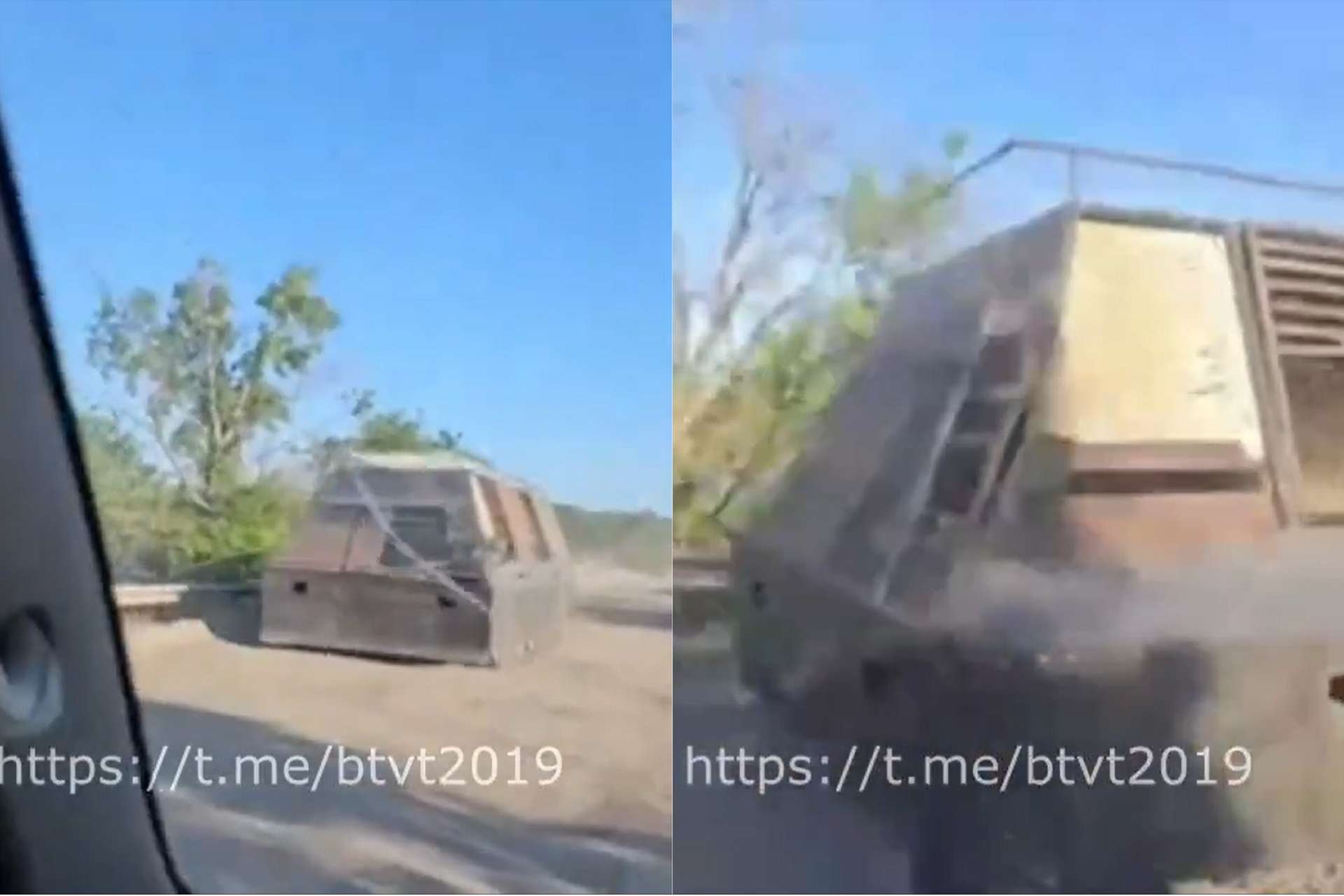
In early April, a new type of Russian armored vehicle crawled onto the battlefields of the Russian war against Ukraine — the "turtle tank" — a T-62, T-72, or T-80 tank with additional metal hulls. This turtle tank is made of roofing materials, grilles, and lattices, considered as invincible agaist FPV drones, we are able to see that's not so true anymore.
Follow Army Recognition on Google News at this link
Destroyed Turtle tank based on T-72 with KMT-7 mine clearing device near Krasnohorivka (Picture source: social network )
Read more: Ukraine strikes Russian Turtle Tank thanks 155mm artillery Shell
- Details
- Written by: Vandenbosch
- Category: 2024
- Hits: 4425
Breaking news
On May 6, 2024, a new armored vehicle modification was spotted on social media, the "Turtle MT-LB." This innovation follows the same principles as the previously introduced "Turtle Tank", but instead of using a tank chassis, the modification has been applied to the MT-LB, a versatile tracked armored vehicle.
Follow Army Recognition on Google News at this link
The Turtle MT-LB, like its tank counterpart, aims to survive the battlefield by resisting drone attacks. (Picture source: Open Source Information)
Following the Turtle Tank, we now have a new member of the turtle family, the "Turtle MT-LB." However, unlike the Tank, this version is somewhat less extravagant, as we will see in this article.
Firstly, what is a Turtle Tank and more broadly, what does it mean to "turtelize" a vehicle? The "Turtle Tank" refers to Russian tanks, often T-72 models, modified with additional armor resembling a turtle shell, hence the name. These modifications include the installation of super cage armor made of sheet metal and steel, designed to protect the vehicle against various threats, particularly drone attacks. This armor offers increased protection but significantly reduces the tank's mobility and turret functionality.
In this latest adaptation, Russian forces have applied similar protective measures to the MT-LB, a versatile tracked vehicle traditionally used for transporting troops and equipment. The MT-LB has been covered with sheet metal and steel to create makeshift armored plating, aimed at providing increased defense against drone strikes. While offering additional protection, this modification also limits the vehicle's operational capabilities, including visibility and mobility. However, the loss of capabilities in the MT-LB is less severe than that of the T-72. But before discussing the loss of capabilities, let's talk about the capabilities of a standard MT-LB.
The MT-LB is a tracked armored vehicle initially designed by Russia. Weighing 11,900 kg, many countries use this vehicle; it has been a best-seller and is one of the most widely distributed vehicles worldwide. It is normally equipped with a PKT 7.62 mm machine gun or a 12.7 mm machine gun as its primary armament, offering steel protection of 3 to 10 mm against small arms fire and shell splinters.
The MT-LB can reach a speed of 62 km/h and has a range of 500 km. It is also equipped with an NBC (nuclear, biological, and chemical) protection system, night vision equipment, and a white searchlight, enhancing its capability to operate in varied and dangerous environments. With a length of 6.45 meters, a width of 2.86 meters, and a height of 1.86 meters, it is designed to carry a crew of two and eleven additional passengers.
The Turtle MT-LB, like its tank counterpart, aims to survive the battlefield by resisting drone attacks. However, these modifications have elicited mixed reactions. While the additional armor can potentially protect the vehicle against immediate drone threats, it also makes it more cumbersome and less capable in dynamic combat situations. Moreover, the effectiveness of these modifications in real combat scenarios remains to be examined, as the compromises in maneuverability and visibility could be detrimental during intense engagements.
But the main criticism that could be made about the Turtle Tank does not apply here, as the main problem is that the Turtle Tank loses its primary role as a Main Battle Tank in favor of that of an APC (Armored Personnel Carrier) or even a self-propelled howitzer. This criticism does not apply to the Turtle MT-LB, which does not lose its primary function as an APC. Certainly, several functionalities are altered by this modification, such as its mobility or firepower, but its role as a troop carrier is still fulfilled.
The deployment of the Turtle MT-LB in Ukraine is partly due to Russia's efforts to adapt to the growing threat of Ukrainian drones. Ukrainian forces have effectively used drones to target Russian armored vehicles, prompting these unconventional defensive measures, with a certain paranoia seemingly having reached Russian soldiers, leading to makeshift and artisanal "turtelizations". Despite the additional protection, these modifications come with many compromises.
Read more: After Turtle Tank Russia Invents and Deploys Turtle MT-LB in Ukraine

- Details
- Written by: Halna du Fretay
- Category: 2024
- Hits: 5627
Breaking news
Latvia has started the full-cycle production of Patria 6x6 armored vehicles, marking a significant advancement in its national military industry. Defense Minister Andris Sprūds announced on Latvian radio Labrit that the production of these Finnish-designed vehicles is a crucial development, aiming to deliver more than 20 units to the army by the end of the year. This initiative is part of a transnational cooperation program involving Finland, Sweden, and Germany, focusing on the research and production of military equipment tailored to the needs of allied countries' armed forces.
Follow Army Recognition on Google News at this link
The first Patria vehicle, known for its mine protection, mobility, speed, and comfort in rough terrain, is expected to be ready for testing by July (Picture source: Patria)
The Patria 6x6 is designed to meet the rigorous demands of modern warfare, offering modern protection and extreme mobility, making it a valuable asset for military operations in challenging environments. Equipped with a robust independent suspension system and a high-performance transmission, the Patria 6x6 ensures unparalleled mobility and comfort for the crew. It can transport up to ten soldiers in the rear, along with a driver and commander in the front cabin, all housed within a protected hull designed for 72-hour missions. The vehicle also features continuous all-wheel drive, steering by two front axles, and an optional amphibious capability for water crossings and operations.
In terms of survivability, the Patria 6x6 provides STANAG level 2 ballistic and mine protection, which can be upgraded to STANAG level 4 for various roles. This high level of protection, combined with unique mobility and the latest technology, enables the Patria 6x6 to offer advanced capabilities for protected troop transport and combat support. The vehicle is designed for ease of use, with an intuitive, truck-like user interface, good visibility, and a large internal volume, simplifying training, maintenance, and operation.
Affordability has been a key design principle, ensuring low acquisition and maintenance costs over an expected service life of more than 30 years. The basic vehicle design focuses on essential capabilities, with optional features available to meet specific user needs. Maintenance, repair, and system upgrades are integrated into the design, along with readiness for wireless data transfer for fleet management solutions. Patria guarantees reliable maintenance services through its OPTIME solutions.
The technical specifications of the Patria 6x6 include a length of 7.5 meters, a height of 2.5 meters, and a width of 2.9 meters. The vehicle has a maximum payload of 8,500 kg and a maximum combat weight of 24,000 kg. Its performance capabilities include a top speed of over 100 km/h, a climbing capacity of 60%, a side slope capacity of 30%, and the ability to cross obstacles up to 0.6 meters and trenches up to 1.2 meters. The optional swimming capability allows for speeds of 6-8 km/h in water, and the vehicle can ford up to 1.5 meters. It has an operating distance of over 700 km. The Patria 6x6 is equipped with a 5-cylinder in-line diesel engine producing 294 kW of power and 1870 Nm of torque, coupled with an automatic transmission with 7+2 gears.
The driveline features all-wheel drive and pneumatically controlled hydraulic disc brakes with ABS. The suspension system is fully independent, with double wishbone coil springs and hydraulic shock absorbers, with optional hydropneumatic springs. The steering system is hydraulically assisted with mechanical linkage for the first and second axles. The vehicle also includes modular ballistic, mine, and IED protection systems that can be tailored to customer requirements, readiness for future protection technologies, and maintenance-free LED lights.
Patria's commitment to optimizing and extending fleet availability is demonstrated through its digital solutions and advanced capabilities. The company supports its customers throughout the entire lifecycle of the vehicle, ensuring systematic training and seamless collaboration with organizations and partners. This approach guarantees the best price-quality ratio and ultimate fleet availability.
The first Patria vehicle, known for its mine protection, mobility, speed, and comfort in rough terrain, is expected to be ready for testing by July. Sprūds confirmed that the Ministry of Defense plans to produce around 30 armored vehicles per year, with 25 to be delivered to the National Armed Forces (NBS) this year. This effort underscores Latvia's commitment to enhancing its military capabilities and supporting its defense sector. The production of these armored vehicles in Latvia reflects successful collaboration with Defence Partnership Latvia Ltd, which began operations in 2020.
Despite financial challenges, the company has shown a strong ability to meet production and delivery targets. The Ministry of Defense emphasized the importance of legislative and regulatory frameworks established to facilitate the testing of military vehicles on Latvian territory. This development not only strengthens the national military industry but also enhances national industrial capabilities. As Latvia progresses in this production endeavor, it continues to align with its international partners, ensuring that the collective defense needs of allied countries are met.
The integration of Latvian-produced Patria armored vehicles is also a strategic move following the proven performance of these vehicles in Ukraine, where they have been deployed since 2023 in response to Russia's full-scale invasion. This production initiative aligns with Latvia’s broader defense strategy, emphasizing both national security and industrial growth.
Read more: Latvia Begins Full-Cycle Production of Patria 6x6 Armored Vehicles

- Details
- Written by: Vandenbosch
- Category: 2024
- Hits: 2902
Breaking news
On May 14, 2024, the Lithuanian Ministry of Defense announced the acquisition of additional Javelin anti-tank missile systems from the United States, valued at approximately $16.6 million.
Follow Army Recognition on Google News at this link
The FGM-148 Javelin is an anti-tank missile designed in the United States. (Picture source: Lithuanian MoD)
The Javelin system, known for its "fire-and-forget" capability, allows operators to neutralize enemy armored vehicles with precision, significantly enhancing the operational efficiency of the Lithuanian armed forces. The newly acquired batch includes both missiles and Command Launch Units (CLU), which are essential for deploying the system in the field.
Defense Minister Arvydas Anušauskas previously emphasized the strategic importance of this acquisition, stating that the Javelin systems make a substantial contribution to Lithuania's long-term military capabilities. This delivery is considered a crucial element of Lithuania's overall defense strategy, particularly in light of current security dynamics.
This acquisition is part of a series of similar purchases over recent years. In previous contracts, Lithuania has invested millions to expand its inventory of Javelins. The United States has been a key ally in these efforts, providing not only equipment but also financial support to strengthen Lithuania's defensive capabilities.
The FGM-148 Javelin is an anti-tank missile designed to be used by one or two people. This system has been in service since 1996 and has been deployed in various conflicts, including the war in Afghanistan, the war in Iraq, the Syrian civil war, the second Libyan civil war, and the Russo-Ukrainian war.
Initially designed by Texas Instruments and Martin Marietta, the Javelin is now produced by Raytheon Technologies and Lockheed Martin. Since its inception in June 1989, it has been in continuous production, with over 45,000 missiles and 12,000 Command Launch Units (CLU) ordered.
The Javelin stands out for its "fire-and-forget" capability, thanks to its infrared guidance system, which allows operators to move quickly after firing. The missile is contained in a launch tube and is ready to use, with a total weight of 22.3 kg. The detachable CLU weighs 6.4 kg, and the missile itself in its launch tube weighs 15.9 kg.
The Javelin has an effective range of up to 2,500 meters with the original CLU, and up to 4,000 meters with the lightweight CLU. When launched from a vehicle, its range can reach 4,750 meters. The targeting system combines classic optics and thermal imaging.
The Javelin's ammunition is a tandem HEAT (High-Explosive Anti-Tank) warhead, designed to penetrate rolled homogeneous armor (RHA) thicker than 760 mm. The explosive charge weighs 8.4 kg and is triggered by a contact fuse. The missile can attack targets either in top-attack mode with a flight ceiling of 150 meters or in direct-attack mode with a ceiling of 60 meters.
Lithuanians increasingly fear an escalation of the ongoing conflict between Ukraine and Russia. While a few Javelins may seem insignificant, the system has proven its utility, making this a smart purchase by the Lithuanian government.
Read more: Lithuania Receives Additional Javelin Missiles From United States

- Details
- Written by: Jérôme Brahy
- Category: 2024
- Hits: 7975
Breaking news
On April 25, 2024, the US Army conducted the inaugural test-firing of the Autonomous Multi-domain Launcher (AML), an unmanned variant of the M142 HIMARS rocket launcher, at Yuma Proving Ground, Arizona. Developed by the US Army Combat Capabilities Development Command Aviation & Missile Center and the Ground Vehicle Systems Center, the AML successfully launched six Reduced Range Practice Rockets (RRPRs) during the test.
Follow Army Recognition on Google News at this link
On April 25, 2024, the US Army conducted the inaugural test-firing of the Autonomous Multi-domain Launcher (AML), an unmanned variant of the M142 HIMARS rocket launcher, at Yuma Proving Ground, Arizona. (Picture source: US DoD)
During the testing, the Autonomous Multi-domain Launcher (AML) prototype showcased its mobility across different mission profiles, including teleoperation, waypoint navigation, and convoy operations. Notably, the AML prototype is scheduled for another live-fire test as part of the bi-annual joint service Valiant Shield 24 exercise this summer, which is one of the largest US military war games held in the Pacific region.
An important aspect of the AML is its compatibility with existing ammunition pods used by the M142 HIMARS and the M270 Multiple Launch Rocket System (MLRS), ensuring interoperability and access to various munitions. These include precision-guided rockets, short-range ballistic missiles, and the Reduced Range Practice Rocket (RRPR), a training munition without warheads or guidance systems and a maximum range of approximately 15 kilometers.
A notable feature of the AML unmanned launcher is its truncated cab section, visually distinguishing it from the conventional M142 HIMARS vehicle. Despite its autonomous capabilities, the AML can be remotely operated either on-site or from a distance using teleoperation methods, providing flexibility in various operational scenarios. Features such as convoy operations, autonomous waypoint navigation, and remote-controlled turret and fire control operation are incorporated into the AML, which is projected to give the US Army a three-times increase in firepower.
In terms of operational efficiency, a fleet of AMLs, capable of being transported via C-130 aircraft, presents potential benefits in reducing personnel requirements compared to crewed launch systems. Compared to a traditional US Army HIMARS unit, a smaller number of soldiers could operate a similar number of AMLs, potentially reducing vulnerability to enemy counter-attacks.
The US Army recognizes the potential utility of the AML in future conflicts, particularly in the Indo-Pacific region, where strategic competition with China is a focal point. The AML's rapid deployment capabilities, alongside its capacity to disrupt adversary anti-access and aerial denial (A2/AD) strategies, could position it as a significant component of the US Army's modernization efforts. Moreover, there is a global trend toward autonomous military vehicles, as highlighted by the war in Ukraine.
For example, Russia has plans to develop an autonomous 300mm Multiple Launch Rocket System (MLRS) based on the BM-30 Smerch and Tornado-S MLRS platforms, aimed at modernizing rocket systems using prior experiences. Additionally, Uralvagonzavod (UVZ) is testing the Sturm unmanned combat robot, constructed on the T-72B3 tank chassis, while Rostec is advancing the remote-controlled BMP-3 Sinitsa infantry fighting vehicle (IFV), with potential deployment within the Russian military operational zone in Ukraine.
Additionally, the US Marine Corps is also pursuing similar capabilities with the Remotely Operated Ground Unit for Expeditionary Fires (ROGUE-Fires), based on the Joint Light Tactical Vehicle (JLTV), for similar reasons. Marine ROGUE-Fires vehicles configured to launch Naval Strike Missile (NSM) anti-ship cruise missiles and Tomahawk cruise missiles are currently in development, with discussions about a type capable of using the same ammunition pods as the M142 HIMARS and the M270 MLRS. Additionally, the AML's development aligns with broader American initiatives aimed at enhancing ground-launched long-range strike capabilities, with additional variants and derivatives of the Precision Strike Missile (PrSM), which could complement the AML's capabilities.

An important aspect of the AML is its compatibility with existing ammunition pods used by the HIMARS and the M270 Multiple Launch Rocket System (MLRS), ensuring interoperability and access to various munitions. (US DoD)
Read more: US Army to deploy unmanned HIMARS rocket launcher in Valiant Shield 24 joint exercise

- Details
- Written by: V.Saint
- Category: 2024
- Hits: 4344
Breaking news
The British ground forces have started to receive and deploy the previously ordered "smart sights" for light weapons, produced by the Israeli company SmartShooter. With the aid of these devices, they will enhance the accuracy and overall shooting efficiency of existing automatic rifles. The primary task of the new sights will be to combat drones and small unmanned aircraft.
Follow Army Recognition on Google News at this link
British infantry tries the SMASH X 4 mounted on L85A3 rifle (Picture source: British MoD)
Britain is closely monitoring the progression of ongoing hostilitie aroud the world and is also collecting and analyzing various information. As a result, the British military has drawn conclusions about the state and prospects of light unmanned aircraft. They concluded that it was necessary to create or acquire specialized means to combat this phenomenon.
In June 2022, a potential solution to this new challenge was found. As an air defense system, it was proposed to use the army's standard L85A3 automatic rifles, additionally equipped with computerized sights from the SMASH series by the Israeli company SmartShooter. The tests took place at the base of the Yorkshire Infantry Regiment. Rifles equipped with new sights were tested on shooting ranges and firing fields. Test shooters fired at fixed and mobile targets on the ground and in the air, independently or in groups.
Based on the results of these tests, the foreign-made "smart sights" made an excellent impression. The devices capable of independently calculating firing data increased the accuracy and precision of shooting in all conditions and situations.
The order, placed at the end of 2023, tasked the British company Viking Arms Ltd with purchasing 225 sights from SmartShooter and delivering them to the client. The total cost of these products was 4.6 million British pounds (approximately 5.38 million euros), equating to 20,000 pounds or 24,000 euros each. The first batch of 225 sights is designated for the permanent readiness units of the ground forces. Future purchases to equip other units and formations of the army are also possible. Moreover, devices like the SMASH X4 could potentially be adopted by the Marine Corps or RAF rifle units in the future.
Recently, photos from such a training session were published on the official brigade social media accounts. They notably featured shooting with a standard L85A3 rifle equipped with a new sight at a small quadcopter. Given the role of the 16th Brigade and its position within the British armed forces, it is expected that SMASH sight-equipped rifles will soon appear on foreign training grounds as part of certain NATO exercises. Additionally, these weapons may also be used in overseas operations by the British military.
Since the early 2010s, SmartShooter Ltd. from the Israeli kibbutz Yagur has been working on computerized sights for light weapons. In the mid-2010s, it presented its first such developments, suitable for use, and soon secured orders for mass production and delivery of sights.
To date, the company has developed and marketed several "smart sights" under the general name SMASH. Products in this family are based on common solutions, components, and algorithms. Moreover, each has its own characteristics and differs from the others in some way. For this reason, they are attempting to expand the circle of potential buyers and increase their chances of securing new contracts.
The SMASH X4, purchased by the UK, is an electronic sight for light weapons designed to enhance accuracy and precision under all conditions. It comes in a complex-shaped body mounted on a standard rifle rail, featuring a remote control button at the front to operate the sight. The sight is over 200 mm in length, 90-100 mm in width (depending on configuration), and 83 mm in height. When fully equipped, the device weighs 1.25 kg.
SMASH X4 is based on an optical sight with a 4x magnification. This device is supplemented by an opto-electronic system, a computing unit, and an optional laser rangefinder. Upon the shooter's command, the automatic system tracks the target, measures the range, and computes shooting corrections. The outcome of the calculations, in the form of an aiming mark at the optimal point, is displayed in the main sight through the collimator.
The X4 Smart Sight shares features similar to other products in the SMASH series. However, it stands out by incorporating an optical sight with magnification. According to the developer, the sight allows engaging and hitting ground targets at distances up to 400 meters both day and night. It is designed to target aerial objects up to 250 meters away. The device is powered by an integrated lithium-ion battery, which lasts for 72 hours of operation or 3600 shots taken.
The positive experience of the 16th Airborne Brigade and other units of the British army could also interest foreign militaries. All developed armed forces, observing the events in the Donbass, are now seeking means to protect against drones of all existing classes. The British army, with its "smart sights," could set a good example for them, which will stimulate the development of an interesting and promising direction.
Read more: British Army tries Israeli "smartsights" SMASH X4 against FPV

- Details
- Written by: Halna du Fretay
- Category: 2024
- Hits: 4476
Breaking news
The British Army's new main battle tank, the Challenger 3, has successfully completed its first live-fire trials in Germany, as reported by Rheinmetall BAE Systems Land (RBSL). These tests, aimed at ensuring the accuracy and effectiveness of the new 120mm smoothbore gun, mark an important milestone in the tank's development. The trials, led by RBSL and Rheinmetall, adhered to NATO Reference Standards to verify the tank’s performance at various distances.
Follow Army Recognition on Google News at this link
The Challenger 3 is expected to achieve initial operating capability by 2027 and full operating capability by 2030. (Picture source: RBSL)
The first pre-production Challenger 3, which rolled off the production line in Telford in January 2024, was sent to Germany for these rigorous tests. This new tank is part of the Army’s broader modernization program, which includes equipping forces with advanced armor, active protection systems, increased firepower, and cutting-edge technology. This modernization effort aims to make the Challenger 3 one of Europe’s most lethal and survivable tanks.
The Challenger 3 is set to be a key component of the Army’s Armoured Brigade Combat Teams, operating alongside vehicles such as the Ajax and Boxer. This new tank is crucial for the Army's combat capability and the UK's contribution to NATO’s deterrence strategy. Developed by RBSL, a joint venture between BAE Systems and Rheinmetall, the Challenger 3 is an upgrade of the Challenger 2, which has been in service since 1998. The new tank incorporates the latest digital enhancements and weaponry, positioning it at the forefront of the Army’s ground force deterrent capabilities.
Equipped with a new digital crew station, the Challenger 3 offers interoperability with other combat vehicles and supports multi-domain integration for data sharing. Its design includes a new turret structure and advanced armor, providing superior protection. The tank also features a laser warning system and an active protection system to identify and neutralize incoming threats. Comprehensive electromagnetic testing has ensured the tank’s survivability in sensor-saturated battlefields.
The tank’s armament includes Rheinmetall’s L55A1 120mm smoothbore gun, capable of firing advanced kinetic energy rounds and programmable multipurpose ammunition. This high-pressure cannon enhances the tank’s firepower and accuracy, aligning it with other NATO member state tanks.
The UK Ministry of Defence placed an £800 million contract with RBSL in May 2021 to convert 148 Challenger 2 tanks into the Challenger 3 configuration. The first prototype began trials in January 2024, with the eighth prototype unveiled in April 2024. These prototypes will undergo extensive testing in operational conditions to validate their performance and make necessary refinements.
The Challenger 3 is expected to achieve initial operating capability by 2027 and full operating capability by 2030. The tank is projected to remain in service until at least 2040, modernizing UK land forces with its advanced lethality and technological capabilities.

Screenshot of the video broadcast by RBSL of the live qualifying shoot-out in Germany (Picture source: RBSL)
Read more: British Army's New Challenger 3 Tank Undergoes First Live Fire Testing

- Details
- Written by: Vandenbosch
- Category: 2024
- Hits: 6987
Breaking news
GLOCK announced the introduction of the GLOCK 49 MOS Special Edition on May 14, 2024. This latest model is a hybrid that combines the dimensions and features of some of the brand's most acclaimed designs, targeting both tactical enthusiasts and everyday carriers who demand reliability and precision.
Follow Army Recognition on Google News at this link
The G49 MOS Special Edition chambered in 9 mm Luger. (Picture source: Glock)
The G49 MOS Special Edition, chambered in 9 mm Luger, represents an evolution in the GLOCK range, incorporating a standard-size slide with a compact frame. This crossover configuration, combining the compact G19 Gen5 frame with the long sight radius of the G17 Gen5 MOS slide, caters to a diverse range of users. The result is a pistol ideally suited for concealed carry without compromising the ballistic advantages of a longer barrel.
It has an overall length of 197 mm (7.76 inches) and a height including the magazine of 128 mm (5.04 inches), making it a compact weapon. Despite its small size, it maintains a substantial weight of 661 grams (23.32 ounces with an empty magazine), which aids in stability and recoil management. The pistol's width is only 34 mm (1.34 inches), enhancing its profile for seamless concealment.
From a performance standpoint, the GLOCK 49 MOS excels with the GLOCK Marksman Barrel (GMB), which promises enhanced accuracy, a crucial feature for a firearm with a long sight radius in a compact frame. The flared mag well is a thoughtful addition, facilitating faster and error-free magazine changes. The removal of finger grooves and the integration of an ambidextrous slide stop lever mark significant ergonomic advancements, offering improved control and versatility. The trigger pull is calibrated at about 26 Newtons, balancing responsiveness with safety.
The G49 MOS is a limited-time offer that encapsulates the best of Gen5 technology with additional customization options such as the reversible magazine release, which can be adjusted for right or left-handed users. Other customization options are available, such as laser sights or tactical lights positioned under the barrel.
This special edition model is a compelling choice for those who value compactness, versatility, and the proven reliability of GLOCK engineering. It bridges the gap between the comfort of everyday carry and the stringent demands of tactical use. As this model will only be available for a limited period, enthusiasts and professionals alike are encouraged to explore this unique offering, ensuring they experience the latest in tactical firearm innovation.

- Details
- Written by: V.Saint
- Category: 2024
- Hits: 4354
Breaking news
The departure of French and American troops from Niger creates an opportunity for the Russians to replace them. The Russians aim to clearly counter the West and reduce its influence in the Sahel, West Africa, and elsewhere on the African continent. The French were naturally the first to face difficulties in the Sahel.
Follow Army Recognition on Google News at this link
On may 6, 2024 a Russian cargo plane IL-76 landed with humanitarian help in airbase 101 near Niamey
(Picture source: African Initiative 2023)
Their exit from Mali, Burkina Faso, and Niger was met with anger in Paris towards Moscow, considered the real architect behind the French withdrawal from the Sahel. To such an extent that the Moscow-Paris rivalry prompted French President Emmanuel Macron to suggest that NATO troops might be sent to Ukraine to combat Russian forces. Such a statement is both serious and a sign of despair in Paris's military and foreign circles.
In Niger, the Russian presence is not as dense as in neighboring Mali, where the Russian Wagner group is actually an extension of the Malian army. However, Moscow continues to court Niger to increase its troop presence there. On May 4, 2024, a third Russian cargo flight landed in Niger, loaded with military equipment and instructors. The flight also brought humanitarian aid, which the Nigerien authorities described as "a breakthrough in bilateral cooperation, aiming to strengthen Niger's military capabilities while addressing the pressing needs of its population for basic necessities." In early April, a first batch of Russian military equipment and instructors arrived in Niamey, bringing an air defense system that Niger wishes to use to control its airspace.
In early May, a strange transition occurred when Russian troops entered base 101, close to the international airport, where American soldiers were already stationed. The U.S. Defense Secretary, Lloyd Austin, told the media that the forces were distributed in separate sections of the base, insisting that it was not serious.
This situation is particularly delicate for the United States as they are in full discussion about the withdrawal of more than 1,000 American soldiers from Niger, including from the drone base near Agadez, following tensions with the Nigerien junta that denounced the existing military cooperation agreement and labeled the American presence as "illegal."
For its part, Moscow remains evasive about its presence at airbase 101. Kremlin spokesperson Dmitry Peskov spoke about the evolution of Russia's relations with several African countries, without confirming or denying the Russian presence in Niamey. This complex situation reflects the geopolitical stakes in the region and raises questions about the future of military relations between the United States, Russia, and African countries.
Read more: Russians instructors arrives in Niger with weapons air defense systems and vehicles

- Details
- Written by: Administrator
- Category: 2024
- Hits: 5466
Breaking news
Australian Defence Minister Richard Marles confirmed that Australia is set to provide Ukraine with a comprehensive new $100 million military aid package. The information was reported on May 9, 2024, via the "Defence-Industry" website, highlighting the inclusion of advanced Swedish-made RBS 70 NG air defense systems sourced from the Australian Army's inventory.
Follow Army Recognition on Google News at this link
The RBS 70 NG is a MANPADS Man Portable Air Defense Missile System fully developed and designed by the Swedish Company SAAB. (Picture source SAAB)
The aid package extends beyond air defense missile systems, with a $32.5 million allocation for the procurement of drones. This drone acquisition is a testament to the power of international collaboration, spearheaded by the United Kingdom and Latvia, and aimed at fortifying Ukraine's aerial surveillance and defense capabilities.
Furthermore, the package equips Ukrainian forces with essential gear, including helmets, boots, generators, and rigid inflatable boats. This provision significantly enhances the operational readiness of the troops on the ground, instilling confidence in their ability to effectively respond to any situation.
While the exact number of RBS 70 NG launchers and missiles has not been disclosed, the commitment marks a crucial update in Australia’s support amid the ongoing conflict in Ukraine. Questions remain about whether supplementary equipment, such as the Giraffe AMB air defense radars from Swedish defense manufacturer Saab, will also be included in the aid consignment.
This strategic move by Australia reinforces its position in the global effort to support Ukraine, showcasing a robust international partnership and commitment to upholding international security standards and stability in the region.
The RBS 70 NG (New Generation), developed by Saab, is a highly advanced surface-to-air missile system featuring a range of technical enhancements designed to meet modern air defense needs. It utilizes a laser beam riding guidance system that keeps the missile on track by following a laser beam aimed at the target. This system is highly effective in ensuring precision strikes against incoming threats.
The RBS 70 NG incorporates an integrated sighting system equipped with thermal imaging and automatic target-tracking capabilities. These features facilitate all-weather and nighttime operations and enhance the system's ability to lock onto and engage moving targets accurately.
The RBS 70 NG can engage various aerial threats, including fixed-wing aircraft, helicopters, drones, and cruise missiles. It operates effectively at altitudes up to several thousand meters, providing a substantial protective layer over critical assets or infantry units.
The RBS 70 NG can engage aerial targets at distances up to 9 kilometers, giving it ample reach to counter threats before they come within striking distance of sensitive or strategic locations. This range, altitude capability, and precision combination makes the RBS 70 NG a formidable asset in any military's air defense arsenal, suited for defensive and preemptive operational strategies.

- Details
- Written by: Jérôme Brahy
- Category: 2024
- Hits: 6681
Breaking news
On May 13, 2024, the first GCS-200 remote-controlled demining vehicle was officially transferred by Hamburg's Senator of the Interior to the Ukrainian Ambassador to Germany. This machine, set to commence operations in June, signals the start of a series of deliveries aimed at supporting Ukraine in its demining efforts. By August, Ukraine is slated to receive three more GCS-200 units from the city of Hamburg.
Follow Army Recognition on Google News at this link
This GCS-200 demining vehicle, set to commence operations in June, signals the start of a series of deliveries, with three more GCS-200 units expected to be supplied by the city of Hamburg. (Picture source: Oleksii Makeiev)
The decision to enhance support for Ukraine's demining efforts was made by the Hamburg Senate on September 12, 2023. The Senate approved measures to streamline the procurement and distribution of aid supplies, allocating approximately €10 million for crisis assistance. Building on the "Pact for Solidarity and Future" signed between Hamburg and Kyiv, this partnership has facilitated the extensive delivery of aid, including medical supplies and demining equipment, partly funded by citizen donations.
The Swiss company Global Clearance Solutions (GCS) has played a significant role in supplying an increased quantity of demining equipment to Ukraine. Although the exact number of units delivered to date is unspecified, Canada donated two GCS-200 units in May 2023, and Germany delivered three units in January 2023. Furthermore, Germany plans to deliver seven additional units to Ukraine. As reported by Deaidua on December 12, 2023, GCS intends to significantly increase the number of demining platforms supplied to Ukraine, aiming for a total of 70 units by mid-2024. The company plans to deliver 25 vehicles by the last quarter of 2023, 40 in the spring of 2024, and reach the target of 70 units by mid-2024. This commitment includes an incremental increase to 60 units by mid-2024, reflecting GCS's willingness to enhance Ukraine's demining capabilities.
The GCS-200 is a key product of Global Clearance Solutions, as one of its two remote-controlled demining platforms designed for mine clearance tasks. It is equipped with a tiller that reaches depths of up to 31.5 cm and a flail for ground clearance, capable of neutralizing both anti-personnel (AP) and anti-tank (AT) mines. With a capacity to demine up to 12,000 square meters per day, the GCS-200 features a V-shaped hull for survivability in high-threat environments. It includes a manipulator arm for handling unexploded ordnance (UXO) and improvised explosive devices (IEDs), enabling lifting, excavating, and disrupting explosive devices. The vehicle's remote operation, supported by integrated camera systems, allows safe and precise demining activities from distances ranging from 300 to 3,500 meters, depending on the configuration.
The context for these efforts is Ukraine's status as the most heavily mined country in the world, primarily due to the Russian invasion and ongoing hostilities. The landmine crisis has resulted in an extensive minefield estimated to potentially cover 250,000 square kilometers, surpassing the size of the entire Korean Peninsula. In 2023, Ukraine made significant strides in acquiring mechanized demining equipment, with the number of machines increasing from 12 in March to nearly 60 by December. This progress was facilitated by support from various donors, including Japan, Canada, and Korea. However, the use of air bombs, rockets, and scattered munitions by Russian forces has complicated demining efforts and slowed clearance rates.
This growing demand for demining machines has attracted international manufacturers interested in supplying Ukraine. Foreign mine-clearing vehicles delivered to Ukraine include the German Wisent 1, the Slovakian Bozena-4 and Bozena-5, the Swiss Digger D-250, the South Korean K600 Rhino, and the American M1150 Assault Breacher Vehicle. However, as reported by Globsec, Ukrainian operators must carefully assess their specific needs to ensure efficient resource allocation, considering factors such as machine availability, production capacity, delivery time, spare parts, and maintenance services. Therefore, advanced government planning and centralized target setting are recommended by this NGO to optimize the procurement processes.
To further accelerate the supply of demining equipment, the Ukrainian government is encouraging local manufacturers to develop their production capabilities through joint ventures and cooperation with international OEMs (original equipment manufacturers). This initiative has led to the development of vehicles such as the Pozhmashina PM-B and an unnamed farm tractor-based unmanned ground vehicle (UGV). Supporting small and medium-sized enterprises (SMEs) and integrating Ukraine into international supply chains are key aspects of this strategy. Despite challenges such as limited manufacturing capacities and less advanced technologies domestically, the option of ordering equipment from abroad remains attractive and stays crucial to meet Ukraine's demining requirements successfully.
- Patria Announces Readiness to Restart Field Artillery Production
- Italian State Police and Engineering Group Sign Agreement to Prevent and Combat Cybercrime
- Hanwha Signs Agreement to Integrate K9 Thunder Gun Into Polish Krab Self-Propelled Howitzer
- Germany to Supply Another IRIS-T SLM Air Defense System to Ukraine