
- Details
- Written by: Vandenbosch
- Category: 2024
- Hits: 4714




Breaking news






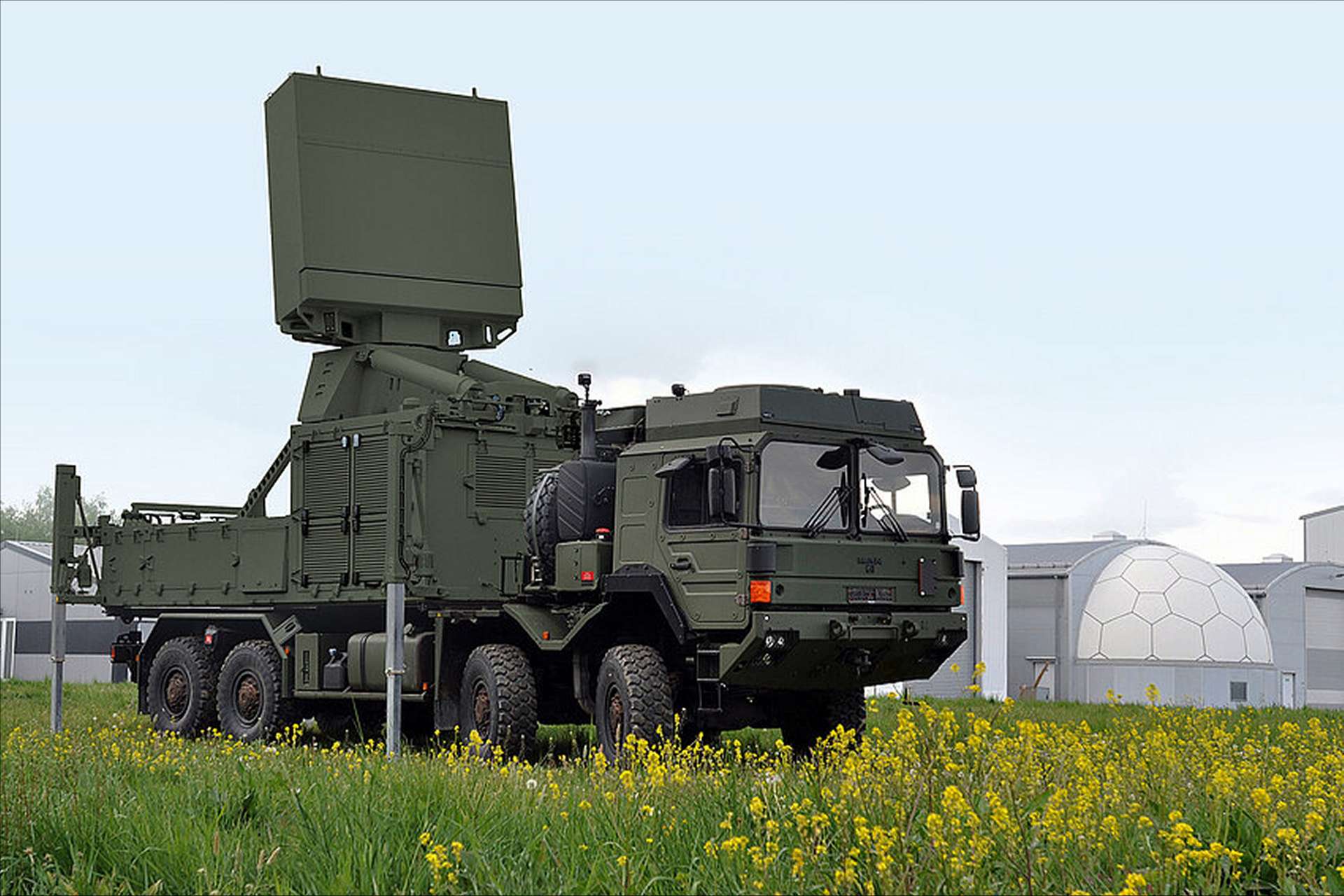
Hensoldt announced on May 3, 2024, the delivery of six additional TRML-4D radars to Ukraine. This initiative is part of a contract worth over 100 million euros, aimed at improving Ukraine's defense infrastructure. Scheduled for delivery later this year, these radar systems mark a crucial step in Hensoldt's commitment to supporting Ukraine's security.
Follow Army Recognition on Google News at this link
The TRML-4D radar system is part of Hensoldt's TRS-4D/TRML-4D radar family.
(Picture source: Hensoldt)
Hensoldt CEO Oliver Dörre emphasizes the urgency of this deployment, highlighting the crucial role these radar systems play in protecting Ukrainian airspace. Dörre expressed pride in Hensoldt's ability to meet delivery commitments, reaffirming the company's commitment to meeting the urgent security needs of its customers.
The TRML-4D radar system, part of Hensoldt's TRS-4D/TRML-4D radar family, represents an advancement in air surveillance and target acquisition capabilities. Equipped with state-of-the-art Active Electronically Scanned Array (AESA) technology and integrated features such as Identification Friend or Foe (IFF), the TRML-4D offers remarkable operational versatility.
Thanks to digital beamforming and pulse Doppler processing in all beams, this radar is capable of detecting, tracking, and classifying a wide range of airborne targets. It stands out for its ability to detect small, fast-moving, low-flying targets, as well as cruise missiles and stationary helicopters.
The TRML-4D has an instrumented range of 250 kilometers with 360-degree azimuthal coverage in rotating mode and 100-degree coverage in fixed mode. It can detect targets with a Radar Cross Section (RCS) as low as 0.01 m², and track up to 1500 targets in 3D simultaneously, with a tracking data update of less than one second.
Its extended performance allows for tracking fighter aircraft at over 120 kilometers and supersonic missiles at over 60 kilometers. With a Mean Time To Repair (MTTR) of less than 0.5 hours and high mobility, the TRML-4D can be rapidly deployed, operationalized, and dismantled in less than 10 minutes.
This radar also stands out for its ability to operate effectively in cluttered environments and high target densities, providing accurate and reliable tactical information even in adverse conditions. It supports short-range and medium-range surface-to-air missile systems and is designed for continuous operational availability, with reduced maintenance facilitated by semiconductor transmit and receive modules and advanced built-in test equipment. In summary, the TRML-4D represents a major advancement in air defense capabilities, offering reliable and effective protection against a variety of airborne threats.
The TRML-4D radar, alongside other offerings such as the short-range SPEXER radar and the passive Twinvis radar, illustrates the company's comprehensive portfolio addressing various defense needs. Notably, the TRML-4D and SPEXER are essential components of the German Armed Forces' NNbS air defense system, demonstrating Hensoldt's trusted partnerships in defense solutions.
Beyond national defense, Hensoldt's radar systems find applications in maritime security, with deployments on German Navy frigates and corvettes, as well as in airspace surveillance and approach control at Bundeswehr air bases. Ukraine is in great need of systems capable of helping it counter the Russian air threat, and any hardware that goes in this direction is welcome, such as the TRML-4D. However, radars alone will do nothing and these systems will have to be coupled with others to obtain a complete shield capable of neutralizing any Russian air attack, perhaps in the image of the Israeli Iron Dome.
Read more: Germany Provides 6 Additional TRML-4D Radars to Ukraine

- Details
- Written by: Halna du Fretay
- Category: 2024
- Hits: 4147
Breaking news
Ukraine has intensified its requests to the United States for MQ-9 Reaper drones, prioritizing this asset as it plans summer operations and seeks new methods for identifying Russian targets deep behind the front lines as reported by Politico on May 03, 2024. Since the conflict's onset, Reapers have been a high priority for Kyiv, initially desired for strike and surveillance missions. However, recent adjustments have shifted the focus to exclusively reconnaissance roles, as informed by four anonymous sources familiar with the strategy. Despite previous losses of Western-supplied weapons to Russian defenses, Ukraine views the Reapers as crucial for negating some tactical advantages held by Russia.
An MQ-9 Reaper sits on the flight line at Creech Air Force Base, Nevada, Dec. 17, 2019 (Picture source: Us DoD)
Operated from Ramstein Air Base in Germany by the 163rd Attack Squadron, these drones, which are already patrolling the Black Sea, could be transferred to Ukraine if Washington approves. U.S. and NATO specialists have been analyzing surveillance data since the war's beginning, emphasizing the drones' importance for future operations.
The MQ-9 Reaper, developed by General Atomics and first flown in 2001, was commissioned in 2007. Known for its enhanced endurance and payload capabilities, it can fly for about 27 hours at altitudes up to 50,000 feet with a payload of 3,850 pounds. This operational flexibility makes it vital for extensive surveillance and precision strikes.
However, the risk of these drones being shot down by Russian anti-aircraft missiles, such as the S-300, remains a significant concern. This risk is compounded by the potential exposure of S-300 positions when Reapers transmit electronic intelligence. Thus, their use would be cautiously reserved for coordinated operations targeting high-value objectives.
Despite challenges, Ukraine remains committed to acquiring these drones to enhance its reconnaissance and precision strike capabilities, particularly in preparation for summer combat. The Pentagon has yet to approve the drone transfer, cautious of losing sensitive technology if a drone were shot down and recovered by Russian forces. This reflects strategic prudence in the context of the ongoing conflict.
Ukraine continues to seek more advanced military equipment, evidenced by its recent requests for F-16 fighter jets and now MQ-9 Reaper drones. This relentless pursuit of technological enhancements occurs within the challenging context of its prolonged conflict with Russia, aiming to maximize offensive and defensive capabilities.
While these requests are understandable given the strategic stakes and the need to effectively address battlefield challenges, their formulation could potentially irritate supplying nations. The constant pressure to rapidly obtain cutting-edge equipment might complicate diplomatic relations and slow down the equipment delivery process essential to Ukraine.
Moreover, it is becoming clear that no matter how advanced, no single piece of equipment serves as a decisive factor or "game changer" in the Ukrainian conflict. The reality on the ground shows that the availability of personnel and munitions supply are the central issues, essential for sustaining the war effort effectively and efficiently, rather than relying solely on sporadic technological advances, which, although beneficial, cannot alone determine the conflict's outcome.
- Details
- Written by: Triffaux
- Category: 2024
- Hits: 45570
Breaking news
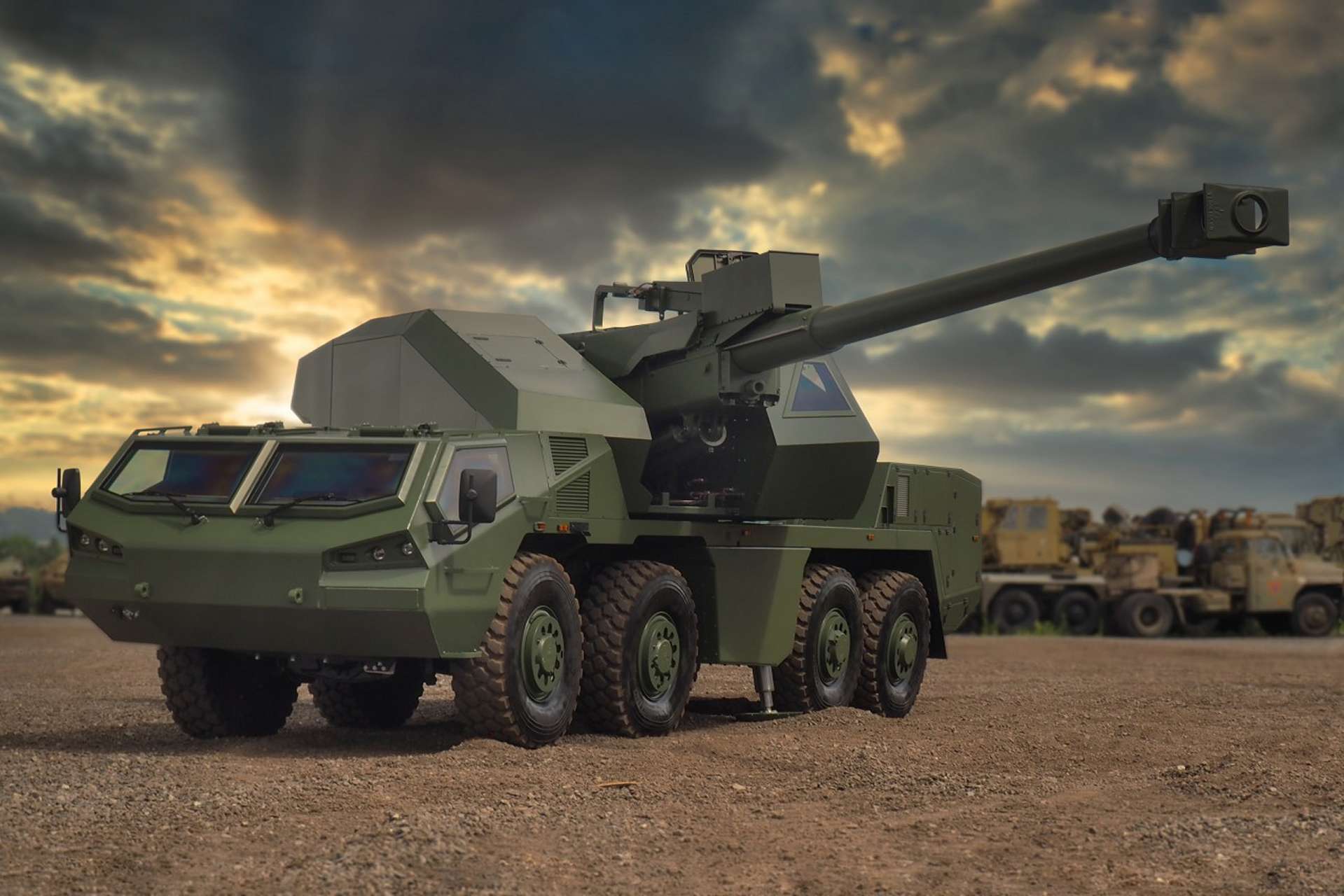
According to an article published by AZE. Media on May 6, 2024, the Czech defense company Excalibur Army is planning to deliver over 70 units of the 155mm/L45 "DITA" self-propelled howitzers to Azerbaijan. This transaction represents the largest order of Czech or Slovak artillery systems since 1989.
Follow Army Recognition on Google News at this link
Czech company Excalibur Army 155mm DITA Self-Propelled Howitzers (Picture source: Excalibur Army)
In September 2021, Excalibur Army already delivered 152mm Dana-M1 self-propelled howitzers and 122mm RM-70M1 Vampire MLRS to Azerbaijan, as explained in an article dated September 21, 2021.
The DITA 155mm, an 8x8 self-propelled howitzer developed by Excalibur Army, is designed to address modern artillery challenges. Derived from the Tatra 8x8 truck-mounted howitzer designs, it features a fully automated superstructure, requiring only a driver and commander on board. In January 2021, a functional prototype was completed, paving the way for performance testing. The DITA made its debut at IDEX 2021 in Abu Dhabi, presented in partnership with the UAE-based EDGE Group.
Measuring 13.02 meters in length, 3.08 meters in width, and 3.12 meters in height, and weighing up to 29 tons, the DITA is versatile and capable of being mounted on various wheeled or tracked chassis. Its ballistic crew cabin offers STANAG 4569 Level I protection and is equipped with a high-performance heating, air conditioning, and NBC filtration system.
Armed with a NATO-standard 155mm L45 gun, the DITA can fire up to 39 km using HE BB shells, achieving a maximum rate of fire of six rounds per minute. It supports various firing modes and can store 40 rounds in its turret conveyors.
Multiple Round Simultaneous Impact (MRSI) is a capability of some modern artillery systems where multiple shells are fired in rapid succession but timed to reach the target simultaneously, designed to overwhelm enemy defenses or achieve a concentrated effect.
The DITA features a modern Onboard Control System (OCS) for diagnostics, navigation, automatic gun guiding, and ammunition management. Powered by a Tatra T3C-928-90 engine with a maximum power output of 300 kW, it can reach speeds of 90 km/h on roads and 25 km/h off-road, with a maximum cruising range of 600 km.
For crew protection, the DITA offers Stanag 4569 Level 1 ballistic protection, ensuring crew safety in combat situations. Its advanced OCS allows for quick adjustments in firing position and streamlined operation by just two crew members. In case of navigation system failure, an emergency optical sight ensures continuous gun aiming capability.
Overall, the DITA 155mm represents a significant advancement in military mobility and operational flexibility, equipped to meet the demanding requirements of modern warfare.
According to the Military Balance 2022 report, Azerbaijan currently possesses a diverse artillery arsenal, totaling 630 units. This includes 102 self-propelled artillery pieces, consisting of 46 units of the 122mm 2S1 Gvozdika, 39 units of the 152mm 2S3 Akatsiya, 18 units of the 152mm 2S19 Msta-S, and 15 units of the Dana-M1M. Additionally, Azerbaijan has 5 units of the 155mm ATMOS 2000 self-propelled howitzer and 12 units of the 203mm 2S7 Pion.
The primary objective of the Azerbaijani armed forces is territorial defense, marked by the resumption of armed conflicts with Armenia over Nagorno-Karabakh after September 2020. This conflict, lasting six weeks, concluded in favor of Baku, but tensions between the two nations persist, with sporadic exchanges of fire occurring in late 2020 and throughout 2021. Azerbaijan maintains military cooperation with Russia and has recently developed ties with Turkey, evidenced by the signing of the "Shusha Declaration" in June 2021, implying a mutual defense agreement. Additionally, Azerbaijan maintains a defense relationship with NATO, having completed its fifth cycle of the NATO Individual Partnership Action Plan in 2019. Preparedness within the Azerbaijani armed services, based on compulsory military service, varies among units, with the country participating in multilateral exercises and conducting bilateral exercises with Turkish troops, such as the "Indestructible Brotherhood" in 2021.
While the armed forces have limited expeditionary capability, they have contributed to NATO's Resolute Support mission in Afghanistan. Over the past decade, Azerbaijan has prioritized defense modernization and procurement to replace its aging inventory, with recent orders focusing on air defense, artillery systems, and wheeled and tracked armored vehicles, primarily of Russian origin. Notably, there has been significant procurement and industrial cooperation with Israel, particularly in drones and guided weapons, and increasing collaboration with Turkey as a key defense partner.

- Details
- Written by: Vandenbosch
- Category: 2024
- Hits: 10188
Breaking news
On May 4, 2024, the French armored vehicle Jaguar was operationally deployed for the first time in Estonia. This information was relayed on the X CTE_OFF account. The vehicles traveled across 5 countries, covering 3,000 km to strengthen NATO's eastern flank through a strategic deployment via rail.
Follow Army Recognition on Google News at this link
France deploys in operation the Jaguar armored reconnaissance and combat vehicle for the first time. (Picture source: French MoD)
Following the escalation of the conflict in Ukraine, France decided to enhance its contingent in Estonia as part of NATO's Lynx mission, incorporating the multi-role armored vehicle Griffon from the SCORPION program. These vehicles, previously used in the Sahel during Operation Barkhane, have now been supplemented by the Jaguar armored reconnaissance and combat vehicles from the 1st Foreign Cavalry Regiment (REC), which were transported by rail.
Colonel Bertrand Dias, commander of the 1st REC ( Régiment étranger de cavalerie), shared on X that the Jaguars traveled 3000 km through five countries to reach the eastern flank of NATO, demonstrating excellent logistical coordination with allied forces.
Unlike the Griffons, the Jaguars were not deployed in the Sahel climate as they were delivered to the REC when France was completing its withdrawal from Mali. Their participation in the Spring Storm exercise in Estonia represents their first operational engagement in an external theater.
However, the deployment of the Jaguars raises questions about their readiness, as they are still in the familiarization phase with the armored cavalry branch and have not been officially declared operational, as acknowledged by General Pierre Schill, Chief of Staff of the Army, in May 2023. He indicated that adjustments were needed before the Jaguar could be fully operational.
The Jaguar is an armored reconnaissance and combat vehicle developed by France, in collaboration with the companies Nexter, Renault Trucks Defense (RTD), and Thales. This armored vehicle is equipped with a 40 mm cannon, a 7.62 mm machine gun, and medium-range anti-tank guided missiles. Designed to offer robust protection, the Jaguar withstands small arms fire and shell splinters, in line with NATO STANAG 4569 Level 4.
Weighing 25 tons, the Jaguar measures 7.3 meters in length, 3 meters in width, and 2.6 meters in height, allowing a three-person crew to operate it effectively. This vehicle is particularly suited for reconnaissance operations due to its day/night vision capabilities, protection against nuclear, biological, and chemical threats, which include internal overpressure and an air conditioning system.
Moreover, the Jaguar is equipped with advanced technologies such as a laser warning system, a threat missile detection system, as well as radio and infrared jamming systems, making it particularly effective for missions in hostile and varied environments. With a maximum speed of 90 km/h and a range of 800 km, it can respond quickly over long distances, thus offering considerable operational flexibility. Currently, the Jaguar is in service in France and has attracted interest from Belgium for its adoption.
The Ministry of Armed Forces has praised the versatility, robust armament, protection, and mobility of the Jaguar, which is designed to operate in urban and mountainous environments thanks to its six-wheel drive and steerable rear axle, as well as its advanced equipment and sensor technologies. The impact that the Jaguars will have on the ground and the feedback received on these new armored reconnaissance vehicles remain to be seen.

- Details
- Written by: V.Saint
- Category: 2024
- Hits: 3752
Breaking news
Following the initial announcement in January 2024, Spectra Group presents the GENSS system into the US market at SOF 24. Spectra Group, a specialist provider of secure voice, data, and satellite communications systems, is showcasing its next generation of tactical radio communications GENSS at SOF Week 2024 from 6-10 May 2024 at the Tampa Convention Centre Florida.
Follow Army Recognition on Google News at this link
GENSS architecture (Picture source: Spectra Group)
GENSS builds on the foundations created by their award-winning SlingShot system, embodying Spectra Group’s vision of producing the ultimate radio systems that capitalize on technological advances, adapt to the evolving demands of military operations and simplify the user experience.
GENSS is a significant advancement in the field of tactical radio communications, due to its modular core framework and software-defined flexibility, heralding a new era in communication technology.
This modular hardware radio system is designed to be agile and provide the ultimate interoperability through straightforward software reprogramming to adapt quickly and easily to meet the diverse needs of its users. Capable of operating across HF, VHF, UHF, and satellite bands, GENSS is engineered to conquer Beyond Line-of-Sight (BLOS) barriers and support Communications on the Move (COTM), delivering a robust and agile solution for voice and high-bandwidth data transmission across all domains — land, sea, and air. GENSS boasts high-capacity, network sensing capabilities and has increased data rates over 25kHz LTAC channels, scaling up to 90kBps.
This radio solution can stand alone or be integrated into any existing radio infrastructure and works seamlessly with SlingShot; unleashing superior interoperability and flexibility to meet the demands of today and the future. By integrating multi-mission and multi-mode functionalities, combined with its modular design and open architecture, it delivers unparalleled adaptability for robust battlefield connectivity.
Simon Davies, Chief Executive at Spectra Group, said: “For years, my vision has been to craft the ultimate radio system — user-friendly, light, modular and supremely flexible to adapt to the evolving demands of military operations and technological advances. After years of dedicated development, GENSS is the fruition of that vision and builds on the foundations set by our award-winning SlingShot system. Designed by soldiers, for soldiers, GENSS is not just a game-changer for military applications but possesses vast potential for integration into broader communication networks, unlocking endless possibilities.”
Spectra has over 15 years of experience in providing solutions for governments worldwide, elite militaries, and private enterprises of all sizes. As a security-focused organization, Spectra can provide timely cybersecurity advice and secure hosted and managed solutions, tailored to specifications and budget constraints, ensuring compliance with industry standards and best practices.
Spectra Group (US) Inc was established in 2018 to directly support the American market. In late 2019, Spectra Group was awarded a 5-year contract to serve as the UK distributor of Troposcatter COMET for the American company COMTECH Systems Inc. Comtech is a leading global provider of next-generation 911 emergency systems and critical wireless and satellite communication technologies.
Read more: Spectra Group launches GENSS new tactical radio communications system at SOF 2024

- Details
- Written by: Halna du Fretay
- Category: 2024
- Hits: 3752
Breaking news
At the Special Operations Forces (SOF) Week 2024, Galvion, a global leader in power and data management solutions and innovative head protection systems, will showcase its new wireless charging concept for combat systems, named BATLCHRG. This presentation follows the January 2024 announcement of a strategic investment partnership with Canadian technology company Quaze Technologies.
Powered by magnetic resonance, this technology provides a safe, secure, and seamless solution to efficiently charge multiple devices with variable power demands across a wide platform surface area (Picture source: Galvion)
Galvion's investment in Quaze represents a merging of technological innovation strengths from both companies, aimed at introducing revolutionary wireless charging technology into the combat systems market. Galvion will display the BATLCHRG wireless charging concept alongside other systems and solutions at booth 948 during SOF Week 2024.
For this year's SOF Week, Galvion demonstrates the BATLCHRG wireless charging capability in two battlefield scenarios: integrated into a vehicle seat and a wall-mounted mat in a ready-room scenario. Both instances show that soldiers can charge multiple battery-powered systems via the wireless power transfer system. This robust solution, utilizing a charging mat and receiver configuration, offers excellent power transfer rates and efficiency, broad position tolerance to accommodate movement and misalignment of surfaces, and operates effectively even in the harshest environments, remaining efficient when covered with water, snow, dirt, or dust.
Incorporating Galvion's power and data ecosystem, which includes the 2-Port Power & Data Hub (PDH-2), Personal Worn Scavenger (PWS), and SoloPack battery, the BATLCHRG wireless concept significantly reduces the logistical burden of battlefield power management. It will substantially enhance functionality and capacity by allowing soldier power systems to automatically and wirelessly charge while in static positions, such as traveling in a vehicle, on sentry duty, at a command post, or resting.
Quaze's Surface Power Technology revolutionizes how devices are powered, enabling easy and reliable wireless charging for remote or autonomous devices on land, sea, or air. Powered by magnetic resonance, this technology provides a safe, secure, and seamless solution to efficiently charge multiple devices with variable power demands across a wide platform surface area.
Todd Stirtzinger, CEO of Galvion, expressed the company's commitment to continuously exploring ways to alleviate the challenges faced by warfighters. He highlighted that in October 2023, Galvion introduced its Charge on the Move capability, which utilizes a vehicle-mounted Squad Power Manage to harness vehicle power systems for the benefit of today's dismounted soldiers. This initiative is part of a broader strategic partnership with Quaze Technologies. The collaboration has culminated in the BATLCHRG capability, a feature of their presentation at SOF Week, aimed at advancing wireless charging technology for untethered power provision and management. Stirtzinger emphasized the transformative potential of wireless technology, noting its ability to offer remarkable flexibility in system expansion when integrated with software development. He affirmed Galvion's readiness to leverage these advancements for future developments.
Read more: Galvion Unveils BATLCHRG Wireless Charging Concept for Combat Systems at SOF Week 2024

- Details
- Written by: Vandenbosch
- Category: 2024
- Hits: 4186
Breaking news
FNSS, a Turkish company, is showcasing its latest innovations in armored vehicles at the DSA 2024 exhibition, which is being held from May 6 to 9 in Malaysia. In this article, we will focus on one of FNSS's presentations, the Remote Controlled Turret that can be mounted on the PARS III 6x6, as featured on Army Recognition on 6 May 2024.
Follow Army Recognition on Google News at this link
The Teber-II 30/40 RCT is equipped with a 30mm dual-feed automatic cannon, which can be upgraded to a 40mm cannon. (Picture source: Army Recognition)
The Teber-II 30/40 RCT is equipped with a 30mm dual-feed automatic cannon, which can be upgraded to a 40mm cannon while retaining the main components and the original structure. This feature offers users the flexibility to increase their firepower according to operational needs. Additionally, a 7.62mm coaxial machine gun accompanies the main cannon.
The turret system is capable of integrating various anti-tank missile systems, enhancing its defensive capabilities. It supports two ready-to-fire anti-tank missiles, controlled by an integrated fire control system, enabling engagement of threats up to four kilometers away.
A notable addition is the independent remote-controlled weapon system (RCWS), which allows for the adjustment of firing angles both vertically and horizontally. This system can be adapted to use either 7.62mm or 5.56mm machine guns and is particularly effective in urban warfare scenarios, targeting elevated positions and high-angle threats such as drones. Furthermore, it serves as an independent sighting system for the commander, facilitating advanced "hunter-killer" tactics.
The Teber-II turret can be customized with a variety of manually or remotely controlled armament configurations, including 7.62mm and 12.7mm machine guns, 25mm and 35mm automatic cannons, 40mm automatic grenade launchers, 90mm cannons, and various anti-tank systems.
The PARS III 6x6 Armoured Fire Support Vehicle, designed to offer both the protection of mine-resistant transport vehicles and the offensive capabilities of modern armored combat units, stands out in its class. The vehicle is versatile enough to be transported by land, air (A400M transport aircraft), sea, highways, and railways, reflecting its adaptability to various military logistics and deployment strategies.
FNSS will be present at DSA 2024 in Malaysia. However, it remains to be seen whether FNSS will be able to win contracts in Malaysia at DSA 2024, but this turret could certainly convince some customers with its modularity and ability to be mounted on different vehicles.
Read more: DSA 2024: FNSS from Türkiye Presents TEBER-II 30/40 Remote Controlled Turret

- Details
- Written by: Triffaux
- Category: 2024
- Hits: 4894
Breaking news
At the ongoing DSA 2024 exhibition, from May 6th to 9th, 2024, the Army Recognition team discovered a new drone defense technology: the Skyfend Blader. This portable jammer specifically targets Small Unmanned Aerial Vehicles (SUAVs), offering comprehensive countermeasures against various aspects of their operation.
Follow Army Recognition on Google News at this link
Chinese SkyFend Blader Drone Killer (Picture source: Army Recognition)
Dubbed the "Skyfend Blader," this portable jammer specifically targets Small Unmanned Aerial Vehicles (SUAVs), providing comprehensive countermeasures against various aspects of their operation. From disrupting flight control to obstructing map transmission and interfering with Global Navigation Satellite Systems (GNSS) bands, the Blader is designed to repel drones or compel them to a controlled landing, thus mitigating the risks posed by unauthorized SUAVs.
The Skyfend Blader offers an impressive range of features tailored to address modern drone threats. Its jamming capabilities cover a wide range of consumer drone models, ensuring versatility and effectiveness in various operational scenarios. Additionally, it can seamlessly integrate with decoys, enhancing its countermeasure capabilities against sophisticated drone systems.
In terms of physical specifications, the Blader is designed to be portable and efficient. With dimensions of 795 × 100 × 304 mm and a weight of only 4 kilograms, it provides a lightweight yet robust solution for mobile defense against drone incursions. Despite its compact size, the Blader offers an impressive jamming range of up to 1,500 meters, coupled with a jamming duration of 30 minutes, providing sufficient coverage and duration to neutralize potential threats.
The Field of View (FOV) of the Blader includes azimuth angles of ±15° and pitch angles of ±10°, ensuring comprehensive coverage and effective jamming capabilities over a wide area. Furthermore, its rugged design and IP65 rating make it suitable for use in various environmental conditions, with an operating temperature range of -20°C to +55°C and a storage temperature range of -20°C to +60°C.
One of the notable features of the Skyfend Blader is its adaptability to evolving threat landscapes. Equipped with an extension module, it allows for the incorporation of arbitrary frequency bands, enabling continuous updates and customization to effectively counter new drone technologies.
With its comprehensive jamming capabilities, seamless integration with decoy systems, compact design, and adaptability to various operational environments, the Blader promises to enhance the security and resilience of defense forces against the growing threat posed by unmanned aerial vehicles.
Read more: DSA 2024: Chinese SkyFend Technology showcases New Blader Drone Killer
- Details
- Written by: Halna du Fretay
- Category: 2024
- Hits: 5196
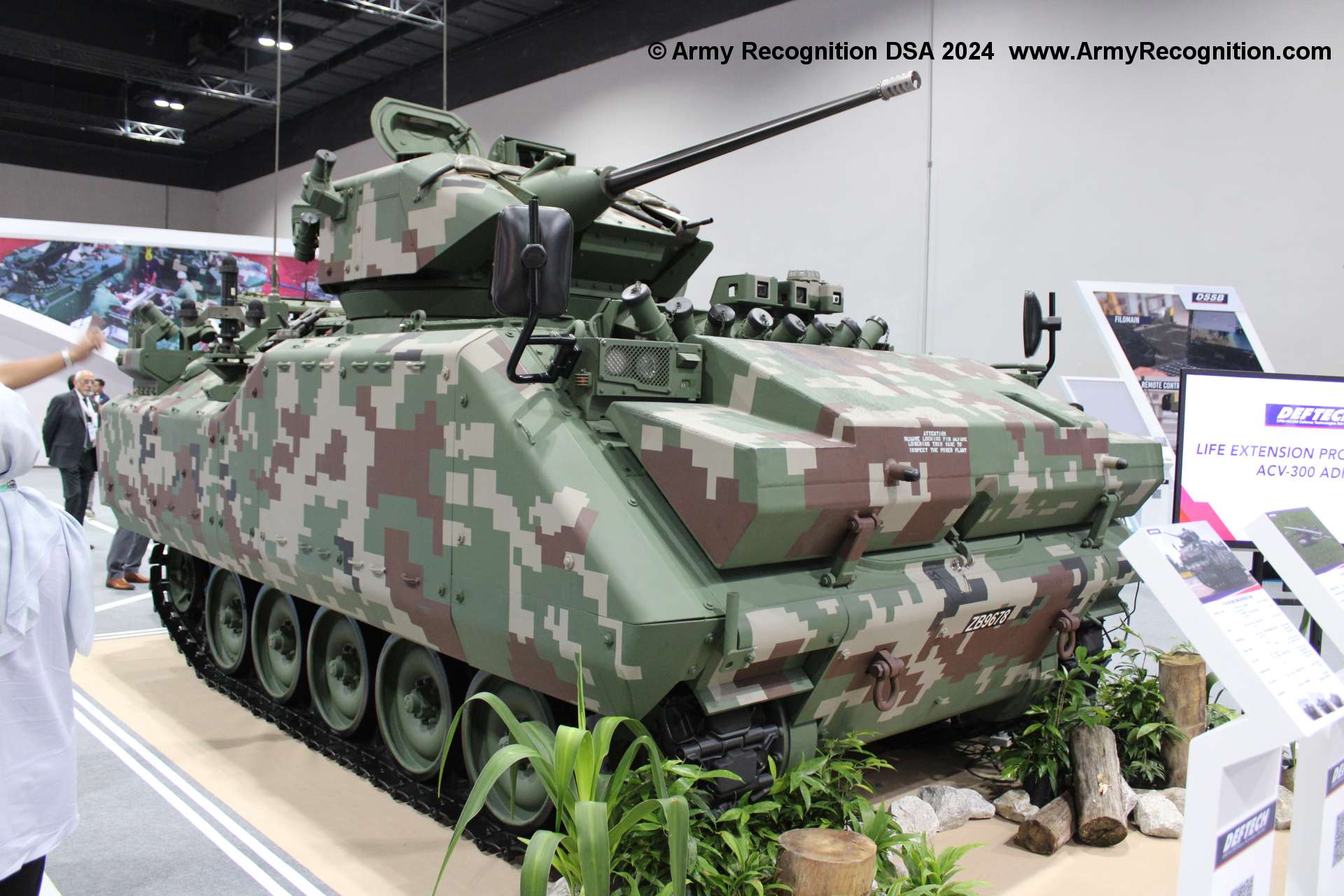
At the Defense Services Asia (DSA) 2024 in Malaysia, a new version of the ACV-300 Adnan equipped with the Spy Ball optical unit was unveiled as part of the Life Extension Program (LEP). This infantry combat vehicle (ICV) is central to operations in the Malaysian army. The ACV-300 is co-developed by Turkish company FNSS and DefTech, and is based on the ACV-15, an amphibious armored combat vehicle. Malaysia originally ordered 267 units of the ACV-15 in various configurations starting in 2000, all of which have since been delivered, solidifying the vehicle's presence on the field.
The ACV-300 was co-developed by Turkish company FNSS and DefTech of Malaysia at DSA 2024 (Picture source: Army Recognition )
The ACV-300 is powered by a 300-horsepower Detroit Diesel 6V53T engine, achieving notable performance with a maximum road speed of 65 km/h forward and 11 km/h in reverse. It has a fuel capacity of 416 liters, providing significant range and mobility on the battlefield. Its filtered transmission system ensures optimal operation in diverse environments.
In terms of protection, the current ACV-300 withstands 14.5 mm caliber armor-piercing rounds. However, enhancement options are available, including additional armor kits and internal spall liners, increasing protection against 30 mm caliber rounds and rocket-propelled grenades like the RPG-7 equipped with anti-armor explosive-shaped charges.
A key feature of the ACV-300 is its Sharpshooter turret, designed for a single operator and equipped with a 25 mm automatic cannon. This stabilized turret allows for the installation of various weapons systems, including a 25 mm M242 Bushmaster cannon, a 40 mm grenade launcher, or a 12.7 mm machine gun, along with a coaxial 7.62 mm machine gun. Featuring a day/night aiming system for the gunner, which includes a thermal imager and a laser rangefinder, the turret supports firing on the move due to its electric drive system.
A collaboration between DefTech and Thales successfully integrated the Spy Ball optronic payload into the ACV-300 ICV. This initiative is part of the Life Extension Program (LEP).
The Spy Ball features a suite of high-definition, multi-spectral sensors for intelligence and surveillance missions in various operational environments. With its advanced image processing algorithms borrowed from the Rafale reconnaissance pod, it ensures optimized image acquisition and processing, crucial for tactical operations.
Equipped with an uncooled infrared thermal camera and a high-definition day camera, the Spy Ball provides comprehensive coverage day and night, with continuous optical zoom for precise long-range target identification. Its integrated laser allows for target designation up to 2 kilometers, enhancing the vehicle’s target designation capabilities.
The Spy Ball XR (Extended Ranges) variant further extends operational capabilities, with day and infrared channels allowing target detection up to 7 kilometers. This version offers increased discretion in the field due to its range from sensitive areas.
Moreover, the Spy Ball IRT and IRZ variants add functionalities for specific missions. The IRT incorporates a laser rangefinder for precise target geolocation, while the IRZ offers continuous optical zoom for long-range identification, capable of detecting NATO tanks up to 3 kilometers.
In summary, the integration of the Spy Ball optronic payload into the ACV-300 vehicle enhances the Malaysian army's reconnaissance and surveillance capabilities, providing a significant tactical advantage on the battlefield. With its advanced performance and operational versatility, the Spy Ball contributes to the security and effectiveness of military operations.
Breaking news
Read more: DSA 2024: Deftech Introduces Life Extension Program for ACV-300 Adnan with Spy Ball Optic

- Details
- Written by: Vandenbosch
- Category: 2024
- Hits: 3379
FNSS, a Turkish company and a leader in defense systems development, is showcasing its latest innovations in armored vehicles at the DSA 2024 exhibition, taking place from May 6 to 9 in Malaysia. Among the notable equipment featured are the PARS III 6x6 Armoured Fire Support Vehicle, advanced turret systems, and a prototype for upgrading the Malaysian army's ACV-15 vehicles.
Follow Army Recognition on Google News at this link
FNSS thus presented its wheeled combat armored vehicle, the PARS III 6x6, alongside a turret and other equipment introduced by the Turkish company. (Picture source: Army Recognition)
FNSS thus presented its wheeled combat armored vehicle, the PARS III 6x6, alongside a turret and other equipment introduced by the Turkish company. This article, however, will focus on the presentation of the PARS III 6x6.
The PARS III 6x6 Armoured Fire Support Vehicle, with a combat weight exceeding 25,000 kg, is powered by a diesel engine and can reach speeds of up to 100 km/h. It excels in challenging terrains, capable of navigating on 60% vertical slopes and 30% side slopes, climbing obstacles up to 0.7 meters high, and crossing trenches around 1.75 meters wide.
Due to the strategic placement of the engine, its balanced axle loads allow for effective navigation on soft or irregular surfaces. This design helps maintain control at high speeds and ensures efficient braking. The vehicle is equipped with lockable differentials on each axle and a central tire inflation system that adjusts tire pressures to suit various terrain conditions.
The vehicle's powertrain can be quickly removed or installed in less than an hour, enhancing field maintenance and engine swaps. Its fully independent hydropneumatic suspension system provides superior maneuverability, whether on rough terrain or paved roads. The vehicle also includes a unique steering system on its first and third axles, minimizing its turning radius and improving maneuverability.
The PARS III 6x6 offers remarkable payload capacity and optimal comfort and is designed to carry up to nine occupants and their equipment. It has a driving range exceeding 800 km and is equipped with explosion-resistant fuel tanks and an additional tank under the armor for emergencies. Even with flat tires, run-flat inserts ensure the vehicle remains operational.
The vehicle's hull incorporates modular armor systems allowing for customizable protection levels. Its specialized design, including an underbelly structure and mine-resistant seats, protects occupants against severe mine threats.
A key feature of the PARS III 6x6 is its 30 mm TEBER-II Remote Controlled Turret, which offers the flexibility to switch to a 40 mm cannon if necessary. This turret system not only provides significant firepower but also integrates anti-tank missile capabilities, enhancing the vehicle's operational range and threat engagement.
FNSS's participation at DSA 2024 underlines its role as a key player in the defense sector, bringing a series of new products to its catalog. It remains to be seen whether FNSS will be able to secure one or two contracts in Malaysia during DSA 2024.
Breaking news
Read more: DSA 2024: FNSS Showcases PARS III 6x6 with Various Equipment

- Details
- Written by: Administrator
- Category: 2024
- Hits: 305641
Breaking news
On May 4, 2024, the Russian Ministry of Defense reported a significant interception of American-made ATACMS (Army Tactical Missile System) missiles. According to the Ministry's announcement today, Russian air defense units successfully destroyed 15 ATACMS missiles, with four being intercepted over the Crimea Peninsula on May 4, 2024.
Follow Army Recognition on Google News at this link
The US ATACMS missile was recently delivered to Ukraine to fight Russian troops. (Picture source U.S. DoD)
These interceptions were made possible by the latest version of Russia's Buk air defense missile system, the Buk-M3. The Buk-M3, renowned for its capability to engage multiple aerial targets under severe electronic warfare conditions, proved its effectiveness against the ATACMS, a longer-range missile system recently supplied by the United States to Ukraine.
The ATACMS delivery to Ukraine was disclosed at the end of April 2024, with over 100 units reportedly provided to enhance Ukrainian strike capabilities. This disclosure came from The New York Times, which cited unidentified U.S. officials noting the secretive delivery of these advanced tactical missiles.
The ATACMS were reportedly first used by Ukraine on April 17, 2024, to target the Dzhankoi air base in northeastern Crimea. This strike resulted in substantial damage to Russian military assets, including helicopters, an S-400 strategic surface-to-air missile system, and an aerospace surveillance complex that serves as a command-and-control center.
The U.S. Army Tactical Missile System (ATACMS) is a key component of America's tactical missile arsenal, designed for precision strikes against high-value targets at long ranges. Developed in the early 1980s and first deployed during the Gulf War in 1991, ATACMS is a surface-to-surface missile system that can be launched from multiple platforms, including the widely used M270 Multiple Launch Rocket System (MLRS) and the newer M142 High Mobility Artillery Rocket System (HIMARS). Capable of striking targets up to 300 kilometers away, depending on the variant, ATACMS fills a critical role in ground-based tactical warfare, allowing for deep strikes behind enemy lines with a high degree of accuracy.
The ATACMS family includes several variants, each designed to meet specific mission requirements. The missiles are equipped with different types of warheads, ranging from unitary high-explosive to cluster munitions, making them adaptable for a variety of tactical scenarios. Recent upgrades have focused on improving the missile's accuracy and extending its range, as well as reducing collateral damage by incorporating more precise guidance systems. These enhancements have solidified ATACMS's position as a strategic asset in the U.S. military's arsenal, providing a significant standoff capability and the ability to engage and defeat time-sensitive targets swiftly and effectively in various conflict scenarios.
The possible use of the Buk-M3 against the ATACMS highlights a significant escalation in the technological warfare aspect of the Ukraine conflict, showcasing advanced military capabilities on both sides. As the situation develops, the strategic implications of these engagements could significantly influence the ongoing military dynamics in the region.
The Buk-M3, also known as the Viking, is the latest generation of Russia's renowned Buk air defense missile system, designed to address a wide spectrum of aerial threats with improved efficiency and precision. Developed to replace older models of the Buk family, the Buk-M3 significantly enhances the capabilities of ground-based air defense by being able to engage aircraft, helicopters, cruise missiles, and drones, as well as tactical ballistic missiles like the ATACMS. With an operational range of up to 70 kilometers and an altitude reach of up to 35 kilometers, the Buk-M3 stands out for its ability to target multiple airborne objects simultaneously under intense jamming conditions, thanks to its sophisticated radar systems and modernized fire control technology.
The system's mobility and versatility are among its key strengths, featuring a rapid deployment and re-deployment capability that enables it to relocate and become operational within minutes. This makes the Buk-M3 particularly effective in modern, fast-paced combat environments where air threats can emerge suddenly and from multiple directions. Additionally, each Buk-M3 unit can track up to 36 targets and guide missiles at 6 of them concurrently, ensuring a high-density fire capability during combat scenarios. This multi-target engagement capacity, combined with advanced electronic countermeasure resistance, provides a robust defense against a variety of aerial attacks, thereby enhancing the overall air defense structure of the forces it protects.

- Details
- Written by: Jérôme Brahy
- Category: 2024
- Hits: 8290
Breaking news
As reported by the US Department of Defense (DoD) on April 30, 2024, the M88A3 Hercules Heavy Equipment Recovery Combat Utility Lift Evacuation System (HERCULES) is presently undergoing reliability and maintainability (RAM) testing at Yuma Proving Ground. According to Test Officer Yoselyn Vargas of the Combat Automotive System Division, such testing is indispensable for verifying the functionality and durability of military vehicles, especially with the introduction of new upgrades.
Follow Army Recognition on Google News at this link
Currently, two M88A3 Hercules are undergoing testing, covering a combined distance of 6,000 miles, with simulated loads weighing around 80 tons. (Picture source: US DoD)
Currently, two M88A3 Hercules vehicles are undergoing testing, covering a combined distance of 6,000 miles, with each vehicle individually completing 3,000 miles. The testing evaluates various aspects, including hoisting and winching capabilities, with simulated loads weighing around 80 tons. Testing commenced in mid-March 2024 and is slated to continue throughout the year, reflecting the thorough assessment required for such critical equipment.
Aberdeen Proving Ground (APG) is also actively involved in M88A3 Hercules testing, deploying four vehicles for performance and RAM testing. Their testing focuses on assessing the vehicle's longevity, particularly in the sandy conditions unique to their environment. While APG's testing shares similarities with Yuma Proving Ground's, the sandy conditions provide a distinct challenge that necessitates a comprehensive evaluation of the vehicle's capabilities.
Unveiled in 2018, the M88A3 Hercules aims to surpass its predecessor, the M882, by offering improved performance, especially in rescuing heavier modern tanks like the M1A2 Abrams SEP v.3, without requiring the assistance of a second vehicle, addressing a critical gap in US Army's single-vehicle recovery operations on the battlefield, where operational efficiency is deemed paramount.
The M88A3 Hercules is the latest version of the M88 armored recovery vehicle series developed by BAE Systems for the US Army. To increase operational efficiency and reduce logistical demands, BAE Systems developed this model, enhancing its performance, survivability, and responsiveness through various upgrades, including a modernized powertrain, a seventh road wheel for stability, and hydro-pneumatic suspension units to enhance mobility and recovery operations across diverse terrains.
The primary goal of these upgrades was to increase the vehicle's towing, winching, and hoisting capacities from 70 tons to 80 tons, aligning it with the growing weight of modern vehicles and ensuring its effectiveness in battlefield scenarios. Additionally, the design updates of the M88A3 Hercules feature an upgraded Caterpillar C32 ACERT engine, which provides improved horsepower and torque, and enhanced armored protection for increased survivability, resulting in an overall weight of approximately 78,000 kg.
In September 2019, BAE Systems received a contract from the U.S. Army, worth about $318 million, to upgrade M88A2 vehicles to the M88A3 configuration. This upgrade is being carried out at multiple BAE Systems facilities across the U.S., including in York, Pennsylvania; Aiken, South Carolina; Anniston, Alabama; and Sterling Heights, Michigan.
The M88A3 Hercules is a heavy recovery vehicle designed to accommodate a crew of a driver, mechanic, and commander, along with the crew of a recovered main battle tank. Powered by a Caterpillar C32 Acert engine, generating a gross horsepower of 1,350 hp, the M88A3 can reach speeds of approximately 56 km/h, with a cruising range of about 405 kilometers. The vehicle can navigate challenging terrains with a 60% slide slope, cross trenches up to 2.6 meters wide, and overcome vertical obstacles up to 1 meter high. Measuring 8.5 meters in length, 3.6 meters in width, and 3.1 meters in height, the Hercules possesses a ground clearance of over 40.6 cm. In terms of capacity, this armored recovery vehicle features a hoisting capacity of approximately 36,287 kg, a pick and carry capacity of about 29,030 kg, and a total recovery capacity of around 72,575 kg, making it suitable for heavy-duty recovery operations.
Read more: US Army conducts critical tests on future M88A3 Hercules armored recovery vehicle
- Italy prepares new aid package for Ukraine including SAMP/T air defense missile system
- Army Recognition Transforms into New Global Defense News Website Following Strategic Merger
- DTI Thailand Delivers CS/AH2 105mm Light Artillery Prototypes to Royal Thai Army
- UK Plans to Deploy Nation's First Domestically Produced Hypersonic Missile by 2030