0:11
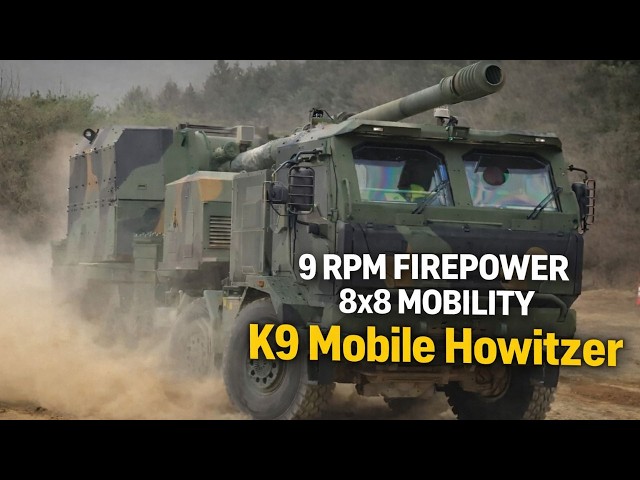
What you're looking at is one of the
0:12
newest artillery systems to come out of
0:14
South Korea's defense industry, the K9
0:17
mobile howitzer or K9 MH. Recently
0:21
unveiled by Hanwha Aerospace, this new 8
0:24
by 8 wheeled 155 mm system takes the
0:28
combat proven firepower of the K9 family
0:31
and places it on a road mobile platform
0:33
designed for faster deployment, easier
0:36
sustainment, and broader export appeal.
0:39
Hanwha is clearly aiming this system at
0:41
NATO users and other armies looking for
0:43
long-range firepower without the full
0:45
weight and support burden of a tracked
0:47
self-propelled gun. So, what exactly is
0:50
the K9 mobile howitzer? In simple terms,
0:52
it is a wheeled artillery system built
0:54
around the K9A2's automated 155 mm 52
0:59
caliber turret. Instead of the
1:01
traditional tracked chassis used by the
1:03
K9 Thunder, Hanwha mounts that turret on
1:06
a heavy 8 by 8 truck, creating a gun
1:08
system that can move quickly on road
1:10
networks, deploy in a short time, fire,
1:14
and then relocate before enemy
1:15
counter-battery fire arrives. Hanwha
1:18
showed the system publicly in 2025 at
1:21
AUSA and company material presented
1:23
there described the wheeled variant as
1:26
already in production with US testing
1:28
planned afterward. It's purpose on
1:30
today's battlefield is directly tied to
1:32
the lessons of modern high-intensity
1:35
>> Artillery is still decisive, but
1:37
survivability now depends on speed,
1:39
dispersion, and constant movement. A gun
1:42
that stays in one place too long risks
1:44
being detected by drones,
1:46
counter-battery radars, or long-range
1:50
That is where the K9 MH fits in. It is
1:53
designed for rapid redeployment, reduced
1:56
logistical burden, and compatibility
1:58
with NATO standard ammunition, giving
2:00
forces a way to combine mobility and
2:02
reach in environments where static
2:04
artillery positions are increasingly
2:06
vulnerable. Technically, the heart of
2:08
the K9 MH is its main armament, a 155 mm
2:13
52 caliber gun derived from the K9
2:16
family. That matters because the K9 is
2:19
already a mature artillery architecture
2:22
with a broad user base and existing
2:24
logistics ecosystem. In the wheeled K9
2:27
MH configuration shown by Hanwha, the
2:30
system retains a fully automatic loading
2:32
arrangement, carries 30 rounds and 192
2:35
charges, and is operated by a reduced
2:38
crew of only two to three personnel.
2:40
Hanwha's 2025 presentation also stated
2:43
that setup time is under 30 seconds,
2:46
that the system can deliver up to nine
2:48
rounds per minute, and that it can fire
2:50
a three-round burst in 15 seconds. Range
2:54
is one of the key selling points.
2:56
Reporting on the unveiled system says
2:57
the gun can engage targets beyond 40 km
3:00
with conventional ammunition and up to
3:03
roughly 70 km with extended range or
3:06
rocket-assisted projectiles.
3:08
That places it firmly in the category of
3:10
long-range tube artillery designed not
3:12
just for battlefield support, but for
3:14
deep fires against command posts,
3:17
logistics nodes, artillery batteries,
3:19
and time-sensitive targets. Mobility is
3:22
the other half of the equation. Hanwha
3:24
says the wheeled K9 mobile howitzer has
3:27
an operational range of up to 700 km and
3:31
a maximum speed of 100 km/h.
3:34
Those are major advantages for armies
3:36
operating over large road networks,
3:39
where a wheeled system can often
3:40
self-deploy faster and with less support
3:43
than a tracked vehicle. In practical
3:45
terms, that means quicker repositioning
3:47
between sectors, simpler transport over
3:50
long distances, and lower wear compared
3:52
with moving tracked artillery on roads.
3:55
And this is where the loading system
3:56
becomes especially important. The K9 MH
3:59
is not just a gun on a truck. The
4:01
automation is central to its battlefield
4:03
role. Instead of relying on a larger
4:05
crew to manually handle shells and
4:07
charges at high tempo, the automatic
4:10
ammunition handling system reduces
4:12
manpower while keeping a high rate of
4:14
fire. In combat, that matters for two
4:16
reasons. First, it shortens the time
4:19
from halt to fire mission. Second, it
4:22
reduces the crew's exposure outside the
4:23
vehicle during loading and firing. Now,
4:26
compared with its predecessor, the K9
4:28
[music] Thunder, the biggest evolution
4:30
is not the gun itself, but the concept
4:32
of employment. The classic K9 is a
4:35
tracked self-propelled howitzer built
4:37
for armored and mechanized formations.
4:40
Official Hanwha material describes the
4:42
K9 family as a 155 mm system with a 40
4:47
km effective range, a maximum firing
4:50
rate of six rounds per minute, 48 rounds
4:53
carried on board, and a top speed of 67
4:55
km/h in its tracked form. It is a highly
4:59
successful platform that has spread
5:01
widely in international service. The K9
5:04
MH takes that family and pushes it
5:06
toward a different operational logic. It
5:08
reduces crew size through automation,
5:10
increases road speed, and favors
5:13
strategic and operational mobility over
5:15
tracked cross-country endurance. In
5:17
other words, the K9 Thunder is built to
5:20
move with armored forces, while the K9
5:22
MH is built to move fast across a wider
5:25
theater, deploy quickly, shoot,
5:28
displace, and do it again.
5:30
That makes it particularly attractive
5:32
for countries that want long-range
5:34
artillery, but do not necessarily need a
5:36
fully tracked solution for every unit.
5:39
There is also a broader industrial and
5:41
strategic layer here. Hanwha is not
5:43
presenting the K9 MH as an isolated
5:46
prototype. It is tying the vehicle to
5:48
the wider K9 ecosystem, including shared
5:51
software, common ammunition logic, and
5:54
the possibility of pairing it with a
5:55
wheeled ammunition resupply vehicle
5:57
derived from the K10 concept. That tells
6:00
you this is not just an export
6:01
demonstrator. It is part of a larger
6:03
attempt to turn the K9 family into a
6:06
modular artillery architecture for
6:08
multiple markets. As for rivals, the K9
6:11
MH enters a crowded field. Hanwha itself
6:14
is being measured against systems such
6:16
as Germany's RCH 155,
6:19
France's Caesar MK2, Israel's ATMOS
6:22
2000, and Rheinmetall's HX3 artillery
6:26
concept. What makes the K9 MH stand out
6:29
is that it combines an already
6:31
established K9 derived gun system with a
6:34
high degree of automation and a wheeled
6:36
chassis aimed at quick deployment and
6:39
lower support demands. Unlike the RCH
6:41
155, which is marketed around firing on
6:45
the move, Hanwha's approach relies on
6:47
stabilizing before firing. But its
6:50
advantage is the maturity of the K9
6:52
family and the industrial base already
6:54
built around it. That industrial base is
6:57
not a minor detail. Hanwha has
6:59
repeatedly highlighted the international
7:01
footprint of the K9 program, and the
7:03
company has described the K9 as already
7:05
adopted by 10 countries, including six
7:08
NATO states. That matters because armies
7:10
do not only buy guns, they buy supply
7:13
chains, upgrade paths, training
7:15
ecosystems, and interoperability.
7:19
The K9 MH arrives with the benefit of a
7:21
family name that is already well
7:23
established in the global artillery
7:26
So, in the end, the K9 mobile howitzer
7:29
is best understood as a next step in the
7:31
evolution of South Korean artillery.
7:33
It keeps the firepower DNA of the K9
7:36
Thunder, adds K9A2 style automation,
7:40
shifts to a wheeled 8 by 8 chassis, and
7:42
answers a very modern battlefield
7:44
requirement: strike hard, move fast, and
7:48
stay alive. For armies looking at the
7:50
future of tube artillery, Hanwha's
7:52
message is clear. You do not necessarily
7:54
need to reinvent the gun. You need to
7:56
make it faster, leaner, easier to
7:58
deploy, and better suited to a
8:00
battlefield where every firing position
8:02
is temporary. And that is exactly what
8:05
the K9 MH is trying to be.