0:15
In modern war, one of the deadliest
0:17
threats may not be a fighter jet, a
0:19
tank, or even a missile. It may be a
0:21
cheap drone flying low, fast, and just
0:24
long enough to find a target. And in
0:26
March 2026, during Operation Skyfall in
0:29
Germany, the US Army used one of its
0:31
most recognizable attack helicopters to
0:34
show it is adapting to exactly that
0:36
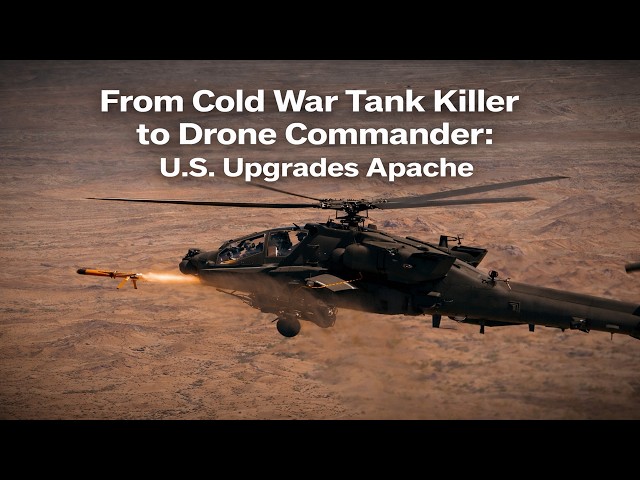
threat. At Grafenwoehr, AH-64E Apache
0:43
Attack Battalion detected, tracked, and
0:45
defeated simulated drone targets in a
0:47
counter-UAS exercise designed to test
0:50
how Army Aviation can survive and fight
0:53
in a battle space increasingly shaped by
0:55
unmanned systems. This was not just
0:57
another training event. According to the
0:59
US Army footage, Operation Skyfall was
1:02
designed to advance the eastern flank
1:04
defense line concept through
1:05
demonstrated counter-unmanned aerial
1:07
systems capabilities. The exercise
1:10
focused on refining tactics, integrating
1:12
modern technologies, and validating new
1:15
approaches to counter-UAS employment. In
1:18
other words, this was a test of whether
1:20
a helicopter built for tank killing and
1:22
close combat can also become a relevant
1:24
weapon against the small aerial threats
1:27
now saturating modern battlefields. And
1:30
that is what makes Skyfall important.
1:32
Across recent conflicts, drones have
1:34
changed the tempo of war. Small systems
1:37
now scout artillery targets, harass
1:39
ground units, overwhelm air defenses,
1:42
and force expensive platforms to react
1:46
The Army Recognition Report on the
1:48
exercise explicitly links the Apache's
1:50
new role to the spread of cheap drones
1:52
observed in Ukraine and along NATO's
1:54
eastern flank, arguing that Army
1:57
Aviation is being pushed into a critical
1:59
new phase where radar, electro-optical
2:02
sensors, and targeting systems must be
2:04
used not only against armored or ground
2:06
targets, but also against small unmanned
2:12
What Skyfall demonstrated is that
2:14
adaptation is no longer optional.
2:16
Military aircraft designed in an earlier
2:19
era cannot remain effective by doing
2:21
only what they were built to do decades
2:23
ago. They have to evolve. And for the
2:26
Apache, that evolution is especially
2:28
significant because this helicopter
2:30
still sits at the center of US Army
2:32
Attack Aviation. Boeing describes the
2:34
Apache as the backbone of the Army's
2:36
attack helicopter fleet. And the current
2:39
AH-64E model is being kept in production
2:42
into the 2030s, with service life
2:44
expected well into the 2060s.
2:47
That only makes sense if the aircraft
2:49
can absorb new roles, new sensors, new
2:51
software, and new ways of fighting.
2:54
During Operation Skyfall, the AH-64E
3:00
Attack Battalion operated at Germany's
3:02
Grafenwoehr Training Area,
3:04
where they worked through a scenario
3:06
centered on simulated drone threats. The
3:08
significance is not simply that the
3:10
Apache can shoot at drones. The real
3:12
message is that the aircraft can be
3:14
inserted into a wider counter-drone kill
3:17
Detection, classification,
3:19
prioritization, handoff, and engagement
3:24
The AH-64E integrates advanced sensors,
3:27
networking, and real-time data sharing
3:30
to enable the detection and
3:31
prioritization of multiple targets,
3:34
while also giving the helicopter the
3:36
ability to command unmanned aerial
3:38
vehicles to extend its own sensor reach.
3:41
That means the Apache is evolving from a
3:43
traditional attack helicopter into
3:45
something closer to a network node in a
3:47
larger air-ground fight. To understand
3:50
why this matters, it helps to step back
3:52
and look at what the AH-64E
3:54
actually is. The Apache family entered
3:57
US Army service with the AH-64A in 1984.
4:02
Over the following decades, it became
4:03
one of the most recognizable and
4:05
extensively used attack helicopter
4:07
families in the world. Boeing says the
4:10
Apache fleet has accumulated more than
4:12
5.3 million flight hours, including more
4:15
than 1.3 million in combat, and that
4:18
more than 1,300 aircraft are in
4:24
is the latest major evolution of that
4:26
line, built not as a clean-sheet
4:28
replacement, but as a heavily modernized
4:30
and digitally connected version of a
4:32
platform already proven across multiple
4:34
theaters. For the US Army specifically,
4:37
the first AH-64E was fielded in January
4:42
and the type reached initial operating
4:43
capability in November of that year.
4:46
That makes the AH-64E
4:48
a relatively recent variant in service
4:50
[music] terms, even though it belongs to
4:52
a helicopter lineage that dates back
4:54
more than four decades. In practical
4:57
terms, the Army has spent the last
4:59
decade turning the Apache from a Cold
5:01
War anti-armor attack helicopter into a
5:04
far more flexible system capable of
5:06
operating across high-intensity,
5:09
networked, and increasingly
5:11
drone-saturated battlefields.
5:13
Technically, the AH-64E remains a
5:16
twin-engine, tandem-seat, four-blade
5:18
attack helicopter, but the modernized
5:21
version adds a major leap in
5:22
connectivity, sensing, and system
5:25
architecture. The Army describes the
5:29
as equipped with an M230 30-mm
5:32
cannon, Hydra 70 2.75-in
5:35
rockets, and Hellfire missiles,
5:38
including laser-guided and radio
5:40
frequency variants. The E model was
5:42
designed with an open systems
5:43
architecture, so it can [music] keep
5:45
integrating updated communications,
5:47
navigation, sensor, and weapon systems
5:50
[music] over time. That open
5:52
architecture matters because today's
5:54
counter-drone mission is as much about
5:56
software and sensor fusion as it is
5:58
about raw firepower. [music]
6:01
The AH-64E's mission systems are
6:03
optimized for precision engagement,
6:05
situational awareness, and networked
6:08
operations. In combat terms, that means
6:11
Apache crews are no longer limited to
6:13
what they can directly see out of the
6:14
cockpit. They are increasingly tied into
6:17
a larger tactical network, receiving and
6:20
sharing targeting data, while building a
6:22
more complete picture of the battle
6:23
space. Its sensors are a central part of
6:26
that story. Boeing describes the
6:28
Apache's advanced sensor and targeting
6:30
suite as enabling detection,
6:32
classification, and prioritization of
6:35
multiple targets. Lockheed Martin, which
6:38
supplies Apache fire control systems,
6:40
says the Longbow and APG-78 fire control
6:44
radar provides automatic target
6:46
detection, location, classification, and
6:50
prioritization, with version 6
6:52
enhancements adding modes and range
6:54
improvements against land, air, and sea
6:56
targets. The weapon suite also makes the
6:58
Apache adaptable. In its standard role,
7:01
the helicopter can carry combinations of
7:03
Hellfire missiles, Hydra rockets, and
7:07
ammunition. Recent Army reporting on
7:09
Apache counter-UAS demonstrations in
7:13
showed the platform being used against
7:15
drones with radar and laser-guided
7:17
missiles, laser-guided rockets, and the
7:21
gun, while leveraging both radar and
7:23
EOIR sensors. That is important because
7:27
it suggests the Apache is not being
7:28
pushed into a single, narrow anti-drone
7:31
method. Instead, it is becoming a
7:33
multi-option interceptor able to match
7:36
different engagement tools to different
7:38
drone types, ranges, and tactical
7:41
The helicopter is already an established
7:43
combat platform, integrated with ground
7:45
forces, widely fielded, and familiar to
7:48
commanders. So, when the Army gives it a
7:50
counter-drone role, it is not
7:52
introducing a completely new system that
7:54
needs to be inserted from scratch into
7:56
force structure. It is expanding the
7:58
mission set of an existing, fielded,
8:04
So, what is the larger impact of
8:06
Skyfall? On a battlefield increasingly
8:09
crowded with drones, the US Army is
8:11
signaling that the Apache will not
8:13
remain locked in its traditional role.
8:15
It is being recast as part of a layered
8:17
answer to unmanned threats, combining
8:19
mobility, radar, optics, precision
8:22
weapons, and digital connectivity.
8:25
Exercises like Skyfall matter because
8:27
they show the Army trying to build
8:29
tactics before the next crisis, not
8:31
after it. And in Europe, where NATO
8:33
planners are watching the lessons of
8:36
that carries immediate relevance. But
8:38
the challenge is not solved. Drone
8:41
systems are evolving continuously. They
8:43
are getting cheaper, more numerous, more
8:45
autonomous, and more diverse in size and
8:48
profile. For the AH-64E to keep pace, it
8:52
will need constant upgrades in sensors,
8:54
software, networking, and low-cost
8:56
engagement options. The helicopter's
8:59
future value may depend less on how many
9:01
missiles it can carry, and more on how
9:03
quickly it can identify new types of
9:05
aerial threats, share that data across
9:07
the force, and engage them with the
9:09
right weapon at the right cost. Boeing's
9:11
emphasis on open systems, launched
9:14
effects, and greater interoperability
9:16
points in exactly that direction. In the
9:18
end, Operation Skyfall in Germany was
9:21
about more than one exercise. It was a
9:23
glimpse of how an iconic helicopter is
9:25
being reshaped for a battlefield where
9:27
the sky is no longer dominated only by
9:30
aircraft and missiles, but by swarms of
9:32
small unmanned systems. And if the
9:35
Apache can continue to evolve fast
9:37
enough, it may remain not just relevant,
9:39
but central in the next era of