
- Details
- Written by: Triffaux
- Category: 2024
- Hits: 4830










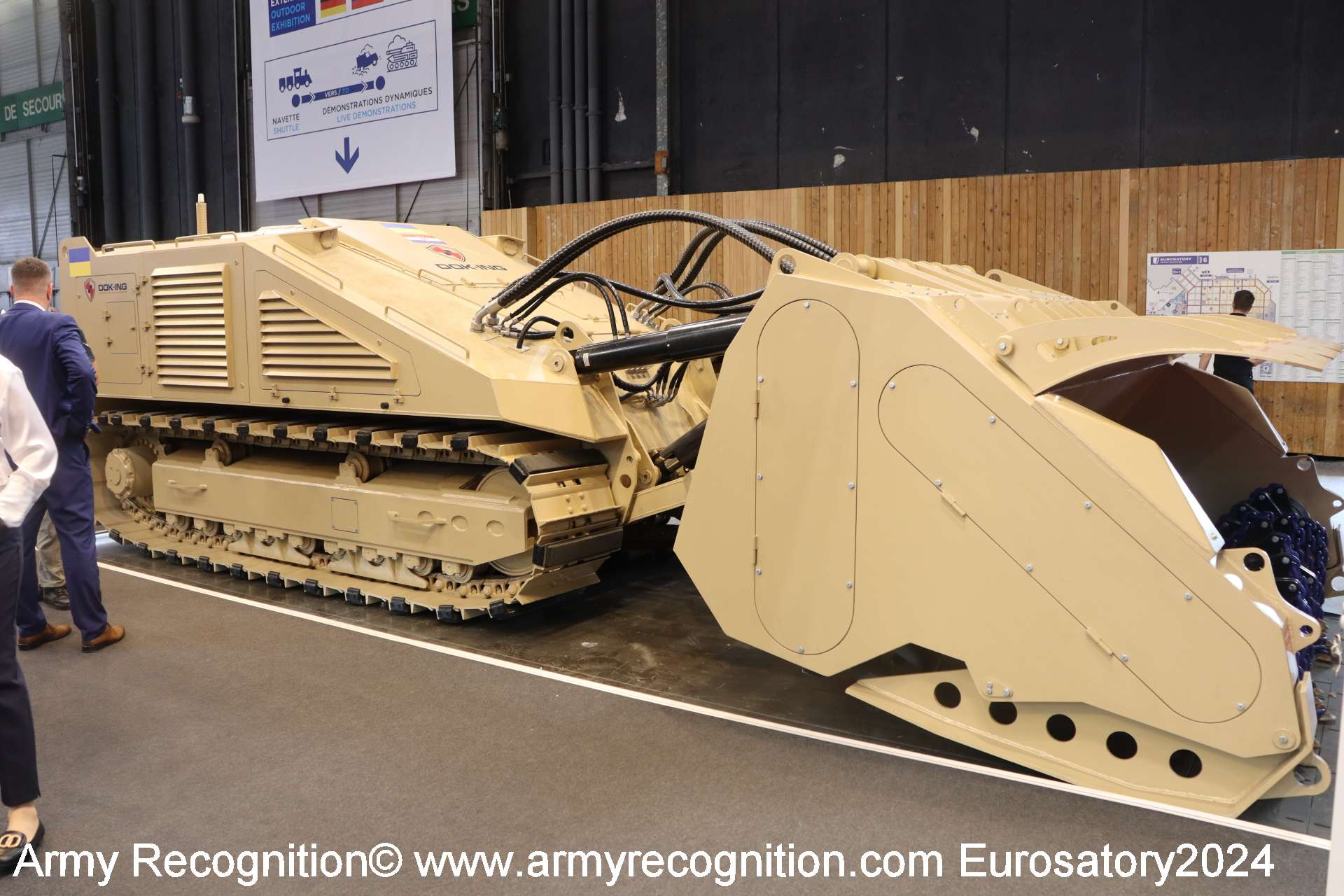
The Ukrainian government announced on June 24, 2024, that the heavy mine clearance machine MV-10, partially manufactured in Ukraine, has recently passed certification. A3Tech-Ukraine, a Ukrainian company that assembles and partially produces these machines in collaboration with the Croatian firm DOK-ING, has received a certificate of compliance. This success paves the way for the production of an additional eight units, with the first example already delivered to Ukrainian sappers thanks to funding from the UNITED24 initiative. The project aims to enhance security and support the reconstruction of conflict zones in Ukraine.
Follow Army Recognition on Google News at this link
A3Tech-Ukraine DOK-ING MV-10 Mine Clearance System (Picture source: Army Recognition)
Yulia Svyridenko, the First Deputy Prime Minister and Minister of Economy of Ukraine, emphasized the significance of this technological advancement. "It is crucial for us that the components are manufactured and assembled by a Ukrainian company, as this strengthens our ability to secure and demine our own territory. With increasing demand for such equipment, we anticipate a significant increase in the number of these machines, thus improving the quality and efficiency of their operation," she stated.
Currently, A3tech is responsible for manufacturing up to 40% of the MV-10's body components, with the goal of reaching 100% by the end of the year. Additionally, two other Ukrainian companies are involved in the project, which strengthens the local industry and demining technology. A3tech plans to produce up to 60 such machines per year, significantly increasing the country's demining capabilities.
The MV-10 is already a cornerstone in Ukraine's demining efforts, with 17 units actively in service in the regions of Mykolaiv, Kherson, and Kharkiv. These machines have played a crucial role in demining 850 hectares of land and destroying more than 4,500 mines, cluster munitions, and other explosive devices until the end of May.
The MV-10 machine is equipped with a dual working assembly consisting of a chain mechanism and a knife, enabling it to withstand the detonation of anti-tank mines and effectively clear up to 3,000 m² of surface per hour. Capable of operating on flat surfaces as well as slopes, the MV-10 is a vital tool for managing areas affected by conflicts, contributing both to the safety of humanitarian operations and the redevelopment of affected regions.
The MV-10 is an advanced mine clearance system developed by the Croatian company DOK-ING, specifically designed to neutralize all types of anti-personnel (AP) mines, anti-tank (AT) mines, and unexploded ordnance (UXO). Introduced in 2005 and validated by rigorous tests conducted by international demining authorities, this tracked system combines a rotary flail and a tiller as standard tools for a flexible and effective operation across various terrains.
The system has proven its value by being adopted by several armies worldwide, including those of the United States, Sweden, and Australia, as well as by organizations specializing in demining conflict zones. The MV-10 stands out for its ability to meet the complex requirements of mined areas, thanks to its optimized technical features for the efficient destruction of mines and UXO. It measures 4.6 meters in length, 2.2 meters in width, and 2.1 meters in height, and can penetrate the soil up to 60 cm, depending on the soil type, while being protected by HARDOX 400 steel plates resistant to explosions and gunfire.
The maneuverability of the MV-10 is enhanced by a remote control system, allowing an operator to control the vehicle from a distance of up to 3,000 meters, with a video control system for operations beyond 800 meters. This feature ensures maximum safety during demining operations in potentially hazardous areas.
The system also stands out for its operational flexibility, capable of functioning on transverse slopes up to 25º and longitudinal slopes up to 37º. It requires minimal maintenance, with components such as flail chains and tiller chisels easily replaceable, ensuring maximum availability and a long lifespan, which are essential for continuous operations in the field.
These features make the MV-10 an indispensable tool in demining efforts, significantly contributing to the safety and reconstruction of regions affected by conflicts.
Read more: Ukraine Announces Home-Made Production of DOK-ING MV-10 Mine Clearance System

- Details
- Written by: V.Saint
- Category: 2024
- Hits: 4607
According to the Financial Times and the Serbian President, Serbia is increasing its sales of ammunition to the West, which then transit through third countries to Ukraine. The amount of ammunition Kiev has received from Belgrade amounts to approximately 800 million euros. The value of ammunition exported by Serbia and entering Ukraine through third parties since the beginning of the large-scale invasion is approximately 800 million euros. This figure was confirmed by Serbian President Aleksandar Vucic.
Follow Army Recognition on Google News at this link
Illustration of 7.62x51 NATO ammo band for Machinegun ( MAG 58 , M269B) used in Irak by Used marine, White means Armor percing, Red tracing Ammo (Picture source: US MoD)
Vucic presented the arms export situation as a business opportunity, insisting that he would not take sides in the Russo-Ukrainian war.
The Serbian leader stated that this was part of their economic recovery and emphasized its importance. He mentioned that even though they export ammunition, they cannot export to Ukraine or Russia. However, they have secured many contracts with the Americans, Spaniards, Czechs, and others.
He emphasized that even though he knew where the sold ammunition ended up, it was not his concern. Vucic stated that his job is to ensure that they handle their ammunition legally and sell it appropriately. He highlighted his responsibility to take care of his people and noted that Serbia "has friends in Kiev and Moscow."
When asked if the 800 million euros in exports was correct, he replied that it was not for one year, but "maybe for two or three years."
According to the president, Serbian arms are cheaper than Western ones, which could lead to an increase in Serbia’s ammunition exports.
Serbia had a thriving military industry during the Cold War, when it was part of Yugoslavia. The country produces ammunition according to Soviet standards, which are still used by the Ukrainian armed forces. On March 5, 2023, Serbian President Aleksandar Vucic stated that his country had not transferred any Serbian weapons or ammunition to Ukraine or Russia, at least directly.
Read more: Serbia counts 800 millions euros of ammo exported in Ukraine with help of Europe

- Details
- Written by: V.Saint
- Category: 2024
- Hits: 2384
Since the beginning of Russia's large-scale invasion, the Ukrainian Ministry of Defense has codified and approved nearly 40 models of armored vehicles, both foreign and domestic, for use by Ukrainian defense forces. This development presents a significant advantage for future relations between Ukraine and NATO.
Follow Army Recognition on Google News at this link
Leopard 2 given to Ukraine evolving on training field near Avdiivka (Picture source: Ukrainian MoD)
The Ukrainian army's fleet of tracked and wheeled combat armored vehicles has been replenished with samples from more than 10 countries worldwide. These countries include the United States, Germany, Sweden, Great Britain, France, Italy, Norway, and others.
For instance, these vehicles include tanks such as the Abrams, Leopard, Challenger, AMX-10 RC, M2 Bradley infantry fighting vehicles, CV90 infantry fighting vehicles, M113 tracked armored personnel carriers in various modifications, M1126 Stryker wheeled armored personnel carriers, Rosomak, Puma, and others.
The defense forces note that Western models of armored vehicles are characterized by enhanced crew protection, engine reliability, good driving characteristics, and high weapon accuracy. This provides an advantage in confronting the enemy.
For example, the crew of an M2 Bradley infantry fighting vehicle from one of the combat brigades of the Ukrainian armed forces disabled a Russian tank during the battle near Avdiivka with a precise shot from a 25 mm M242 Bushmaster automatic cannon.
Among the codified models of armored vehicles are also products from Ukrainian defense companies, including modernized versions of Soviet infantry fighting vehicles and armored personnel carriers.
What are the implications of this government validation?
The codification and admission of domestically produced military weapons and equipment with the assignment of a NATO nomenclature number allow them to be purchased with state budget funds for Ukrainian defense units. This means that the given armaments and vehicles can be permanently in service with the armed forces.
However, even if the type is similar, having vehicles from different manufacturers and nations in service poses technical and cooperation challenges. For instance, technologies might differ, and shells might not be compatible with a particular platform, such as the Challenger and Leopard tanks. Additionally, these vehicles are developed according to the force employment doctrines specific to their countries, and may not fully adapt to others.
Read more: Ukraine validate more than 40 western given vehicles to fight against Russia

- Details
- Written by: Vandenbosch
- Category: 2024
- Hits: 3958
A new batch of Patriot missiles from Spain arrived in Ukraine on Friday, June 21, 2024, as part of Madrid’s ongoing military support to Kyiv amidst continuous Russian missile strikes on Ukraine’s energy infrastructure. This information was reported by El Mundo, with a government source confirming the arrival of the Patriots, along with Leopard 2A4 tanks in Ukraine.
Follow Army Recognition on Google News at this link
The Patriot system is a long-range, all-weather, all-altitude air defense missile designed in the United States and used by several countries. (Picture source: US DoD)
Spanish officials confirmed the delivery to El Mundo, revealing that it included not only the Patriot missiles but also the second batch of Leopard tanks, 155mm artillery shells, anti-drone systems, optical surveillance and tracking systems, and remote weapon turrets.
This latest shipment is part of the military package announced by Madrid during the Ramstein format meeting on May 20, 2024.
Earlier, El Pais reported Spain's commitment to send a dozen Patriot missiles to Ukraine. However, it remains uncertain if this number pertains to the latest shipment, as government officials have not commented on the report. In early May, Spanish Defense Minister Margarita Robles mentioned that Spain had already sent an unspecified number of Patriot missiles to Ukraine.
The arrival of additional Patriot missiles aims to bolster Kyiv's defenses against Russian attacks on its energy infrastructure. This year, Ukraine has already faced eight major attacks that have severely impacted its energy production capabilities.
Additionally, on May 26, Spain promised €1 billion ($1 billion) in military aid to Ukraine for 2024 as part of the bilateral security agreement between Kyiv and Madrid.
The Patriot system is a long-range, all-weather, all-altitude air defense missile designed in the United States and used by several countries, including Germany, Israel, Japan, Kuwait, the Netherlands, Poland, Qatar, Romania, South Korea, Sweden, Ukraine, the United Arab Emirates, and the United States.
Each Patriot missile has a launch weight of approximately 700 kg (1,540 lbs) and is about 5.2 meters (17 feet) long. Its range varies between 20 and 35 km (12 to 22 miles), allowing it to intercept targets at considerable distances. The missile reaches a top speed of Mach 5, which is approximately 3,836 mph (6,173 km/h).
The guidance system of the Patriot missile is particularly sophisticated. It is equipped with an active radar seeker located in the nose of the missile, allowing it to autonomously track and engage targets. This guidance system is complemented by mid-course updates from a ground-based radar and the missile's onboard inertial navigation system. The radar associated with the Patriot system is the AN/MPQ-65.
A notable feature of the Patriot PAC-3 missile is its "hit-to-kill" approach, meaning it does not have an explosive warhead. Instead, it destroys its target through the kinetic energy generated by the missile's direct impact. This mode of destruction is made possible by the solid rocket motor that propels the missile towards its target.
The Leopard 2A4 is a main battle tank designed in Germany, widely used by numerous countries, including Austria, Canada, Chile, the Czech Republic, Denmark, Finland, Germany, Greece, Indonesia, Norway, Poland, Portugal, Singapore, Switzerland, Sweden, Slovakia, Spain, Turkey, and of course, Ukraine.
This tank is equipped with a 120mm L55 smoothbore gun, a coaxial 7.62mm machine gun, and an anti-aircraft 7.62mm machine gun mounted on the loader's hatch. In terms of protection, it features standard-spaced multilayer armor with improved protection on the front of the turret. The interior of the turret is also fitted with spall liners for better crew protection.
The Leopard 2A4 weighs 62,000 kg in combat condition and can reach a maximum road speed of 72 km/h. It has an operational range of 500 km, allowing it to cover great distances without frequent refueling.
The tank is equipped with several accessories, including infrared night vision and an NBC (nuclear, biological, chemical) protection system, enabling the four-person crew to operate effectively in various combat conditions. In terms of dimensions, the Leopard 2A4 is 7.70 meters long, 3.70 meters wide, and 3.00 meters high.
However, this information has not been officially confirmed by either Spain or Ukraine, and no images have been published on social media. Nevertheless, this would represent substantial aid for Ukraine in its conflict with Russia, particularly regarding the Patriot systems, as Ukraine has a significant deficit in its air defense capabilities.

The Leopard 2A4 is a main battle tank designed in Germany. ( Picture Source: Army Recognition)
Read more: Spanish Leopard 2A4 Main Battle Tanks and Patriot Air Defense System Arrive in Ukraine

- Details
- Written by: Triffaux
- Category: 2024
- Hits: 6886
Mercedes-Benz has unveiled the Zetros 8x8 logistic vehicle for the first time at Eurosatory 2024. Designed to meet the modern logistical challenges of military forces, it combines advanced technology and exceptional performance to effectively support military operations.
Follow Army Recognition on Google News at this link
Mercedes-Benz Revolutionizes Combat Support with New Zetros 8×8 Logistic Vehicle (Picture source: Army Recognition)
The Zetros 3851A 8x8 represents a formidable asset in modern defense logistics, combining robust design with advanced technological features suited for military use. This heavy-duty truck, manufactured by Mercedes-Benz, is designed for high mobility in challenging off-road conditions. Key specifications include a length of 11.1 m, a width of 2.6 m, and a height of 3.7 m, supporting its substantial presence and operational capabilities in diverse environments.
The addition of advanced logistical support capability is another crucial highlight of the Zetros 3851A 8x8. Thanks to its Load Handling System (LHS), this vehicle is not only capable of carrying heavy loads, but it can also autonomously load and unload containers and other logistical equipment without needing external assistance.
This system allows remarkable operational flexibility, enabling military units to quickly deploy resources where they are most needed, while minimizing the dependence on additional lifting equipment. The LHS thus significantly enhances field operation efficiency, reducing preparation times and speeding up mission cycles.
By integrating features that facilitate autonomous management of logistical resources, the Zetros 3851A contributes to a more resilient and responsive supply chain, essential for mission success in changing and often unpredictable environments.
At the heart of the Zetros 3851A is the Mercedes-Benz OM 460 Euro V engine, a six-cylinder inline configuration offering a displacement of 12.8 liters and a power output of 376 kW (510 hp). This powerful engine is coupled with an Allison 4500 transmission, ensuring reliable performance in demanding conditions.
The vehicle design emphasizes versatility and durability, with a wheelbase of 6,200 mm and single tires measuring 14.00 R 20. It has a permanent gross vehicle weight (GVW) of 38.0 tonnes, distributed across its axles, and can carry payloads up to 25 tonnes, making it ideal for transporting heavy equipment and supplies.
Special features of the Zetros 3851A include a low silhouette and a three-point mounted cab, which enhance its operational discretion and comfort. The seating position is strategically placed behind the front axle to reduce exposure to frontal impacts. Ease of maintenance is also a central point, with features such as additional storage spaces and bolted aluminum wheels with puncture-resistant tires.

- Details
- Written by: Administrator
- Category: 2024
- Hits: 6848
The Russian State Defense Company, ROSTEC, announced today that a new batch of the latest generation of 2S43 Malva 152mm wheeled self-propelled howitzers has been delivered to Russian troops stationed in Ukraine. This marks a significant enhancement in the artillery capabilities of the Russian forces in the region.
Follow Army Recognition on Google News at this link
The 2S43 Malva is the latest generation of 8x8 152mm self-propelled howitzer fully designed and developed by the Russian defense industry. (Picture source: ROSTEC)
The announcement follows the first reported use of the 2S43 Malva in combat operations in Ukraine on June 9, 2024. Army Recognition, a defense industry media outlet, reported that Russian forces had successfully deployed the new artillery systems in live combat scenarios, marking a pivotal moment in the conflict.
The 2S43 Malva is a state-of-the-art wheeled self-propelled howitzer designed to provide superior mobility, firepower, and operational flexibility. It features a 152mm caliber gun capable of delivering powerful artillery strikes with high precision. The wheeled chassis enhances mobility over various terrains compared to traditional tracked systems, allowing for rapid deployment and swift repositioning on the battlefield. Additionally, the Malva is equipped with advanced targeting and fire control systems, improving accuracy and overall combat effectiveness.
This latest deployment underscores the ongoing modernization of Russian military equipment and its strategic emphasis on increasing the mobility and effectiveness of its artillery units in Ukraine. The introduction of the 2S43 Malva is expected to have significant implications for the dynamics of the conflict, providing Russian forces with enhanced firepower and tactical versatility.
In response to the significant losses of artillery systems during the ongoing conflict in Ukraine, the Russian army is actively developing artillery systems with the latest generation of self-propelled howitzers. One of the notable additions is the 2S35 Koalitsiya-SV, a state-of-the-art 152mm self-propelled howitzer. This model, a testament to the rapid technological advancements, represents a substantial improvement over the older 2S19 Msta model, featuring advanced capabilities such as a higher rate of fire, extended range, and enhanced accuracy.
The 2S35 Koalitsiya-SV can fire up to 16 rounds per minute and has an operational range of 40 kilometers, extendable to 80 kilometers with guided munitions. This system only requires a crew of three to operate efficiently, thanks to its automated loading mechanism, making it more efficient than the 2S19, which needs a crew of five and has a lower firing rate and range.
Additionally, Russia has started deploying these advanced artillery systems to Ukraine to test their performance in real combat conditions and to gather data for further improvements. The introduction of these modern howitzers is part of Russia's broader strategy to modernize its military equipment and enhance its operational capabilities on the battlefield.
In addition to the 2S35 Koalitsiya-SV development, the Russian military has begun deploying the 2S43 Malva, a new generation of 152mm wheeled self-propelled howitzers. The 2S43 Malva offers enhanced mobility due to its wheeled chassis, which allows it to traverse various terrains more efficiently than traditional tracked systems. This system was first reported to be used in combat operations in Ukraine on June 9, 2024, marking its debut in active conflict zones. The Malva is equipped with advanced targeting and fire control systems, significantly improving its accuracy and effectiveness in combat. The integration of these modern artillery systems highlights Russia's commitment to upgrading its military capabilities and maintaining a technological edge in the ongoing conflict.
The recent deployment of the 2S43 Malva in Ukraine, first reported in June 2024, marks a significant step in modernizing the Russian artillery forces. Given its advanced technical features and combat capabilities, delivering more Malva howitzers to Russian troops in Ukraine will likely enhance their operational effectiveness. This continued modernization effort underscores Russia's strategic focus on maintaining technological superiority and adapting to the evolving demands of modern warfare.
Read more: Russian Troops in Ukraine Receive More Advanced 2S43 Malva Self-Propelled Howitzers

- Details
- Written by: Jérôme Brahy
- Category: 2024
- Hits: 2787
According to El Comercio on June 24, 2024, Santa Bárbara Sistemas (SBS) has proposed to the Spanish Ministry of Defense the production of up to fifty ASCOD Infantry Fighting Vehicles (IFVs) within a year to support Ukraine. This offer follows a meeting on March 18, 2024, between the President of the Spanish Government, Pedro Sánchez, and representatives of the Spanish defense industry, including the Minister of Defense, Margarita Robles.
Follow Army Recognition on Google News at this link
Santa Bárbara Sistemas, the Spanish branch of GDELS, indicated it could have the fifty ASCOD units ready within a year, leveraging its experience from past programs such as the Pizarro for Spanish troops and the Ajax for the British Army, which is nearing completion. (Picture source: Army Recognition)
During this meeting at Moncloa, Sánchez reaffirmed Spain's support for Ukraine and called on the defense industry to contribute to the European Defense Industrial Strategy. He also announced a forthcoming security agreement for Ukraine, which was signed two months later in Madrid by Sánchez and Ukrainian President Volodymyr Zelensky, promising Kyiv one billion euros in military aid. Sánchez highlighted the importance of timely military aid delivery to Ukraine and encouraged companies to submit their proposals to the Government.
In response, Santa Bárbara Sistemas offered to supply up to fifty tracked ASCOD fighting vehicles to Ukrainian forces within a year. The Spanish Government has not yet responded to this offer. Other companies have also submitted proposals; for example, Arquimea has offered its Q-SLAM-40 kamikaze drone system.
Santa Bárbara Sistemas indicated it could have the fifty ASCOD units ready within a year, leveraging its experience from past programs such as the Pizarro for Spanish troops and the Ajax for the British Army, which is nearing completion. The company aims to avoid delays by focusing on manufacturing an existing vehicle model. The ASCOD vehicles are produced at the Trubia factory, where the entire production cycle occurs, from cutting metal to final assembly and weapon system integration. Additionally, the company has a tracked armored vehicle production line at the cannon factory capable of producing up to fifty more units of an existing model.
Defense programs usually require several years to implement after a contract is signed, but Santa Bárbara Sistemas' proposal includes a commitment to expedited delivery. Despite this commitment, the Government has not yet responded to the initiative. Neither the Ministry of Defense nor Santa Bárbara Sistemas have made public statements on the matter. Ukraine has been interested in the ASCOD for several months; in October 2023, Ukrainian Armor announced that it was in negotiations with General Dynamics European Land Systems (GDELS) to produce ASCOD infantry fighting vehicles in Ukraine under license.

The ASCOD's armament is highly modular, ranging from a 12.7mm machine gun for the APC variant to the 105mm gun seen in the Sabrah variant used by the Philippine Army, as well as a 30mm cannon for the IFV variant. (Picture source: Army Recognition)
Developed by General Dynamics European Land Systems and Santa Bárbara Sistemas, the ASCOD (Austrian Spanish Cooperation Development) platform is designed with a modular architecture, allowing for multiple configurations, including infantry fighting vehicles, armored personnel carriers, command posts, and light tanks. The platform can be customized to meet specific operational needs. It features a high power-to-weight ratio, advanced suspension systems, and comprehensive protection systems, which can be upgraded to meet future threats. The vehicle's survivability is enhanced by its monocoque steel hull construction and optional active protection systems, providing defense against ballistic threats up to NATO STANAG 4569 Level 4, suitable for deployment in combat zones with high mine and IED threats, common in eastern Ukraine.
Furthermore, the ASCOD's armament is highly modular, ranging from a 12.7mm machine gun for the APC variant to the 105mm gun seen in the Sabrah variant used by the Philippine Army, as well as a 30mm cannon for the IFV variant. In the future, this platform will also be equipped with the Spanish Guardian 30 turret from Escribano, which features a 30mm MK44S Bushmaster Chain Gun, with an adaptable option for a 40mm cannon, and a coaxial 7.62mm machine gun. Powered by either an MTU V8 or a Scania V8 engine, the ASCOD can achieve speeds of up to 72 km/h and has a range of 500 km. These features ensure the ASCOD is well-suited for the varied topography of Ukraine, which includes urban areas, forests, and open plains.
Read more: Will Spain approve the delivery of 50 ASCOD IFVs to Ukraine?

- Details
- Written by: Vandenbosch
- Category: 2024
- Hits: 4216
On June 20, 2024, Deputy Prime Minister Władysław Kosiniak-Kamysz announced that Poland will soon begin production of K2 tanks, following successful negotiations with South Korea. This development is seen as an achievement for the Polish Armaments Group, which is expediting efforts to commence production. Kosiniak-Kamysz confirmed plans to sign an executive contract for 180 K2 tanks during the upcoming defense industry exposition in Kielce, to start production with the current tranche.
Follow Army Recognition on Google News at this link
The K2 is a South Korean Main Battle Tank. (Picture source: US DoD)
The meeting between Deputy Prime Minister Kosiniak-Kamysz and South Korea's Minister of Defense, Shin Won-sik, took place at the Representative Center of the Ministry of National Defense in Pruszków. Kosiniak-Kamysz highlighted the strategic importance of this cooperation, noting that South Korea has already delivered various military equipment to Poland, including FA-50 aircraft, Chunmoo launchers, K9 howitzers, and K2 tanks. The recent contract signed by Minister Paweł Bejda in South Korea for additional Chunmoo launchers under the HOMAR-K program underscores the deepening defense ties between the two nations.
The Polish government is committed to ensuring that 50% of production and purchases for the Polish Armed Forces occur within Poland, a key election promise. This goal necessitates investments and partnerships, as emphasized by the head of the Ministry of National Defense.
The discussions also covered broader military cooperation, focusing on defense and armaments. The ministers co-chaired a meeting of the joint ministerial committee, where they addressed Korean Peninsula stabilization activities and the future development of military relations between Poland and South Korea.
Kosiniak-Kamysz expressed optimism about the swift preparation and adaptation of the production line to the Polish environment. He acknowledged existing delays but stressed the determination to overcome them. The Deputy Prime Minister praised the Republic of Korea's commitment to resolving any issues and ensuring timely information sharing.
The K2 tank, used by South Korea and soon by Poland, is a powerful and sophisticated combat vehicle. Designed in South Korea, it weighs 55,000 kg and can reach a maximum speed of 70 km/h. This tank is equipped with impressive armament, including a 120 mm gun, a 7.62 mm coaxial machine gun, and a 12.7 mm heavy machine gun.
In terms of protection, the K2 is equipped with composite armor and explosive reactive armor (ERA) blocks, providing enhanced resistance against various types of threats. To ensure crew survival and tank efficiency on the battlefield, it integrates an advanced fire-control system, an active protection system, an NBC (nuclear, biological, chemical) protection system, as well as day/night vision and thermal vision capabilities. It also features an automatic fire suppression system and a snorkel for amphibious operations.
The K2 is designed to operate efficiently with a crew of three. Its dimensions are impressive: it measures 10.7 meters in length, 3.6 meters in width, and 2.4 meters in height. With a range of 450 km, it is capable of conducting prolonged operations without frequent refueling. In summary, the K2 tank combines firepower, advanced protection, and mobility to meet the demands of modern battlefields.
Deputy Minister Paweł Bejda noted that the discussions also covered the financing of military equipment purchased from South Korea and the presentation of the Polish armament industry's offerings, which may be of interest to the Korean side.
Read more: Poland to Begin Production of K2 Tanks Following Agreement with South Korea
- Details
- Written by: Vandenbosch
- Category: 2024
- Hits: 3482
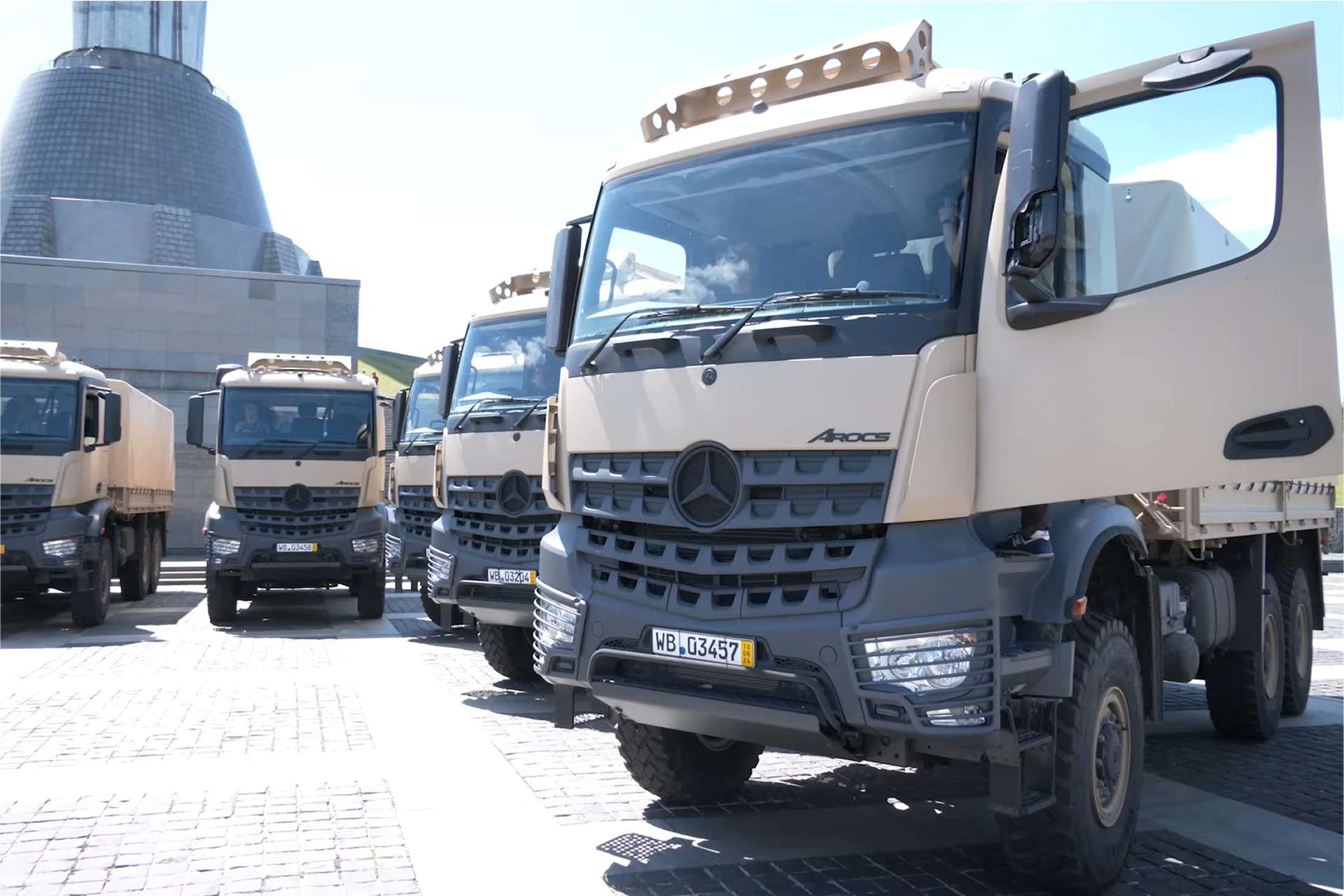
The newly restructured border units have received a delivery of Mercedes Arocs trucks as of June 24, 2024. A total of 41 vehicles have been delivered to the border units, which are an integral part of Ukraine's Defense Forces. This international aid was made possible through the efforts of the German federal government.
Follow Army Recognition on Google News at this link
Ukraine has received a delivery of Mercedes Arocs trucks. (Picture source: Ukrainian MoD)
These trucks will become a crucial part of the logistics on the front lines of the Russo-Ukrainian war. The certificates for the vehicles were handed over to the Head of the State Border Guard Service by the German Ambassador to Ukraine, Martin Jaeger.
"Germany has a very close partnership with Ukraine, and we support Ukraine in all areas, providing a wide range of military assistance - from air defense systems to demining. We have particularly good and close relations with the State Border Guard Service of Ukraine, which have developed over the years into a partnership and personal friendship. That is why I am particularly pleased to be here today when these trucks delivered from Germany will be handed over to the State Border Guard Service of Ukraine and will serve on the front lines. It is our pleasure to provide you with this equipment. I am convinced that with these vehicles, you will gain valuable experience and they will help you succeed," said Martin Jaeger.
"These vehicles will be transferred to our combat units and border protection units. I and the entire State Border Guard Service are sincerely grateful to the German federal government, to the German Ministry of Foreign Affairs represented by Minister Annalena Baerbock, for this initiative and this tangible support to Ukraine and particularly to the State Border Guard Service," said the Head of the State Border Guard Service of Ukraine.
The Mercedes-Benz Arocs is a specialized truck designed for heavy-duty applications, particularly in construction and public works. First launched in 2013, the Arocs is known for its robustness, reliability, and performance on difficult terrains.
This truck is equipped with powerful engines conforming to Euro VI standards, offering power up to 460 kW (625 horsepower) and a maximum torque of 3000 Nm. These characteristics allow the Arocs to transport heavy loads and operate efficiently even in challenging conditions.
The Arocs offers several axle configurations, ranging from two to four axles, providing great flexibility according to the specific needs of users. For example, the 4145 K 8x4 model features a rigid chassis with a 330 kW engine, a total combined weight of 40 tonnes, and a wheelbase length of 4250 mm.
The cabs of the Arocs are also designed to be robust and durable, with variants suitable for both everyday tasks and extended stays on construction sites. These cabs offer exceptional comfort and ergonomics, which is essential for drivers working long hours in tough environments.
In terms of safety and technology, the Arocs is equipped with advanced driver assistance systems, predictive transmission control, and numerous features to reduce fuel consumption and overall operating costs. These aspects make the Arocs not only powerful and reliable but also economical and environmentally friendly in its operations.
"The trucks received today will enhance the combat capability of the border units, especially those on the front line with the enemy. They will improve the logistics system, enabling the direct delivery of military technical equipment to the service locations," added Serhiy Deyneko.

The Mercedes-Benz Arocs is a specialized truck designed for heavy-duty applications. (Picture source: Ukrainian MoD)
Read more: Ukraine Receives 41 Mercedes Arocs Trucks from Germany for Border Units

- Details
- Written by: V.Saint
- Category: 2024
- Hits: 2917
France has selected KNDS France to assist in the development of the high-precision guided munition Katana. The 155 mm shell is currently at Technology Readiness Level 6, with sales approval expected in two years. The Katana can be fired from 155mm caliber guns to strike high-value targets such as artillery systems, radars, or command posts.
Katana llive test conducted in 2021 by KNDS (Picture source: KNDS)
This development reflects the extensive use of CAESAR cannons on the Ukrainian front, including recent orders for this artillery system, for example, the thirty MKII cannons signed between France and Armenia during the Eurosatory expo. The 155 mm cannon in its MKII version offers enhanced mobility, which helps to avoid counter-battery fire aimed at locating and destroying artillery systems.
The Mk 2 version has a declared range of 60 kilometers (37 miles) and a circular error probability (accuracy) of less than 10 meters (33 feet), thus reducing collateral damage in urban areas.
It includes a warhead that is insensitive to powerful explosives weighing six kilograms (13 pounds) and a programmable multi-mode fuse for a terminal effect adjusted according to the target and its levels of protection.
The fuse allows the warhead to explode in the air, on impact, or after a delay for maximum penetration.
Developed since 2020, the KATANA shell not only allows for programmed detonation but also the ability to change and adjust its trajectory in flight.
Additionally, the Katana is equipped with a global satellite navigation system (GNSS) paired with an inertial navigation system to operate in GNSS-denied environments.
To achieve this performance, the developers will integrate "high-performance electronics designed to withstand extreme accelerations and shocks," stated KNDS France.
Furthermore, its modular design allows for future upgrades and supports the integration of local components, thereby increasing its export potential.
Read more: French say yes to high precision controled 155mm shell

- Details
- Written by: V.Saint
- Category: 2024
- Hits: 2972
South Korea announced on Thursday that it would consider sending weapons to Ukraine, a major policy shift suggested after Russia and North Korea rattled the region and beyond by signing a pact to mutually defend each other in case of war. The comments from a senior presidential official came hours after North Korean state media released details of the agreement, which observers say could mark the strongest link between Moscow and Pyongyang since the end of the Cold War. This comes at a time when Russia is facing increasing isolation due to the war in Ukraine and both countries are experiencing escalating confrontations with the West.
Follow Army Recognition on Google News at this link
K239 Chunmoo presented by hanwha defense at Eurosatory 2024(Picture source: Army recognition)
According to the agreement text released by the North Korean official news agency KCNA, if either country is invaded and pushed into a state of war, the other must deploy "all means at its disposal without delay" to provide "military and other assistance." However, the agreement also stipulates that such actions must comply with the laws of both countries and Article 51 of the United Nations Charter, which recognizes the right of self-defense of a UN member state.
The office of South Korean President Yoon Suk Yeol issued a statement condemning the agreement, calling it a threat to his country's security and a violation of UN Security Council resolutions, and warned that it would have negative consequences for Seoul's relations with Moscow. At the United Nations in New York, South Korean Foreign Minister Cho Tae-yul described Russia's actions in violation of multiple UN sanctions resolutions against North Korea, which Moscow had voted for, as deplorable.
Yoon's national security adviser, Chang Ho-jin, stated that Seoul would reconsider the issue of supplying weapons to Ukraine to help the country fight against Russia's large-scale invasion.
South Korea, a growing arms exporter with a well-equipped military backed by the United States, has provided humanitarian aid and other types of support to Ukraine, while joining US-led economic sanctions against Moscow. However, it has not directly supplied weapons to Kyiv, citing a long-standing policy of not providing arms to countries actively engaged in a conflict.
Professor Park Won-gon from Ewha Womans University stated that the lethal weapons South Korea could provide to Ukraine include its multiple rocket launch systems Chunmoo, K9 howitzers, and K2 tanks. The Chunmoo, also known as K239, is a multiple rocket launcher that functions like the HIMARS, carrying pods that include various caliber munitions from 131, 239 to 240 mm, varying the range between 36 and 290 km. The K9 Thunder, developed by Hanwha Defense in South Korea, is a 155 mm self-propelled artillery system with a rapid-fire capability. It can fire three shots in 15 seconds in burst mode and up to 6 to 8 shots per minute in sustained mode, with a maximum range of 40 kilometers using standard shells and up to 60 kilometers with rocket-assisted shells. Robust and adaptable, the K9 is designed to operate effectively in various environments, including extreme weather conditions. It is also equipped with advanced navigation and targeting systems for increased accuracy and is currently used by Turkey, Poland, India, Norway, and Finland.
The K2 Black Panther is an advanced main battle tank (MBT) developed by South Korea. Manufactured by Hyundai Rotem, the K2 is considered one of the most advanced tanks in the world, combining mobility, firepower, and the latest generation protection. The K2 is equipped with a 120 mm smoothbore gun capable of firing NATO standard munitions as well as anti-tank guided missiles. It also has an advanced fire control system that allows for precise targeting, even while moving, thanks to sophisticated stabilization and high-tech sighting systems.
For mobility, the K2 uses a 1,500 horsepower diesel engine that allows it to reach speeds of up to 70 km/h on roads and 50 km/h on rough terrain. It also incorporates active suspension technologies that can vary the tank's height according to tactical needs. In terms of defense, it is protected by advanced composite armor and an active protection system (APS) that can detect and intercept incoming threats such as anti-tank missiles. It is currently used by Poland and has served as the official development base for the Turkish Altay tank.
This aid could potentially be a game changer for Ukraine, not only in terms of combat on the front lines but also for strikes in depth Russian territories.

- Details
- Written by: Vandenbosch
- Category: 2024
- Hits: 6803
The German Army is set to modernize its Puma Infantry Fighting Vehicles (IFVs) with advanced vision systems from the sensor technology specialist HENSOLDT. This order includes not only systems for operational units but also equipment for twelve turret simulators intended for training German vehicle crews.
Follow Army Recognition on Google News at this link
At the recent Eurosatory fair, the German Army showcased a Puma S1 IFV equipped with an anti-drone system. (Picture source: Army Recognition)
Although the exact number of optical vision systems has not yet been determined, the purchase is valued in the tens of millions of euros. The new systems include the PERI-RTWL turret-independent stabilized main optic for commanders and the WAO-independent stabilized fire control optronic system for gunners.
HENSOLDT emphasizes that each aiming system integrates three advanced sensors: the third-generation ATTICA thermal imaging device, an eye-safe long-range laser rangefinder, and a high-sensitivity daytime vision camera for the WAO, along with a scanning camera for the PERI. These components enhance the performance of the optical channel's high-resolution glass.
Jan Erbe, head of HENSOLDT's Ground Systems unit, stated, “In the S1 variant, new color camera views and displays for the PERI and WAO have been installed, significantly improving battlefield recognition for the commander and gunner.”
The PERI system offers a 360-degree vision for vehicle commanders, combining direct and optronic vision within an unmanned turret via a fiber optic channel. It features an independent monitor and adjustable eyepiece, also allowing the gunner to use direct optical vision.
The WAO system, intended for gunners, is a purely optronic vision system equipped with the ATTICA thermal camera, providing detailed observation 24/7 in all weather conditions. Its laser rangefinder provides precise range data to the fire control system, enabling the gunner to detect and engage targets at long distances with high accuracy.
These system integrations are part of the modernization of the Puma IFVs to the S1 standard, which is currently in service. This upgrade includes high-resolution day and night-capable camera systems, digital radio equipment, and the MELLS multi-role capable lightweight guided missile system.
The Puma S1 is an Infantry Fighting Vehicle (IFV) of the German Army. Armed with a 30 mm cannon, a 7.62 mm coaxial machine gun, and eight smoke grenade launchers, it is well-equipped to face various threats. Although specific details on the protection level are not provided, the Puma S1 is designed to withstand small arms, mines, and improvised explosive devices (IEDs).
Weighing 31,450 kg with Protection Level A and reaching 40,700 kg with Protection Level C, this vehicle is both heavy and robust. Designed and used in Germany, the Puma S1 can reach a maximum speed of 70 km/h and has a range of 650 km, allowing it to cover long distances without frequent refueling.
The vehicle is equipped with several sophisticated accessories, including air conditioning, an NBC (nuclear, biological, chemical) protection system, night vision systems, firing control systems, and main armament stabilization. It is designed to transport a crew of three members plus six additional soldiers, making it a valuable asset for transport and combat missions.
In terms of dimensions, the Puma S1 measures 7.33 meters in length, 3.43 meters in width, and 3.050 meters in height, giving it an imposing presence on the field while offering optimal protection and mobility for military operations.
At the recent Eurosatory fair, the German Army showcased a Puma S1 IFV equipped with an anti-drone system known as the DedroneSensor RF-300. This system is designed to passively detect, classify, and locate unmanned aerial vehicles (UAVs) and their remote control signals.
Read more: German Puma IFVs to be Equipped with New HENSOLDT Vision Systems