


Ukraine successfully destroys Russian Shahed drones with new FrankenSAM air defense system
On January 17, 2024, Oleksandr Kamyshin, Minister of Strategic Industries of Ukraine, announced the first successful operational use of one of the new FrankenSAM air defense missile systems. During this operation, a Russian Shahed drone was shot down from nine kilometers away and 400 meters above sea level. This significant combat achievement marks a crucial milestone in the deployment and demonstration of the capabilities of the FrankenSAM unit.
Follow Army Recognition on Google News at this link
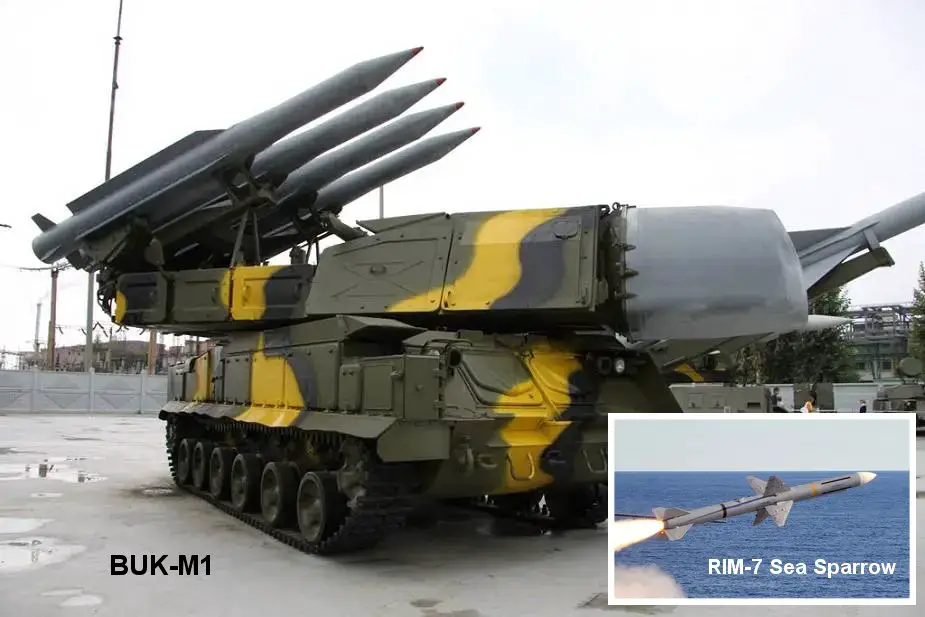
The FrankenSAM project uses components of Russian Buk-M1 and RIM-7 Sea Sparrow (Picture source DVIDS)
The FrankenSAM program is a joint initiative between Ukraine and the United States, aimed at enhancing Ukraine's air defense capabilities against increased aerial threats, including those from Russian forces. This innovative approach involves the integration of advanced American missile technology with Soviet-era launchers and radars to develop cost-effective and efficient air defense systems.
One of the primary variants of this program combines the Soviet Buk tracked chassis with American RIM-7 Sea Sparrow short-range anti-aircraft missiles, recently suppl. The BUK-M1 system, known as SA-11 Gadfly in NATO terms, typically features a radar and a launcher with four missiles capable of firing 9M38 and 9M38M1 missiles. The integration of the American RIM-7 Sea Sparrow short-range anti-aircraft missiles, originally designed for naval use, into this land-based system marks a significant innovation. Developed in the 1960s, the Sea Sparrow is a radar-guided missile that uses semi-active radar homing to track and engage fast-moving targets. It has an operational range of approximately 18.5 to 50 kilometers.
Another key variant involves merging Soviet-era radars with AIM-9M Sidewinder short-range air-to-air missiles. The AIM-9M, part of the larger Sidewinder missile family, is distinguished by its infrared homing guidance and enhanced resistance to countermeasures. With an effective range of around 8 to 10 kilometers, this missile is known for its high maneuverability and reliability in combat situations. Adapting the AIM-9M for use with ground-based radar systems is a notable advancement, enabling Ukrainian forces to effectively utilize existing infrastructure to target and neutralize aerial threats, particularly in close-range engagements.
These FrankenSAM systems have undergone extensive testing in the United States, before a deployment in Ukraine. The strategic significance of these systems has been emphasized by defense officials, highlighting their role in addressing critical gaps in Ukraine's air defense capabilities. The concept of modernizing Soviet-made systems is not new. In 2011, missile manufacturer MBDA demonstrated a modernized version of the Czech Army's SA-6 Gainful system, replacing Russian Kub launchers with Aspide 2000 Missile launchers, thereby significantly enhancing its capabilities. The effectiveness of such upgrades is exemplified by the upgraded 2K12 KUB, capable of engaging targets up to 12 km away at speeds reaching Mach 1.8.
The FrankenSAM program represents a pragmatic and innovative approach to bolstering Ukraine's air defense capabilities. By merging advanced American missile technology with Soviet-era defense infrastructure, the program not only repurposes existing resources but also introduces significant advancements in air defense technology. The integration of RIM-7 Sea Sparrow and AIM-9M Sidewinder missiles into Soviet-era systems illustrates a strategic blend of resourcefulness and international collaboration, aiming to address the evolving military challenges in Ukraine.
Defense News January 2024
- Hits: 3389