










Caribbean Free-Fall Exercises Reveal Shifting U.S. Marines Readiness Near Venezuela.
U.S. Marines from the Maritime Special Purpose Force (MSPF) of the 22nd Marine Expeditionary Unit (Special Operations Capable) carried out military freefall training at Camp Santiago, Puerto Rico, on October 27, 2025, boarding CH-53E Super Stallion helicopters from VMM-263 (Reinforced) for jump operations. The drills come as the Iwo Jima Amphibious Ready Group and 22nd MEU operate in a wider US naval buildup in the Caribbean that is officially aimed at narcotrafficking but is widely read as added pressure on Venezuela.
On October 27, 2025, Marines from the Maritime Special Purpose Force of the 22nd Marine Expeditionary Unit (Special Operations Capable) conducted military freefall training at Camp Santiago, Puerto Rico, as reported by the 22nd MEU on X and by the U.S. Defense Visual Information Distribution Service (DVIDS). Against the backdrop of a broad U.S. naval buildup in the Caribbean and rising friction with Venezuela, the images of heavily equipped Marines moving toward a CH-53E Super Stallion heavy-lift helicopter resonate far beyond routine training. The drills underscore how special operations-capable Marine units are being honed for rapid, discreet intervention across a volatile maritime theater. For regional partners worried about narcotrafficking and potential spillover from the Venezuelan crisis, this type of training is a visible signal of sustained U.S. commitment to security in the hemisphere.

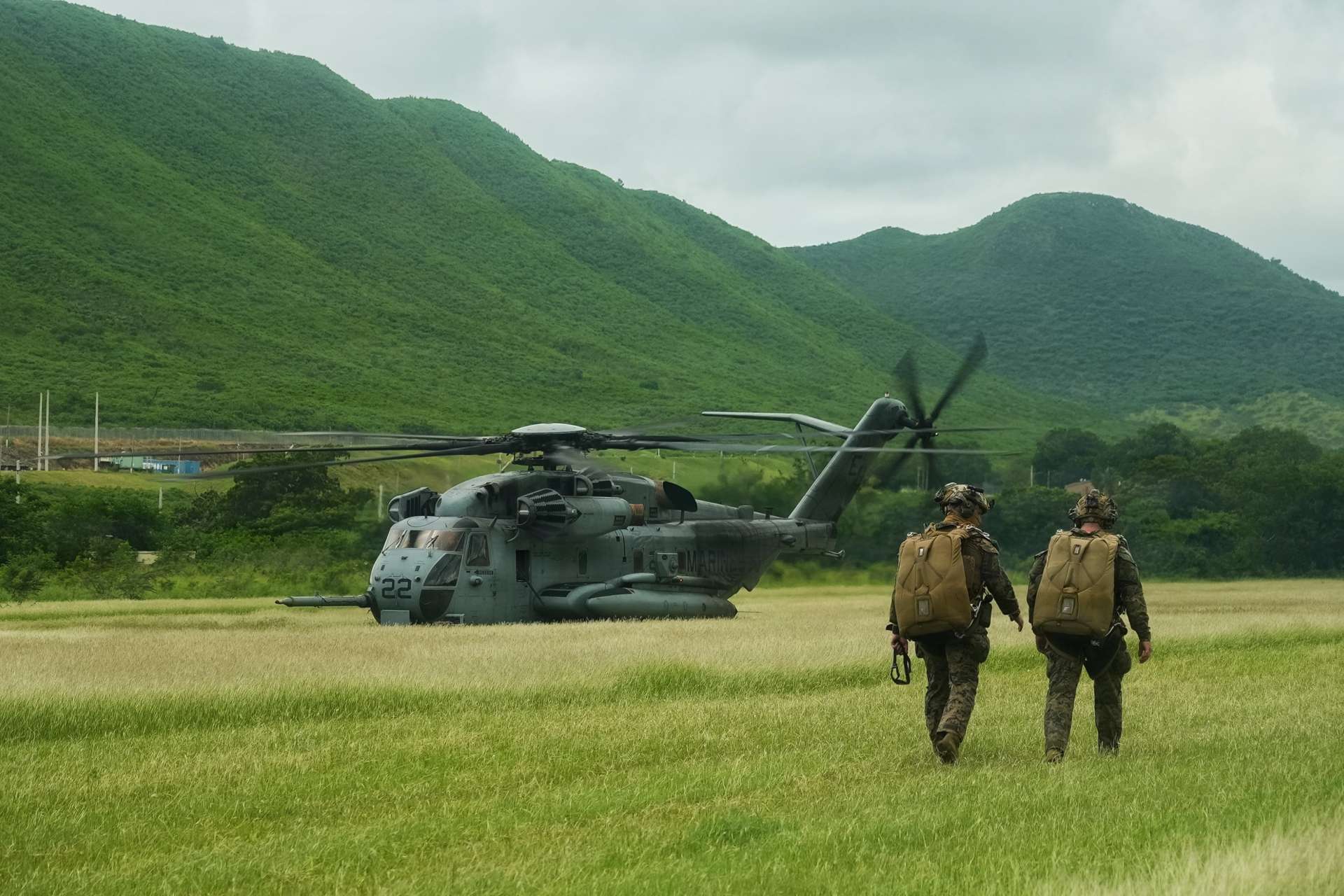
U.S. Marines crossing a field toward a spinning CH-53E under the green hills of Puerto Rico captures a quiet but unmistakable message: the United States is cultivating an agile, expeditionary force posture in the Caribbean at a time when relations with Venezuela are entering one of their most volatile phases in décades (Picture Source: U.S. Marines)
The defense capability showcased in Puerto Rico rests on the combination of the CH-53E Super Stallion and a freefall-qualified Maritime Special Purpose Force. The CH-53E, a three-engine heavy-lift helicopter designed by Sikorsky, can transport large teams of Marines, heavy equipment or vehicles over significant distances, embark from amphibious ships, and operate from austere landing zones similar to the grassy field depicted at Camp Santiago. Its ability to insert or extract forces in confined terrain, including mountainous and littoral environments, remains central to Marine expeditionary doctrine. In parallel, the MSPF element of the 22nd MEU(SOC) is trained for specialized missions such as direct action, maritime interdiction, sensitive site exploitation and high-risk personnel recovery, using capabilities such as high-altitude military freefall to approach objectives with reduced signature.
Operationally, the Puerto Rico deployment reflects a broader, ongoing adaptation by the 22nd MEU(SOC) and other U.S. Marine formations designated as special operations capable. Since the 1990s, these MEUs have sustained organic, composite force packages, infantry, aviation, logistics, and specialized enablers, designed for rapid transition from sea to shore. The CH‑53E has supported such units across theaters from the Middle East to Africa and remains in service as the CH‑53K is introduced into the fleet. Military freefall has evolved from a niche capability into a routine proficiency within selected Marine and joint special operations units, enabling high‑altitude, long‑stand‑off insertions. In the current deployment, the 22nd MEU(SOC) is assigned to U.S. Southern Command, with forces deployed throughout the Caribbean to disrupt illicit drug‑trafficking networks and to support missions that protect the U.S. homeland.
Tactically, the combination of a ship-borne heavy-lift platform like the CH-53E and military freefall-qualified Marines offers a flexible menu of options. Freefall insertion from fixed- or rotary-wing aircraft allows small teams to arrive undetected, bypassing coastal defenses, radar coverage or dense urban approaches that could compromise conventional air assault profiles. Once on the ground, those teams can mark landing zones, seize key infrastructure, or conduct reconnaissance in support of follow-on helicopter lifts. The CH-53E, able to carry substantial internal loads or sling heavy external cargo, then becomes the backbone of rapid reinforcement, casualty evacuation or non-combatant evacuation. In counter-narcotics operations, the same toolkit can be applied to boarding high-value vessels, securing clandestine airstrips or interdicting logistics hubs in remote terrain. For commanders, this “product combination” of precision insertion and massed lift adds depth to contingency planning, enabling calibrated responses that range from covert disruption of trafficking networks to more overt shows of force.
Strategically, these drills carry significant importance amid the escalating confrontation between Washington and Caracas. In recent months, the United States has substantially increased its naval and air presence in the Caribbean, officially to combat drug trafficking but increasingly viewed as a pressure tactic against President Nicolás Maduro’s government. U.S. forces have executed lethal strikes on suspected smuggling vessels near Venezuela while designating purported Venezuelan “narco-terrorist” networks as terrorist organizations, with the option of operations on Venezuelan soil not being ruled out. Caracas condemns these actions as a pretext for regime change and has responded by intensifying military exercises, rhetoric, and leveraging territorial disputes with Guyana to rally internal support. Within this context, the U.S. Marines training in Puerto Rico are not solely focused on counter-narcotics missions but are also honing capabilities essential for crisis scenarios involving the protection of U.S. citizens, critical infrastructure, or allied partners facing Venezuelan coercion.
The image of two Marines crossing a field toward a spinning CH-53E under the green hills of Puerto Rico captures a quiet but unmistakable message: the United States is cultivating an agile, expeditionary force posture in the Caribbean at a time when relations with Venezuela are entering one of their most volatile phases in decades. By pairing heavy-lift aviation with highly trained freefall-capable Marines, the 22nd MEU(SOC) offers U.S. and regional decision-makers precise, rapidly deployable tools for deterrence, crisis response and counter-narcotics operations alike. Whether this strengthened posture helps stabilize the Caribbean security environment or contributes to further escalation with Caracas will depend less on the capabilities on display at Camp Santiago than on the political choices made in Washington and Caracas in the months ahead.
Written by Teoman S. Nicanci – Defense Analyst, Army Recognition Group
Teoman S. Nicanci holds degrees in Political Science, Comparative and International Politics, and International Relations and Diplomacy from leading Belgian universities, with research focused on Russian strategic behavior, defense technology, and modern warfare. He is a defense analyst at Army Recognition, specializing in the global defense industry, military armament, and emerging defense technologies.