
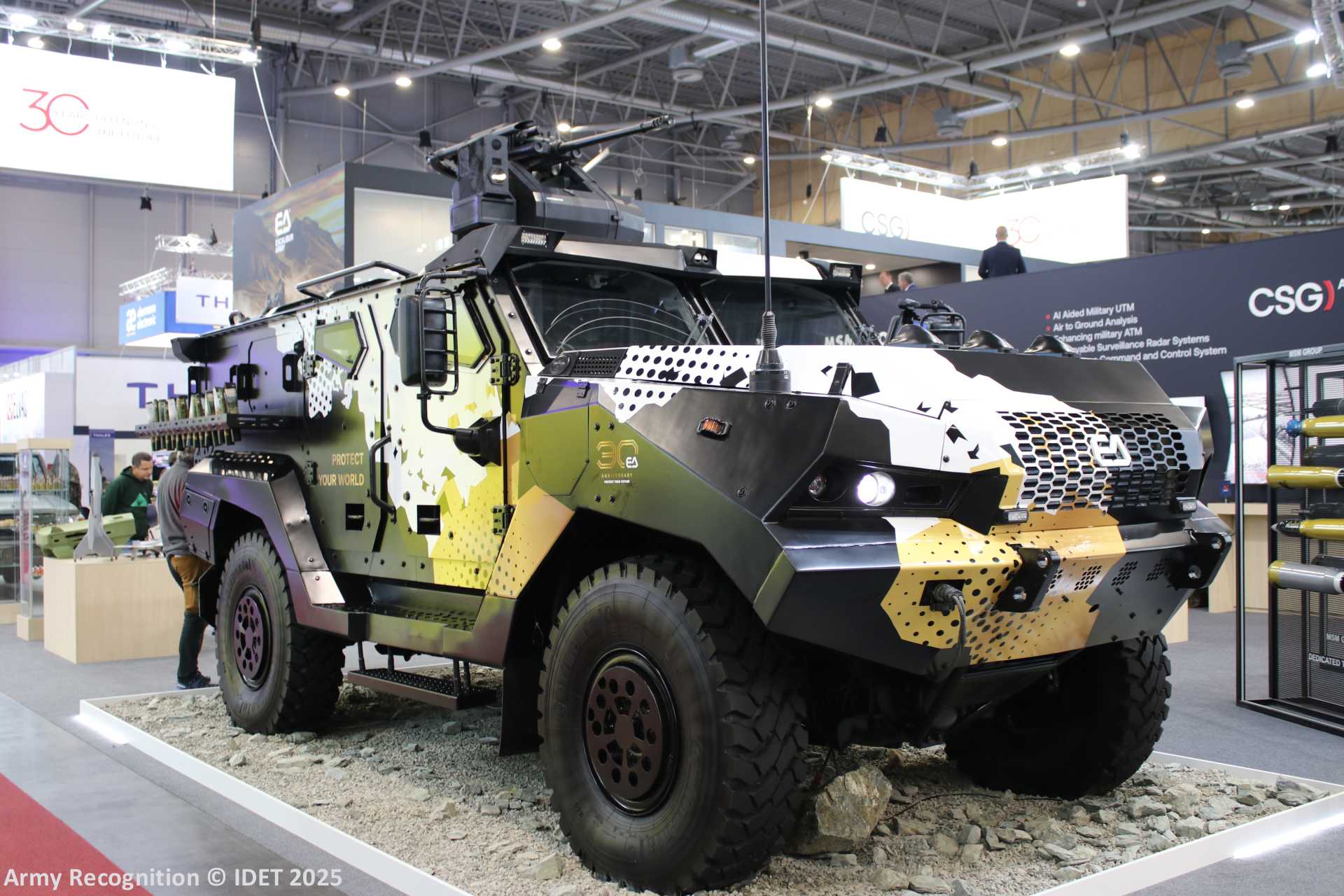










IDET 2025: Czech Patriot II armored vehicle now counter drones with Turkish-made Trakon 30 weapon station.
At the IDET 2025 defense exhibition in Brno, the Czech company Excalibur Army presented the latest configuration of its Patriot II 4x4 armored vehicle. This new version is equipped with the Turkish-made Unirobotics Trakon 30 remote-controlled weapon station (RCWS), which integrates the Venom LR 30x113 mm revolver cannon. The system was shown in both static and dynamic formats during the event, demonstrating its compatibility with the modular Patriot platform. This configuration reflects the company's continued development of the Patriot series as a multi-role wheeled armored platform, suitable for various mission profiles and customer-specific requirements.
Follow Army Recognition on Google News at this link

This new version of the Patriot II 4x4 is equipped with the Turkish-made Trakon 30 remote-controlled weapon station (RCWS), which integrates the Venom LR 30x113 mm revolver cannon. (Picture source: Army Recognition)
The Patriot vehicle family is part of a broader modernization effort aimed at enhancing the operational flexibility and survivability of land forces within NATO and partner countries. Designed by Excalibur Army and based on a Tatra 4x4 chassis, the platform supports a range of configurations, including command and control, chemical and biological reconnaissance, casualty evacuation, and fire support. Since its first public unveiling in 2019, the Patriot has been adapted to serve both military and civil security roles, including firefighting and law enforcement. Current trials of the Patriot II are ongoing in Brazil for police forces and in Slovakia for army use. Excalibur Army has also indicated its intention to offer several engineering and military police variants to the Czech Armed Forces. The integration of advanced remote weapon systems into this vehicle family aligns with operational trends emphasizing unmanned targeting, modular protection, and interoperability across mission types.
The Patriot II weighs between 13.5 and 18 tons, depending on protection levels and mission equipment. It measures 6,250 mm in length, 2,550 mm in width, and between 2,700 and 2,800 mm in height. The vehicle’s driveline is based on Tatra’s backbone tube chassis and swing half-axles, enabling high off-road mobility and stability across challenging terrain. Powerplant options include a 270 kW Cummins ISL water-cooled engine and a 325 kW Tatra T3C-928-90 air-cooled engine, both compliant with Euro III standards. These configurations allow a maximum road speed of 110 km/h and an off-road speed of up to 45 km/h. The vehicle’s cruising range exceeds 600 km. Ground clearance can be adjusted by 70 mm upward or 100 mm downward while driving, using the onboard air suspension system. The cabin accommodates up to eight personnel, depending on internal configuration and role-specific equipment.
The Patriot II’s armored hull follows the Kitted Hull Concept and can be configured to meet ballistic protection levels 2, 3, or 4 under STANAG 4569. Mine protection can be set to levels 2a/2b or 3a/3b. The vehicle’s internal layout includes anti-mine seats, a shock-absorbing suspended floor, and a dual fire suppression system for the engine and crew compartments. A combined air conditioning and NBC filtration system enables operations in chemically or biologically contaminated environments. The platform allows for the mounting of manned or remote-controlled turrets, including machine guns up to 14.5 mm, 20 mm automatic cannons, grenade launchers, anti-tank missile systems, and mortars. Mission role kits are designed for quick interchangeability, providing flexibility for deployment in different operational contexts.
The Turkish-made Trakon 30 RCWS, developed by Unirobotics, a subsidiary of Samsun Yurt Savunma (SYS), is engineered for integration on armored vehicles such as the Patriot II. This system is equipped with the Venom LR revolver cannon, chambered for 30x113 mm ammunition. The Venom LR, originally developed by AEI Systems and now part of CANiK’s product line, operates using a revolver mechanism and is capable of a firing rate between 220 and 1,300 rounds per minute. The cannon supports a variety of ammunition types, including those with proximity fuses intended for engaging aerial targets such as unmanned aerial vehicles (UAVs). The Trakon system includes a fire control system and offers optional integration with counter-UAS radar. It supports both day and night operations and is designed for use in complex operational environments, including urban and asymmetric conflict zones. Unirobotics also developed the RCWS with stabilization features and electro-optical targeting systems to increase accuracy and responsiveness.
The integration of Counter-Unmanned Aerial Systems (C-UAS) capabilities into armored vehicles has become increasingly prevalent due to the growing threat posed by drones on the battlefield. Recent conflicts, notably in Ukraine, have demonstrated how inexpensive drones can significantly reduce the survivability of armored units. In response, armed forces worldwide are equipping their armored vehicles with a growing number of counter-drone systems, including remote-controlled weapon stations, directed energy weapons, electronic warfare systems, and kinetic interceptors. The integration of the Trakon 30 RCWS with the Venom LR revolver cannon into the Patriot II platform now provides the Czech defense industry with a system that aligns with such operational demands. The use of a non-ITAR-controlled weapon system also reflects a deliberate decision to avoid the restrictions associated with U.S.-sourced defense equipment, enhancing export flexibility and potentially accelerating procurement timelines for foreign customers.
The incorporation of C-UAS capabilities also introduces new operational advantages, as these vehicles now serve dual roles, which increases their relevance in both current and future conflicts. For instance, the Canadian Roshel Senator C-UAS vehicle integrates Leonardo’s Falcon Shield system, offering a modular suite capable of detecting, tracking, and mitigating drone threats using radar, electro-optical sensors, and electronic warfare measures. In Europe, Spain’s Escribano has converted the Vamtac ST5 into a comprehensive C-UAS platform, featuring a 360-degree surveillance system and a remote weapon station capable of engaging aerial targets. Therefore, the Patriot II C-UAS not only provides immediate protection against drone incursions but also enhances its relevance for national and international missions, including border security, urban defense, and peacekeeping operations.