






Breaking News





North Korea Unveils New M2020 8x8 Mortar Carrier Echoing US M1129 Stryker.
North Korea showcased a new self-propelled mortar on its M2020-series 8x8 chassis at the Defence Development-2025 exhibition in Pyongyang, according to state media coverage of the show. The design appears to follow the proven 120 mm “under-armor” mortar concept used on U.S. Stryker M1129 and France’s Griffon MEPAC, promising faster “shoot-and-scoot” for wheeled units if similarly equipped.
KCNA-linked outlets and DPRK newspapers reported the Defence Development-2025 exhibition opened in Pyongyang on Oct. 4, where Kim Jong Un inspected new systems; imagery from the hall indicates an 8x8 self-propelled mortar on the M2020 family chassis. The update includes a rear fighting compartment reconfigured for indirect fire, consistent with a 120 mm tube and assisted loading, mirroring Western “fire-on-halt” concepts. A mobile, under-armor 120 mm mortar would increase North Korea’s ability to mass fire quickly and relocate before counter-battery.
Follow Army Recognition on Google News at this link
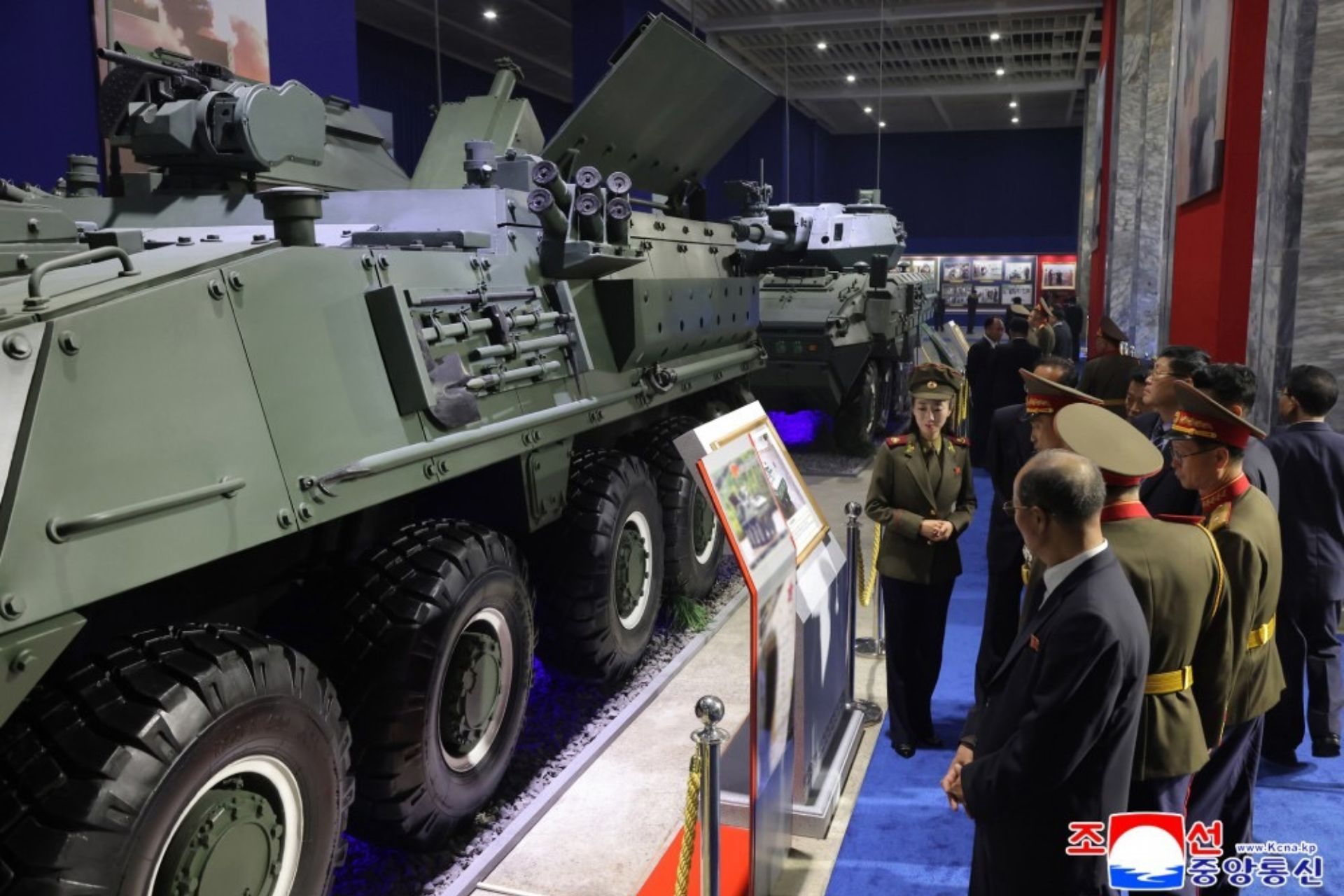
M2020 8x8 mortar carrier presented at Defence Development 2025 in Pyongyang. (Picture source: KCNA)
The vehicle adopts the lines of a Stryker type 8x8 already seen in North Korea with other payloads and appears derived from a common base platform developed into direct fire and anti-tank variants. The advantages of this shared base are visible in the silhouette, the ride height, the large rear stowage volume, and the roof access that aids the employment of onboard fire systems. This modular logic has been documented in recent months on the North Korean 8x8 chassis, including a 105 mm gun variant and a Bulsae anti tank missile carrier.
The core of the system is the mortar. Internationally, a 120 mm weapon mounted in an armored vehicle provides wheeled units with dense indirect fire that is quick to employ and more survivable than towed pieces. The most intuitive reference remains the US M1129 in the Stryker family which fires a 120 mm mortar from under armor and uses a dedicated fire control system to achieve very short halt fire move cycles. Open technical literature notes the existence of an underarmored firing version and its evolutions on the Stryker chassis with reinforced structural elements to absorb recoil. This framework indicates what Pyongyang is seeking with its 8x8 mortar solution.
North Korea fields a very large inventory of roughly 7,500 mortars, mostly in 82 mm, 120 mm and 160 mm calibers, integrated into a doctrine of massed fires and saturation at short and medium range with dense coverage down to battalion level. For mobility the use of VTT 323s and a broad truck fleet enables rapid deployment of mortar sections and shoot and scoot tactics including hatch-fired carrier versions and a 120 mm gun mortar of the Nona type on a tracked chassis. Until now, nothing indicated a comparable wheeled carrier system.
The comparison with the French Griffon MEPAC is also relevant. MEPAC integrates the Thales 2R2M rifled 120 mm mortar with semi-automatic loading, advertised at up to ten rounds per minute in public sources and a range on the order of 8 to 13 km, depending on ammunition all within a 6x6 cell with powered roof panels and digitized navigation and fire control. The concept transfers readily to the North Korean 8x8 seen in Pyongyang, enter position quickly, deliver an initial salvo on coordinates or external designation, correct if needed then depart before counter battery.
Caution remains necessary on the chassis itself. In the absence of official data, typical figures for an 8x8 of this size would be a weight around twenty tonnes, highway cruise of near 90 to 100 km h, and baseline protection against small arms and shell splinters with optional kits by mission. The rear compartment freed from the bench layout of a true IFV would hold 120 mm bomb charges and fuzes with racks, a small spares pack and control electronics. The roof panels visible in the imagery point more to an internal well with assisted loading than to a fully enclosed mortar turret. This option is simpler to produce and consistent with local series production. At this stage, there are no official numbers for range rate of fire or the integration of navigation and laying aids so the assessment rests on technical analogy not certainty.
The North Korean chassis appears closer to a polyvalent 8x8 developed in several versions which increases military utility by pooling maintenance, training and supply chains. The gains are faster reaction and better logistical endurance than towed mortars while keeping high road speed. Actual performance remains unknown in the absence of published figures for automation, fire control and accuracy.
A North Korean caveat remains. The real capabilities of this 8x8 mortar carrier are unknown, no public figures on automation C2 architecture, first salvo accuracy, or drivetrain robustness. The images show a careful integration and a level of finish compatible with limited introduction, yet the lack of interior views and firing demos calls for caution. The exhibition serves as both a technology window and a strategic message, which also argues for restraint. In short, the system borrows from Stryker and MEPAC the essential operational grammar but its exact performance is not yet visible. The public showings fix the scene rather than the details.
Overall, this 8x8 mortar carrier follows a clear logic, standardizes a chassis, multiple variants and provide wheeled maneuver units with mobile, reactive, digital-ready indirect fire. The observed architecture aligns with practices seen on the US M1129 and the French MEPAC, which supports the hypothesis of an onboard 120 mm with an optimized firing cycle. The open questions concern range accuracy and C2 integration, which will determine battlefield effectiveness. Until those variables are clarified, the assessment should remain measured. The concept is sound, the conceptual borrowing is evident and the military value will depend on execution and production.