










Report: US Japan Integrate NMESIS Anti-ship System and MADIS Air Defence Near Taiwan in Clear Signal to China.
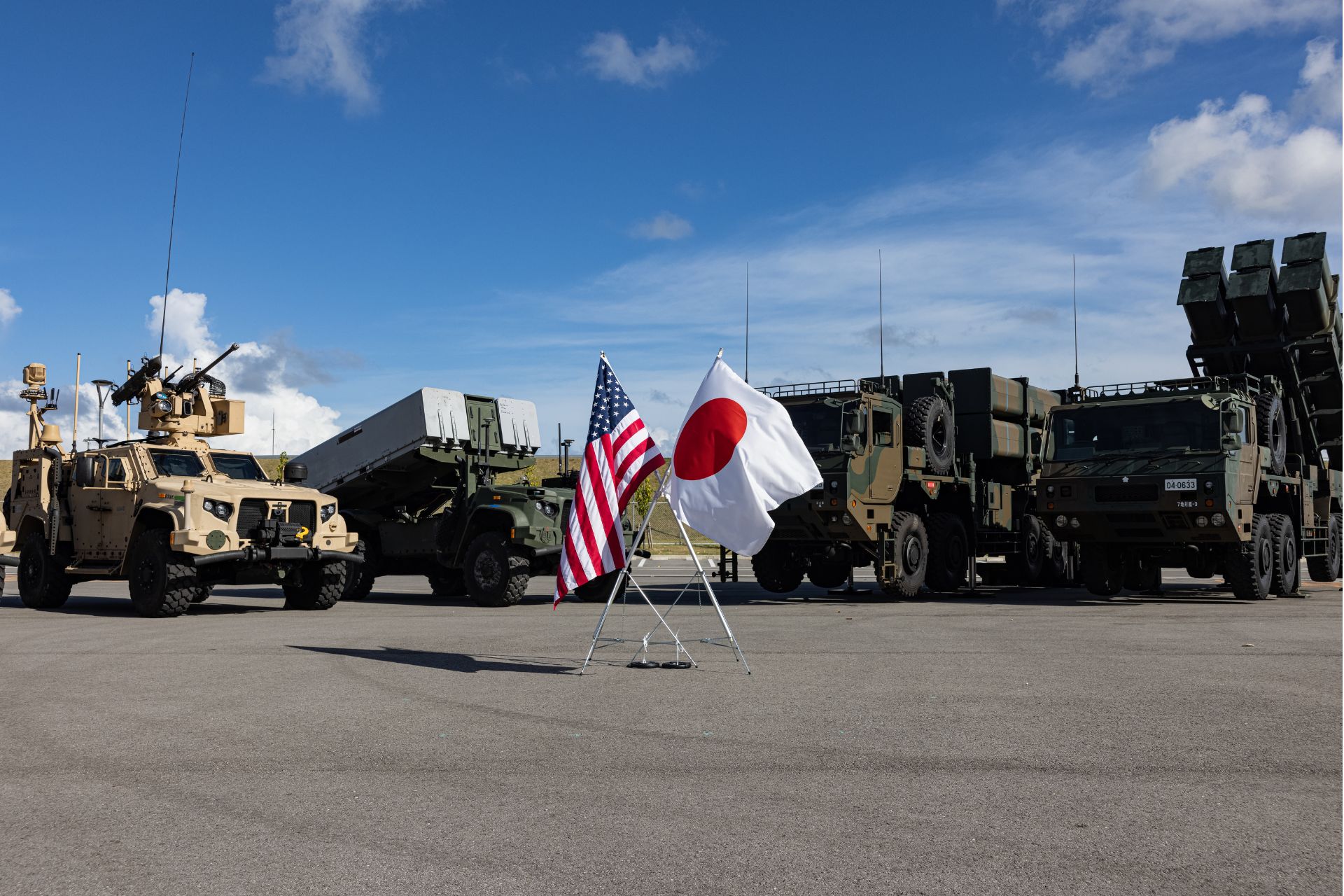
On September 17, 2025, the U.S. Marine Corps and the Japan Ground Self-Defense Force presented side by side their main missile systems, including the Navy-Marine Expeditionary Ship Interdiction System (NMESIS), the Marine Air Defense Integrated System (MADIS), the Type 12 Surface-to-Ship Missile, and the Type 03 Medium-Range Surface-to-Air Missile. The presentation took place during Exercise Resolute Dragon 25 at Camp Ishigaki on Ishigaki Island and brought together Lt. Gen. Roger Turner, commanding general of III Marine Expeditionary Force, and Lt. Gen. Seiji Toriumi, commanding general of the Western Army.
Follow Army Recognition on Google News at this link

Behind the two commanders during the press conference, four systems had been deliberately positioned to highlight current defense priorities. The NMESIS, a vehicle-mounted anti-ship system, is based on the ROGUE Fires Carrier derived from the Joint Light Tactical Vehicle (JLTV) chassis and employs the Naval Strike Missile (NSM). This subsonic cruise missile, with a range of about 185 km, follows a sea-skimming flight path to reduce detection and uses multi-mode guidance combining INS, GPS, and infrared sensors for accuracy within ten meters. Entering service in 2021, NMESIS represents the Marine Corps’ first ground-based anti-ship capability and is part of the Force Design 2030 concept, aimed at reinforcing expeditionary operations in littoral zones.
Alongside it, the MADIS (Marine Air Defense Integrated System) was displayed as the Marine Corps’ new generation ground-based air defense capability. Developed to provide a modernized layer of protection, it defends expeditionary bases and maneuver units against both traditional and emerging aerial threats. Mounted on a JLTV, the system is composed of two complementary vehicles: the MADIS Mk1 and the MADIS Mk2. The Mk1 is armed with Stinger missiles and a 30 mm cannon designed to neutralize aircraft and helicopters. The Mk2 is optimized for counter-drone operations, equipped with the RPS-62 S-band radar and the command-and-control functions for the section. Together, these vehicles detect, identify, and intercept aircraft, helicopters, cruise missiles, and unmanned aerial systems, providing a short-range protection layer in contested environments.
On the Japanese side, the Type 12 Surface-to-Ship Missile (SSM), manufactured by Mitsubishi Heavy Industries and introduced in 2015, represents the latest stage in coastal defense modernization. Measuring 5 meters in length with a mass of 700 kg and a diameter of 350 mm, it carries a high-explosive warhead intended to strike surface ships. Its initial version had a range of 200 km, later extended to 400 km when launched from naval or aerial platforms. Japan is developing future variants capable of reaching up to 1,000 km, which would considerably expand its strike depth. Guidance relies on inertial navigation, GPS, and terminal Ka-band AESA radar homing, providing precision in contested electromagnetic conditions. Mounted on truck launchers from Mitsubishi or Oshkosh, the system can be deployed quickly along coastlines to secure approaches and conduct land-attack missions in its upgraded versions. Alongside it, the Type 03 Medium-Range Surface-to-Air Missile provides medium-range air defense coverage, essential for protecting facilities and ground units. Together, these systems reflect a complementary approach: the Marines contribute mobility and precision strike capabilities, while Japanese forces add depth in coastal and air defense.
By presenting the equipment along with the units operating them, the Marines underscored the operational readiness of their new capabilities. The message conveyed by Turner and Toriumi was explicit: Resolute Dragon 25 is not just a technical exercise but a signal to regional actors. As Turner noted, these demonstrations are meant to “send a clear message to any attempt to undermine regional security.”
Resolute Dragon, held annually in Japan, has become a key framework for bilateral cooperation. The 2025 edition focused on island defense, a particularly sensitive issue due to Okinawa’s geography and its proximity to Taiwan and the disputed Senkaku Islands. The area lies at the center of strategic rivalry with China, which contests Japanese claims over the Senkaku and continues to increase naval and aerial activities in the region. For Tokyo, the objective is to secure sea lines of communication and prepare the defense of its most exposed islands. For Washington, the priority is to demonstrate the credibility of its commitment to the Indo-Pacific and to train Marines for dispersed operations where mobility and resilience outweigh mass.
The choice of Ishigaki as the demonstration site carried specific weight. Located about 270 kilometers from Taiwan, the island is a key position for any regional defense plan. Displaying the new missile systems there, capable of threatening adversary naval units and securing surrounding airspace, amounted to a public statement of allied ability to control straits and sea lanes. In a potential Taiwan crisis, a combination of American NMESIS and Japanese Type 12 systems would provide dense anti-ship coverage, while MADIS and the Type 03 SAM would protect against aerial threats.
This complementarity is exactly what both forces are seeking to achieve. The Marines emphasize their Expeditionary Advanced Base Operations (EABO) concept, deploying light units to forward positions capable of firing and then relocating quickly to avoid targeting. Japanese forces, meanwhile, are strengthening island defense in line with a deterrence strategy designed to complicate any Chinese military operation in the region. Resolute Dragon 25 provided a practical environment to test this integration, from joint planning to system interoperability.
Beyond the technical aspect, the exercise carries political significance. Washington and Tokyo aim to display unity and show that their alliance is adapting to evolving threats. By presenting these systems to international media, both sought to reinforce deterrence credibility and signal to Beijing that any challenge to the regional status quo would face a coordinated response. Turner stressed that the exercises were not aimed at any specific country, but the location, the systems on display, and the overall context clearly pointed to the strategic backdrop of China’s growing activity in the East China Sea and Taiwan Strait.
The regional context gives weight to such demonstrations. China continues to increase air and naval patrols around Taiwan and the Senkaku while developing its own long-range missile capabilities. In this environment, the sight of U.S. and Japanese forces deploying and displaying their weapons on an island located only a few hundred kilometers from Chinese shores sends a strong message. Beijing may view it as a provocation, but for both allies, it primarily represents a demonstration of preparedness and resolve.