






Breaking News






Serbia’s 120 mm kit turns stock mortar rounds into drone-carried guided munitions at Partner 2025.
The Serbian Ministry of Defence displayed a guidance kit at PARTNER 2025 in Belgrade that converts existing 120 mm mortar rounds into guided munitions. The kit is pitched as a lower-cost way to add precision to stockpiled rounds and can be carried by several types of drones, expanding tactical employment options.
At the Partner 2025 exhibition in Serbia, the Serbian Ministry of Defence displays a guidance kit intended to convert existing 120 mm mortar rounds into guided munitions. The system is presented as a lower-cost option for precision strikes that repurposes rounds already in stock. Its design allows carriage by several types of drones, increasing employment flexibility and expanding the tactical profiles available to units that use it.
Follow Army Recognition on Google News at this link
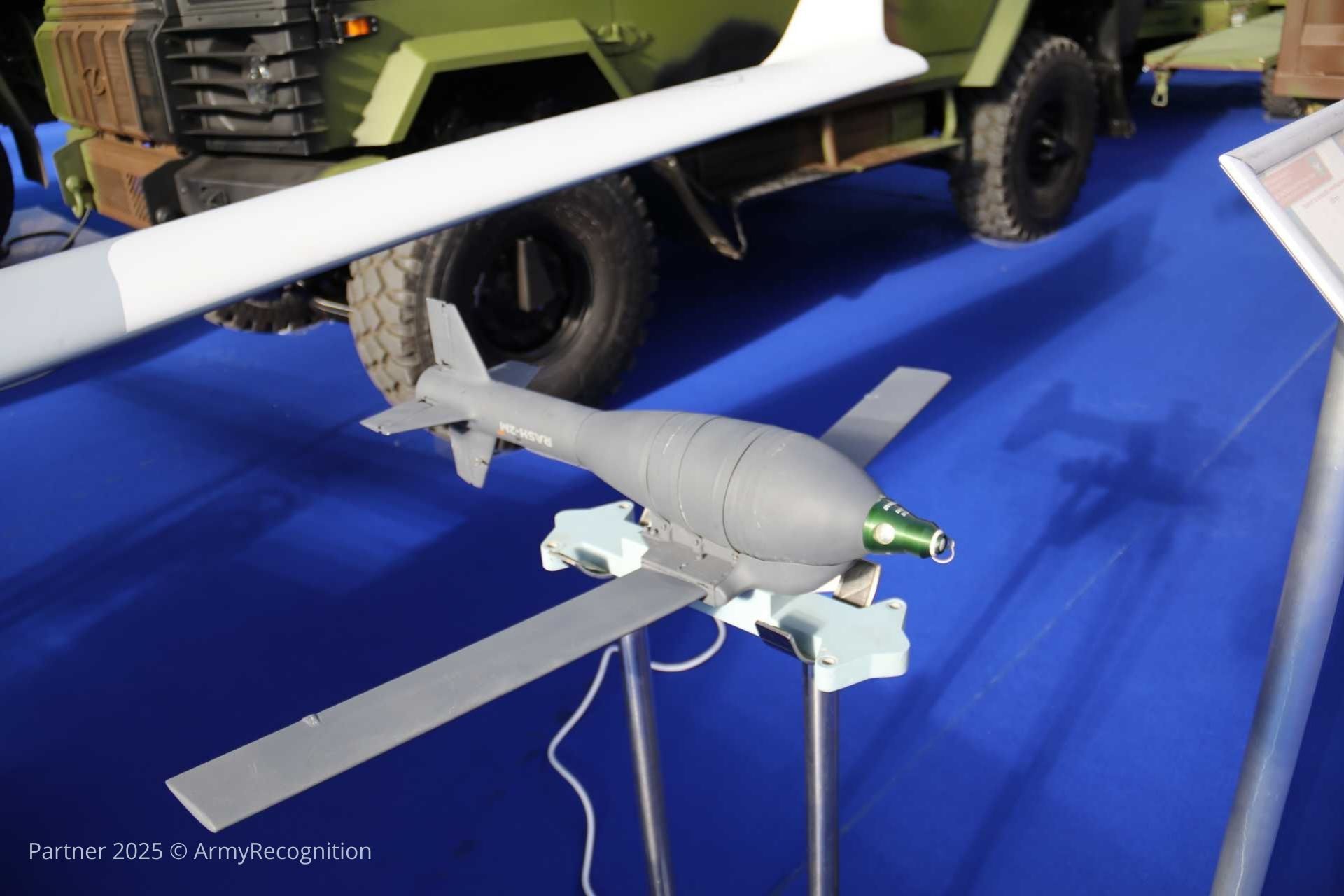
The device can engage coordinates programmed before release or coordinates transmitted in real time by an electro-optical payload carried by a UAV, thus enabling employment against both fixed targets and targets designated from the air. (Picture source: Army Recognition)
The system’s technical operation is described in straightforward terms. After release, the round deploys wings that extend its range and alter its trajectory compared with a purely ballistic path. Guidance is fully autonomous and combines a GPS receiver with an inertial navigation system. The device can engage coordinates programmed before release or coordinates transmitted in real time by an electro-optical payload carried by a UAV, thus enabling employment against both fixed targets and targets designated from the air. The complete assembly mounted on a round weighs 14.5 kg, has an approximate wingspan of 1 metre when deployed, and is reported to reach a range of about 9 km when released from an altitude of 3 000 metres; its maximum operational speed is indicated at 150 metres per second.
The operational value of such a system appears on several complementary levels. First, it converts volumes of conventional mortar rounds into directed strike capability without resorting to costly munitions manufactured specifically for that purpose. Second, adaptation to light aerial platforms, notably drones, reduces dependence on heavy platforms and lowers the logistics required to project precision effects on the battlefield. Third, the capacity to engage point targets limits the need for saturation fires, which can conserve resources and reduce collateral damage where rules of engagement require restraint.
Tactically, adding guidance to a 120 mm round fits a range of scenarios. In counterinsurgency operations or fights against irregular armed groups, target discrimination and minimization of civilian harm become priorities, and these munitions provide a means to address discrete objectives. In contexts where air superiority is contested or access to conventional artillery is constrained, the use of discreet aerial vectors carrying this type of payload permits strikes from lower or more distant approach profiles, potentially reducing exposure for supporting units. Finally, possible integration with civilian or military drone fleets increases capability modularity: the same kit can be used by different classes of platforms, which eases tactical implementation.
These possibilities come with limits and operational risks. Reliance on GPS makes the munition vulnerable to jamming and spoofing, while the INS, although robust, can accumulate drift over long trajectories without external updates, affecting terminal accuracy. From an industrial standpoint, the approach reflects stock optimisation and rapid capability enhancement: by combining simple mechanical elements, such as wing deployment, with standardised electronic modules, production and maintenance can be made more cost-efficient.