
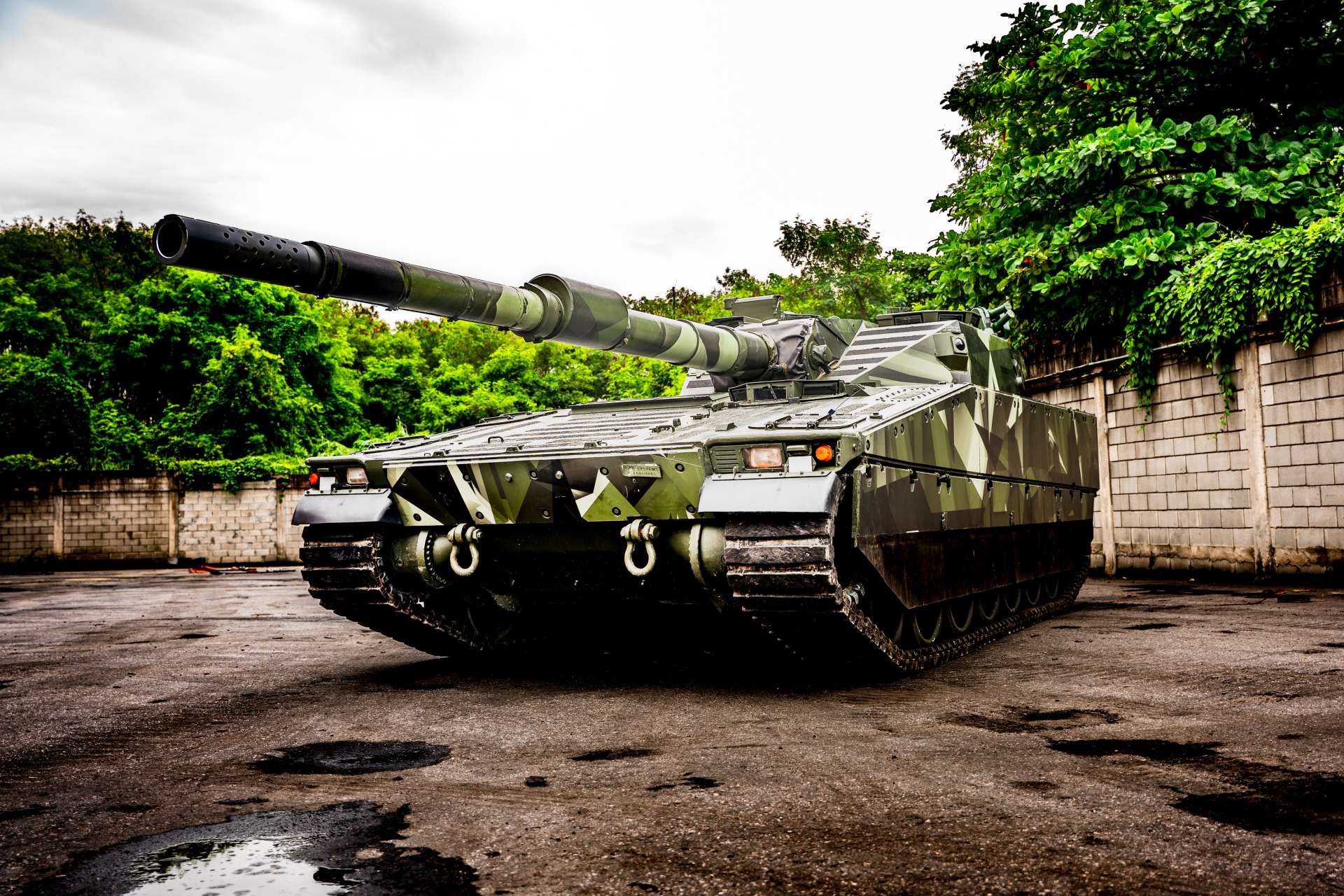










Slovakia evaluates light tanks choosing between BAE's CV90120 and a Turkish-made tank.
Slovakia’s defence minister Robert Kaliňák said the country is evaluating two platforms for a future tank fleet: the British-Swedish CV90120 and a Turkish-made tank.
On September 24, 2025, Slovak Defence Minister Robert Kaliňák said Bratislava is narrowing its search for a future tank to two candidates, according to the Slovak news agency Teraz. The shortlist features BAE Systems Hägglunds’ CV90120 and an unnamed Turkish-made vehicle. While the ministry has not identified the Turkish platform, the defense outlet TurDef reports the most likely contender is Otokar’s Tulpar. The announcement points to a deliberate shift away from heavyweight main battle tanks toward lighter, more economical mobile firepower.

The CV90120 represents a different but familiar path. Derived from the CV90 family in service across several NATO countries, the variant mates a high-pressure 120 mm main gun with a lighter tracked chassis (Picture source: BAE)
Speaking to reporters in Bratislava, Kaliňák described both options as still in development but offering a significant cost advantage over traditional MBTs. He said the proposed vehicles could be 40 to 50 percent cheaper to buy and sustain than legacy platforms, an argument that folds budget constraints and long-term upkeep into the core of the selection. He also emphasized the potential for partial production in Slovakia, framing the program as an opportunity to draw local industry into the supply chain and expand domestic capability.
The minister stopped short of naming the Turkish vehicle. Independent reporting from TurDef, however, points to the Tulpar, a modular armored chassis originally designed as an infantry fighting vehicle and adapted to mount a 120 mm smoothbore gun in a light tank configuration. The Tulpar’s modularity has made it a recurring presence in export discussions centered on mobile, survivable direct-fire support. If it advances in Slovakia’s process, it would mark a notable milestone for Türkiye’s defense industry in a Central European procurement.
The CV90120 represents a different but familiar path. Derived from the CV90 family in service across several NATO countries, the variant mates a high-pressure 120 mm main gun with a lighter tracked chassis. The concept aims to deliver MBT-class lethality with reduced weight, allowing easier deployment and better access in complex terrain where heavier vehicles are constrained. Although the CV90120 is not a standard production model, it has seen repeated prototype trials and live-fire demonstrations in Europe, building a track record that could weigh in its favor.
Kaliňák’s comments effectively rule out top-end MBTs such as the Leopard 2A8 or the K2PL Black Panther, signaling a doctrinal recalibration. For Slovakia, the current operational picture, marked by hybrid threats, dispersed forces, and the premium placed on mobility, appears to favor lighter vehicles that impose a smaller logistical footprint while retaining credible firepower. This line of thinking echoes a broader European debate over how to balance protection, cost, and agility amid evolving battlefield dynamics and tighter defense budgets.
Timelines remain a constraint. The minister cautioned that neither candidate is likely to be fielded for three to four years, underscoring the developmental nature of the offerings and the lead times for any local industrial participation. No budget ceiling or detailed financing plan has been made public, and no contract award is imminent. Even so, the emphasis on affordability and Slovak content suggests the eventual deal will be structured to feed a longer-term national industrial strategy as much as to equip frontline units.
The choice also carries diplomatic and industrial implications. Selecting the CV90120 would deepen ties with Sweden and the United Kingdom through BAE Systems, aligning Slovakia with a well-established Nordic-British supply network already embedded in NATO logistics. Opting for Tulpar would reflect a more diversified approach, tapping Türkiye’s expanding armored-vehicle ecosystem and its increasingly active role within the Alliance. Either path would shape future cooperation on training, upgrades, and munitions in ways that extend beyond the initial delivery.
In practical terms, both candidates promise a similar proposition, 120 mm direct-fire capability on a more mobile and affordable platform, yet they arrive with different pedigrees. The CV90 lineage brings a mature family vehicle with broad NATO use and an established sustainment base. Tulpar, by contrast, leverages modularity and export momentum from Ankara’s rising defense sector, positioning itself as a flexible chassis adaptable to national requirements, including potential Slovak production lines.
As Slovakia weighs these options, the debate captures a wider shift in European land warfare thinking. The calculus is less about replacing like for like and more about matching force structure to today’s operational problems: moving quickly, surviving in contested electromagnetic and drone-dense environments, and delivering precision firepower without the logistical burden of heavy armor. Whether the final choice lands on CV90120 or Tulpar, the signal from Bratislava is clear. Cost efficiency, mobility, and domestic industrial participation are set to shape the next generation of Slovak armored capability, with knock-on effects for the country’s supply chains and its profile inside NATO’s evolving land forces.
Written by Teoman S. Nicanci – Defense Analyst, Army Recognition Group
Teoman S. Nicanci holds degrees in Political Science, Comparative and International Politics, and International Relations and Diplomacy from leading Belgian universities, with research focused on Russian strategic behavior, defense technology, and modern warfare. He is a defense analyst at Army Recognition, specializing in the global defense industry, military armament, and emerging defense technologies.