
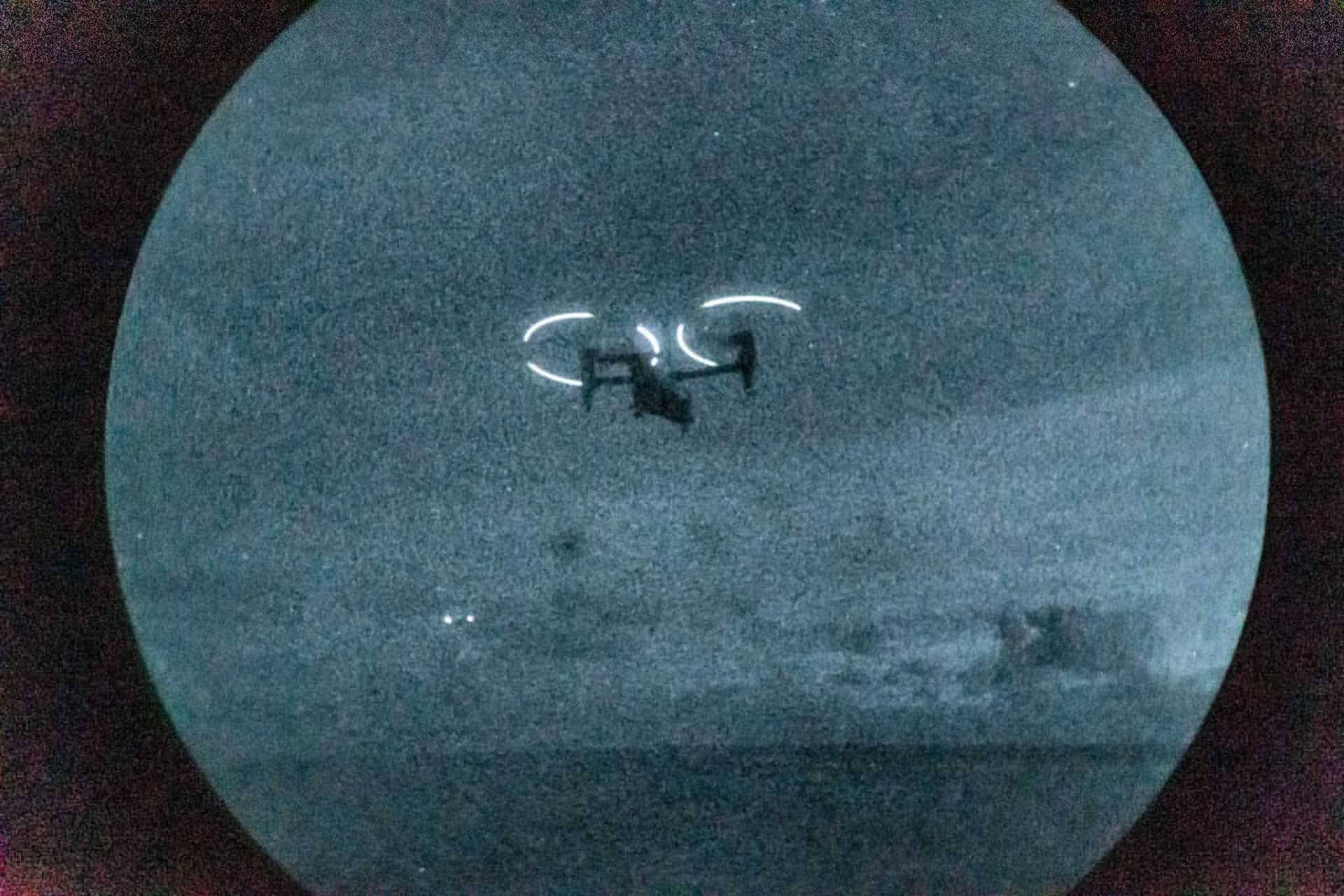










U.S. Marines MV-22B Ospreys conduct night operations in Caribbean Sea as Operation Southern Spear begins.
Citing information from U.S. Southern Command, MV-22B Osprey tiltrotor aircraft crews from the 22nd Marine Expeditionary Unit conduct night flight operations from the USS Iwo Jima in the Caribbean Sea. The flights mark early activity under Operation Southern Spear and reflect heightened U.S. readiness amid regional instability around Venezuela.
According to information published by U.S. Southern Command X account on November 15, 2025, U.S. Marine Corps MV-22B Osprey aircraft operated by the 22nd Marine Expeditionary Unit conducted night flight operations from the USS Iwo Jima in the Caribbean Sea. The activity followed the announcement of Operation Southern Spear, a new U.S. counternarcotics mission focused on disrupting cartel networks and improving regional security cooperation throughout the Western Hemisphere. The timing signals increased U.S. readiness as Venezuelan instability continues to create concerns about humanitarian crises, irregular armed groups, and potential threats to regional partners.
Follow Army Recognition on Google News at this link

Night-vision view of a U.S. Marine Corps MV-22B Osprey conducting night flight operations from USS Iwo Jima in the Caribbean Sea. (Picture source: U.S. Southern Command)
The 22nd MEU (Marine Expeditionary Unit) is currently deployed as a flexible, sea-based crisis response force. Its ground, aviation, and logistics elements allow the unit to operate without shore infrastructure, an important advantage in the Caribbean where access points are limited and conditions can shift quickly. The MEU can conduct interdiction support, littoral reconnaissance, noncombatant evacuation operations, humanitarian relief, and limited-objective tactical missions. These capabilities support the objectives of Operation Southern Spear and also provide tools for managing the consequences of instability linked to Venezuela.
Central to the MEU’s aviation strength is the MV-22B Osprey. The tiltrotor aircraft combines vertical lift with fixed-wing range and speed, allowing it to move 20 to 24 Marines with full combat equipment at speeds above 240 knots (445 km/h). This gives the United States significant mobility across the wide distances of the Caribbean basin. The Osprey can rapidly insert reconnaissance teams, move medical personnel, relocate engineering detachments, or evacuate at-risk civilians. Its advanced navigation, night-vision compatibility, and defensive systems also enable safe flight in low-visibility environments where runways, lighting, or communication infrastructure may be limited.
The night operations conducted from USS Iwo Jima focused on low-light approaches, night-vision procedures, and shipboard launch and recovery. These skills directly support missions that require rapid action with minimal visibility, including urgent evacuation of civilians, delivery of humanitarian supplies to remote coastal zones, or reconnaissance of disrupted areas. Night proficiency is also important for maritime interdiction linked to Southern Spear, since many cartel vessels travel after sunset to avoid detection.
Flight deck teams aboard USS Iwo Jima practiced nighttime handling, signaling, and refueling to maintain continuous aviation operations. The ship’s ability to reposition quickly throughout the Caribbean provides U.S. forces with mobility independent of diplomatic approvals or airfield availability. This flexibility is increasingly important as cartel networks adopt more advanced maritime routes and as Venezuela’s internal situation remains unpredictable.
If conditions deteriorate, the 22nd MEU provides several key advantages. The unit can conduct rapid noncombatant evacuation operations for U.S. and partner-nation personnel. It can deliver humanitarian assistance, medical care, water purification, and engineering support in areas affected by political instability or natural disasters. It can secure ports, airfields, or evacuation corridors upon request from partner nations. It can deploy reconnaissance teams to remote coastal zones to enhance situational awareness and assess population movements or humanitarian needs. These missions align with the MEU’s design as a limited-duration, high-mobility crisis response force rather than a long-term combat formation.
The MV-22B offers long-range mobility essential for contingencies connected to Venezuela. The aircraft can rapidly move embassy protection teams, intelligence personnel, medical specialists, or civil affairs units to isolated areas. It can extract civilians or aid workers if roads or airfields become inaccessible. It can support maritime patrol or counter-trafficking operations by delivering interdiction teams directly onto partner vessels or remote littorals. Its combination of speed, range, and survivability allows the United States to respond quickly to situations that require precision, discretion, and reduced timelines.
Integrating night-capable Osprey operations into Operation Southern Spear marks a strategic shift toward a more agile and persistent U.S. presence in the Caribbean. This capability addresses increased cartel activity, the use of maritime drones by criminal groups, and uncertainty surrounding Venezuela, ensuring the U.S. can respond rapidly at any hour during a period of heightened regional volatility.