










US Army awards second interceptor to Lockheed Martin to bridge short range air defense and Patriot.
The U.S. Army has awarded Lockheed Martin an OTA to prototype the “second interceptor” for IFPC Increment 2, a mid-tier air and missile defense layer that uses the Dynetics Enduring Shield launcher and IBCS. The effort aims to add reach, speed, and magazine depth against tougher cruise-missile profiles while bridging the gap between SHORAD and Patriot.
Lockheed Martin said on 15 October that the US Army selected it under an Other Transaction Authority to develop and prototype Indirect Fire Protection Capability Increment 2 (IFPC Inc 2) second interceptor, a higher-performance effector intended to work with the Enduring Shield launcher and the Integrated Battle Command System. Trade press coverage at AUSA on 16 October confirmed the award and the Army’s plan for technology demonstrations in fiscal 2026 through fiscal 2027, aligning with earlier schedules to add a more capable missile to the IFPC magazine. Company officials and program reporting frame the interceptor as the link between Maneuver-SHORAD and Patriot, adding ready-to-fire inventory and new engagement options in an integrated architecture.
Follow Army Recognition on Google News at this link

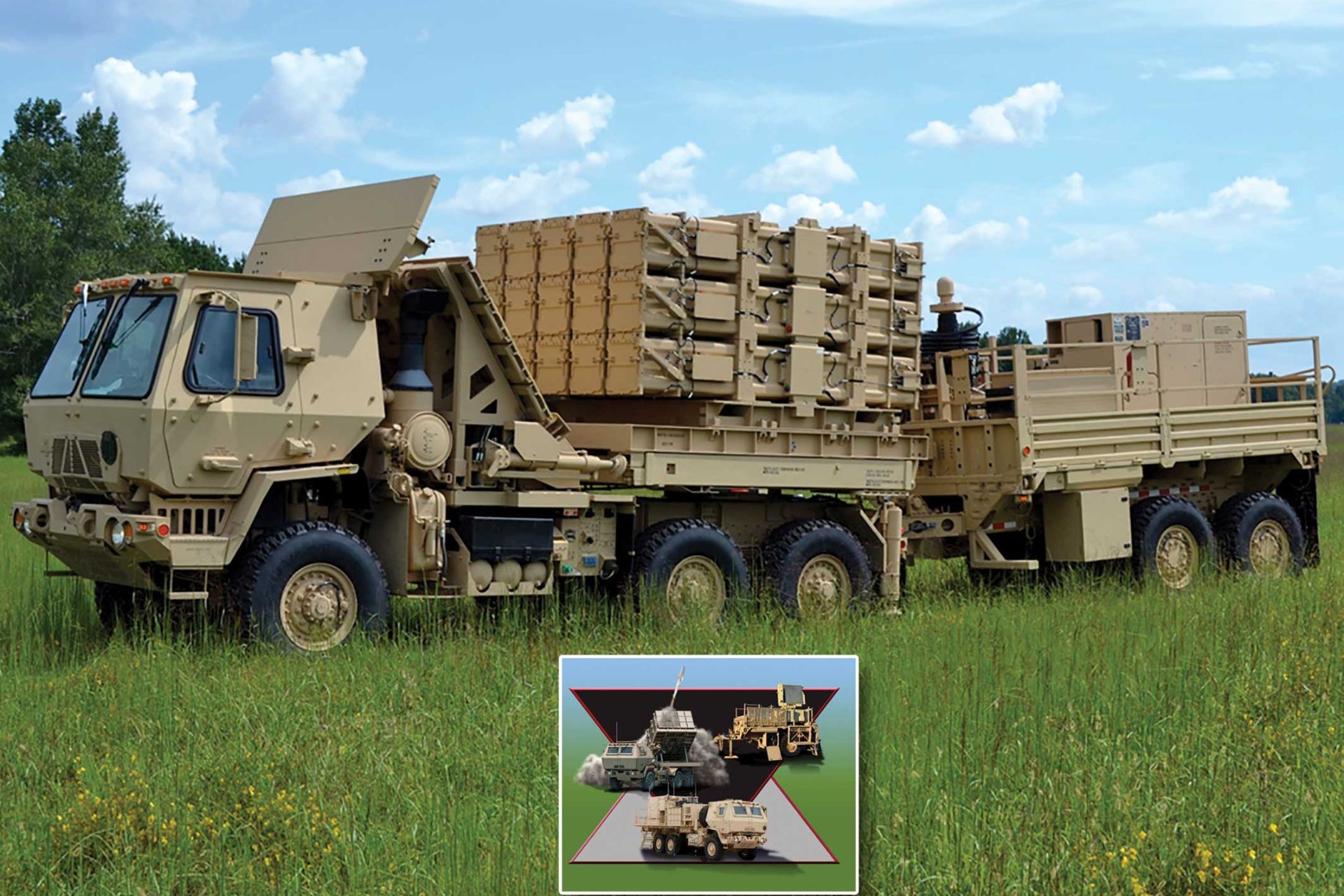
IFPC Inc 2 adds a midtier layer that protects fixed and semi-fixed sites and forward bases from UAS, cruise missiles, rockets, artillery, and mortars. (Picture source: US DoD)
Indirect Fire Protection Capability Increment 2 (IFPC Inc 2) provides the Army with a mobile Enduring Shield launcher that has demonstrated a ground-launched AIM-9X shot and interfaces with the Integrated Battle Command System. The second interceptor adds reach, response speed, and lethality against more demanding cruise-missile profiles. Selecting Lockheed Martin formalizes this step and keeps the schedule aligned with earlier planning for a mid-decade selection and demonstrations.
Three technical points merit attention. First, sensors. The Sentinel A4 radar, now in low-rate production, is slated as IFPC’s primary sensor, delivering 360-degree coverage and passing tracks to IBCS for fire control. This networked approach is routinely highlighted for cruise-missile defense. Second, launcher and integration. Enduring Shield is a modular, palletized system tied to IBCS, with an all-up-round magazine validated during AIM-9X risk-reduction events. Until live-fire testing, the second interceptor is largely an interfaces-and-software task. Third, magazine depth. The aim is to load more rounds per launcher by using smaller diameters, a key factor for withstanding saturation raids.
The IFPC architecture is designed to buy time and geometry. Units can disperse launchers around critical infrastructure, cueing from Sentinel A4 and other sensors through IBCS, then engage low-altitude threats that evade Maneuver-SHORAD before they reach Patriot’s engagement zones. In practice, this provides more shot opportunities against terrain-following cruise missiles, more ready rounds to handle multi-vector drone swarms, and a simpler logistics footprint than deploying Patriot batteries to every vulnerable site. Since 2024, Army briefings have emphasized that the second interceptor targets faster, lower-flying cruise missiles, which require a seeker and propulsion suited to short timelines and high game off-boresight performance.
At the operational level, the timeline matches the ramp-up of the baseline configuration. In 2025, the Army authorized IFPC Inc. 2 to enter low-rate production and issued early orders to field launchers, radars, and battle-management components. Introducing a second interceptor during this rollout allows test units to validate shot doctrine, sensor-to-shooter latencies, and reload cycles in realistic conditions, rather than adding a new missile after force elements are set. Initial events pairing Sentinel A4, IFPC launchers, and IBCS are expected as software drops arrive, including at White Sands.
Two industrial notes add context. While other firms have advanced new-design interceptor proposals in parallel, the latest step confirms that Lockheed Martin will carry an OTA for this second effector path. This dual-track posture reflects the Army’s focus on development speed, required kinematics, and domestic availability, while preserving options before a final down-select. Army expectations converge on AMRAAM-like kinematics in a more compact form factor to deepen Enduring Shield’s magazines.
This comes as the use of conventional interceptors increases in frequency and intensity. Israel and Ukraine, in particular, have been firing large numbers to counter salvos mixing cruise missiles, rockets, and drone swarms. This cadence requires accelerating production and thickening magazines; otherwise, defenses come under pressure quickly. The cost-effect balance is unfavorable over time when an expensive missile downs a low-cost drone, hence the need for complementary low-cost measures: electronic warfare and decoys, upgraded anti-air guns with programmable ammunition, distributed C-UAS capabilities, and, when available, directed-energy weapons. Placed mid-layer in the ground-based air defense stack, the second interceptor is intended to preserve Patriot capacity, close angles against fast low-flying targets, and sustain defense during prolonged attacks.
At this stage, there is no public unit price for the IFPC second interceptor, and nothing indicates a lower initial cost. Higher performance against fast, low-flying cruise missiles typically drives a higher early unit price before economies of scale. The Army is aiming first to improve cost-per-effect by increasing Enduring Shield’s magazine depth, reserving Patriot for harder targets, and combining lower-cost C-UAS tools with non-kinetic options. In practice, expect a relatively high starting price that may fall with production, while the average cost per interception should decline mainly through the layered mix rather than because the new missile is inherently cheap.
The United States and its allies in Europe and the Indo-Pacific face opponents capable of composing mixed raids that combine numerical saturation, decoys, and jamming. A layered defense with greater magazine depth at the mid-tier alters the equation. It increases the resilience of air bases, depots, C2 nodes, and logistics hubs, and it becomes an interoperability reference for partners. In this framework, the IFPC second interceptor can help lower the unit cost of defensive effects by extending force endurance, provided it is backed by sustained production and a portfolio of attrition tools that are cheaper than the complex guided munitions commonly used so far.