










Venezuela Builds Air Defense Decoys as Deterrence Measure Against U.S. Surveillance.
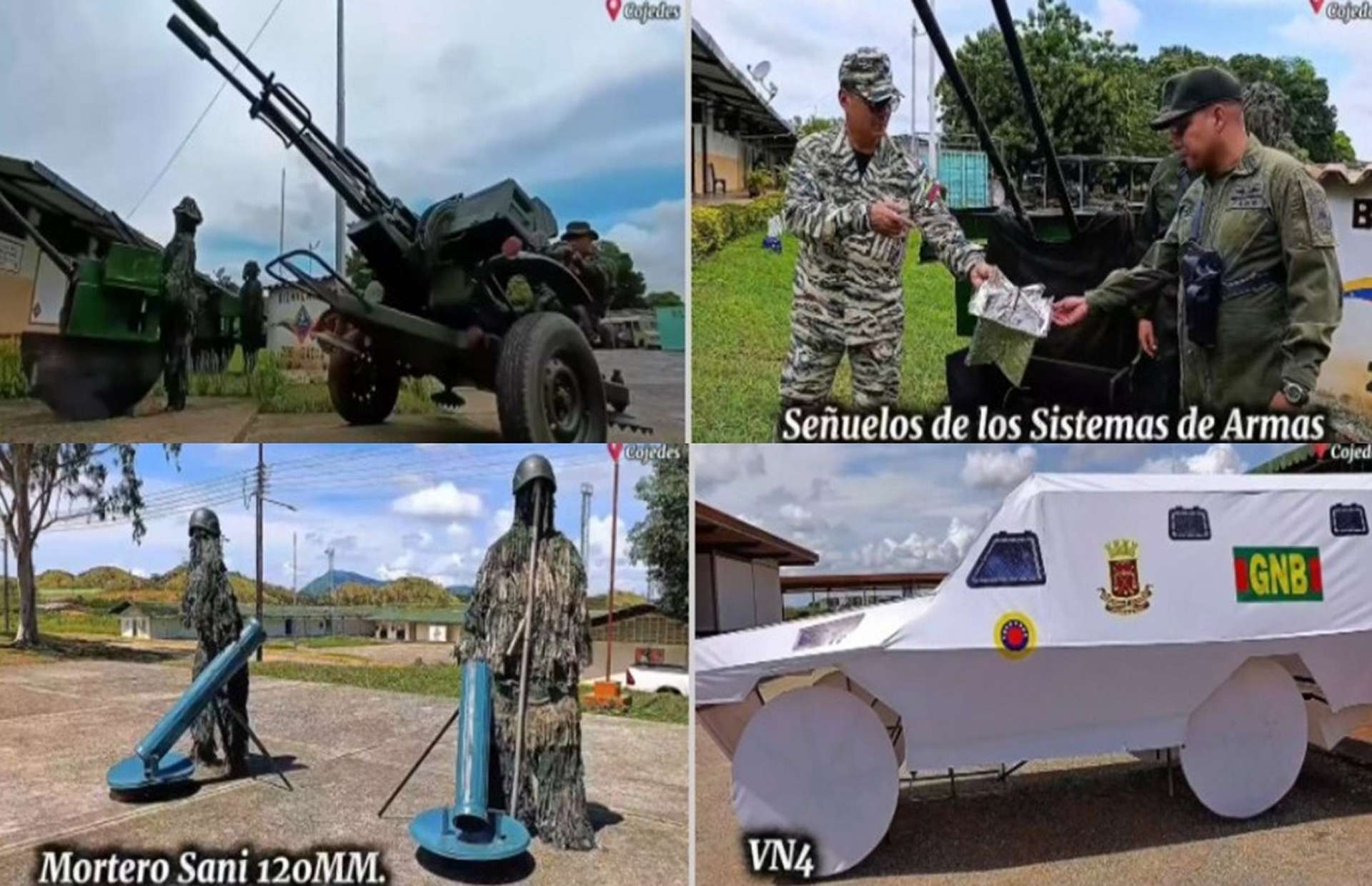
Venezuelan regional command ZODI 34 Cojedes published a video (3 Nov 2025) showing full-scale mockups of ZU-23 guns, a 120 mm mortar and a VN-4 armored car, which analysts say are intended to saturate overhead collection and inflate Caracas’s perceived order of battle. Such a campaign of low-cost decoys complicates suppression of air defenses, forces extra ISR and strike assets, and increases operational cost and time for U.S. planners.
According to a video published by ZODI 34 Cojedes, a Venezuelan army unit, on November 3, 2025, Venezuelan engineers have begun producing full-scale mockups of air defense and ground systems to mislead U.S. intelligence and inflate Caracas’s perceived order of battle. Video material reviewed by Army Recognition shows decoy ZU-23 twin guns, a 120 mm mortar and a VN-4 armored car, with local units presenting the replicas as operational aids for camouflage, deception and training. The intent is clear: saturate overhead collection with plausible aimpoints and complicate target validation before any strike package is built.
Follow Army Recognition on Google News at this link

Venezuelan engineers deploy decoy S-300VM and Buk launchers to mislead U.S. intelligence, inflate defenses, and shield real assets (Picture source: ZODI 34 footage)
ZODI 34 Cojedes is a Venezuelan FANB regional command covering Cojedes state within REDI Los Llanos. It coordinates the army, National Guard, police, and civilian authorities for integral defense, public order, and territorial control. Activities include patrols, joint exercises, and outreach. Communications list Major General Elvis Rafael Durán Lobo as commander.
What is being copied tracks the real kill list. Venezuela’s integrated air defense is anchored by long-range S-300VM batteries and mobile Buk-M2E systems, with legacy Pechora-2M, ZU-23, and MANPADS filling the lower tiers. Those are precisely the silhouettes that matter most to duplicate, from tracked S-300VM TELs and 9S32-class engagement radars to wheeled Buk-style TELARs that menace medium altitudes. If even a fraction of those signatures are dummies, every suppression run takes longer and costs more.
Timing is not accidental: Washington has tightened Venezuela-related sanctions through 2025, and U.S. Southern Command’s own posture statement acknowledges strained detection and monitoring assets in the theater, including a period with zero Navy P-8 aircraft assigned to the mission. At the same time, Russian officials and outlets claim new deliveries of short and medium-range air defense systems to Caracas, notably Pantsir-S1 and additional Buk-M2E, a narrative meant to advertise a thicker air shield just as decoys proliferate. The net effect is deterrence by ambiguity, forcing U.S. planners to assume a denser and more mobile SAM picture than may actually exist.
The mockups themselves appear to rely on lightweight materials and simple fabrication, consistent with the videos circulating on Venezuelan social channels. In practice, convincing decoys do not need exquisite finish; heat sources, rudimentary wiring and accurate dimensions are enough to defeat a quick satellite pass or a loitering munition’s glance. Recent conflicts show how plywood, composites and inflatable shells can mimic armor, artillery and even SAM launchers at a fraction of the cost, preserving real assets while the attacker exhausts ISR and munitions.
For U.S. forces, the operational math is unforgiving: decoys stretch the kill chain, demand more sorties for battle damage assessment and soak costly standoff weapons, whether JASSM-ER against a false S-300VM tube or AARGM-ER launched at a silent radar mast. With SOUTHCOM already signaling ISR shortfalls, mock emitters and launcher replicas increase the number of aimpoints faster than collectors can vet them, pushing commanders toward low-density stealth assets and extended timelines. This is textbook cost-imposition, and it works best in the opening hours of a crisis when uncertainty is highest.
There is nothing new about the doctrine: Serbia’s wartime deception in 1999 forced NATO to waste sorties on crude dummy armor and artillery, a lesson captured in post-conflict assessments. More recently, Russia and Ukraine have used inflatable or flat-pack decoys at scale, while investigations have documented the pairing of cheap decoy drones with lethal payloads to overwhelm air defenses. Caracas is drawing from the same playbook, leveraging engineers and militia to seed the battlespace with believable fakes that buy time for the real S-300VM and Buk components to survive and reposition.
Venezuela’s state defense company CAVIM has the manufacturing base to support serial production of simple mockups and thermal simulators, and local footage suggests distributed workshops can scale output quickly with commercial materials. Even if final assembly remains ad hoc, the effect is the same: a shell game that protects air defenses, deters a first strike and forces any attacker to pay a higher entry fee. The concept will fail if signatures are sloppy or movement discipline breaks down, but as a low-cost hedge against precision targeting, the “phantom army” is money well spent for Caracas.
Written by Evan Lerouvillois, Defense Analyst, Army Recognition Group.
Evan studied International Relations, and quickly specialized in defense and security. He is particularly interested in the influence of the defense sector on global geopolitics, and analyzes how technological innovations in defense, arms export contracts, and military strategies influence the international geopolitical scene.