










Exclusive: Philippine Warship Challenges Chinese Frigate During U.S.-Led Indo-Pacific Exercise.
According to information published by U.S. Pacific Fleet on September 14, 2025, the combined naval and defense forces of the Philippines, Japan, and the United States conducted a high-stakes Multilateral Maritime Cooperative Activity (MCA) inside the Philippines’ Exclusive Economic Zone (EEZ) from September 11 to 13, in a forceful demonstration of alliance resolve and rising maritime interoperability in the Indo-Pacific region. During the exercise, the Philippine Navy’s flagship, BRP Jose Rizal, conducted a radio challenge against a Chinese People’s Liberation Army Navy (PLAN) Type 054A frigate (bow number 551) that was operating approximately 35 nautical miles southwest of Capones Island, well within the Philippine EEZ and only 7 nautical miles from the Filipino warship.
Follow Army Recognition on Google News at this link

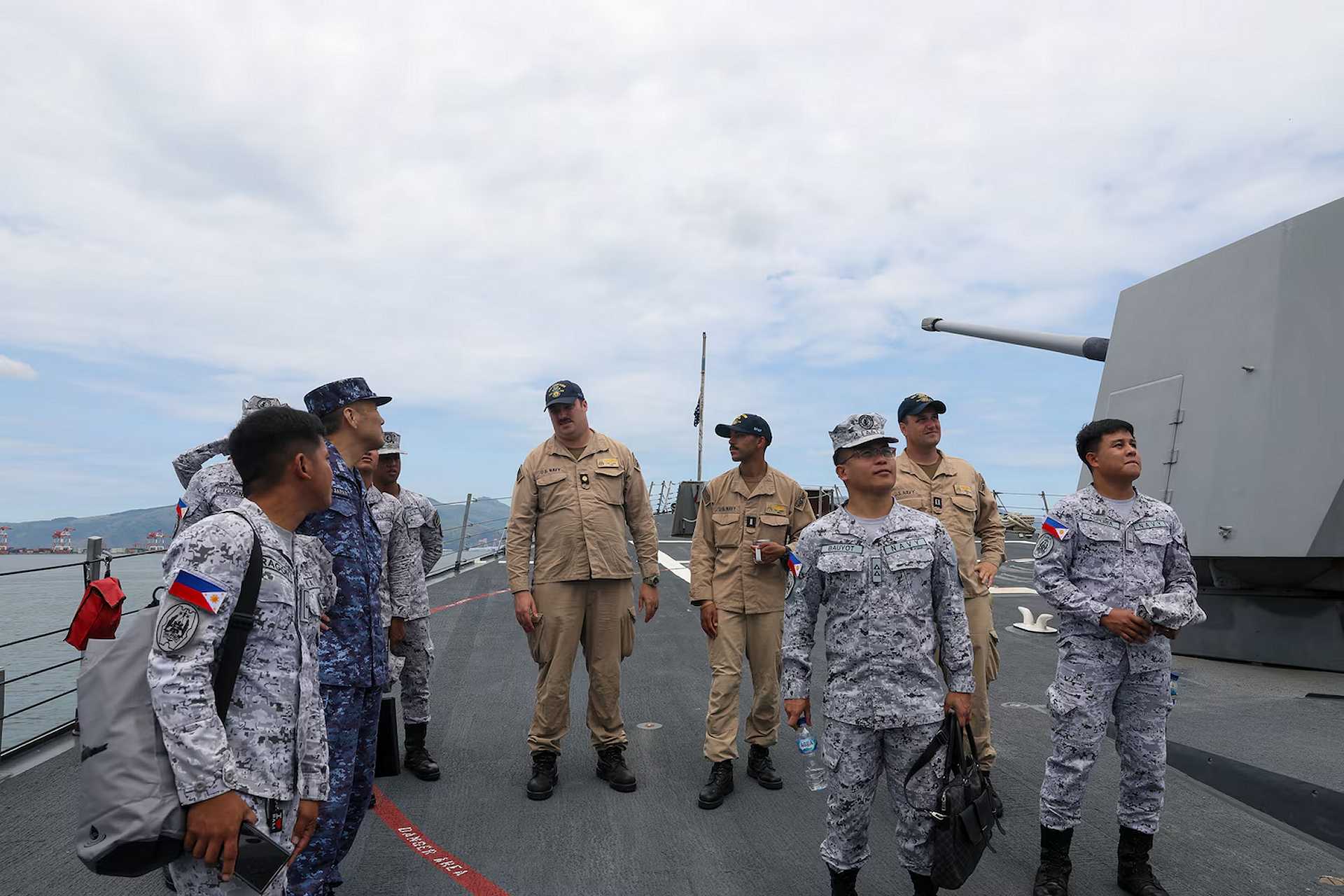
Sailors aboard the Arleigh Burke-class destroyer USS John Finn (DDG 113) conduct a flight operations briefing for Philippine Navy personnel and Cmdr. Noriyuki Kawahata, Assistant Defense Attaché of Japan to the Philippines, during a subject matter exchange on the fo’c’sle as part of the Multilateral Maritime Cooperative Activity in Subic Bay, Philippines, September 11, 2025. (Picture source: U.S. Pacific Fleet)
The incident highlighted the real-world tension underlying the exercise, as participating forces practiced tactical readiness and joint maritime coordination in waters contested by China.
The Philippines’ Exclusive Economic Zone (EEZ) refers to the maritime area extending up to 200 nautical miles from its baselines, as defined under the United Nations Convention on the Law of the Sea (UNCLOS). Within this zone, the Philippines holds exclusive sovereign rights to exploit and manage natural resources, both in the water column and on the seabed, alongside jurisdiction over scientific research, environmental protection, and economic activity. Much of this zone overlaps with contested areas of the South China Sea, including regions repeatedly encroached upon by Chinese coast guard and maritime militia vessels, making it a strategic flashpoint and a focus of defense cooperation with allied nations.
The joint activity featured significant surface and aerial assets from all three countries. The Japan Maritime Self-Defense Force (JMSDF) deployed the Ōsumi-class tank landing ship JS Ōsumi (LST-4001), known for its amphibious lift and humanitarian support capabilities. The Philippine Navy contributed its flagship BRP Jose Rizal (FF-150), a Jose Rizal-class guided-missile frigate equipped with an AW-109 anti-submarine helicopter and supported by a C-208B maritime patrol aircraft and four FA-50 light fighters from the Philippine Air Force. The U.S. Navy deployed the Arleigh Burke-class guided-missile destroyer USS John Finn (DDG-113) alongside a P-8A Poseidon maritime patrol aircraft and two MH-60R Seahawk helicopters from Patrol Squadron 9.
During the MCA, participating forces conducted coordinated division tactics, contact reporting, helicopter landing drills, surveillance missions, and communications exercises aimed at sharpening joint maritime domain awareness. Notably, BRP Jose Rizal conducted a radio challenge against a Chinese People's Liberation Army Navy (PLAN) Type 054A frigate (bow number 551) operating approximately 35 nautical miles southwest of Capones Island, within the Philippine EEZ and only 7 nautical miles from the Filipino warship. The Chinese vessel responded by asserting sovereign immunity and legal justification for its presence, but refrained from interfering with the exercise.
This latest MCA builds on over a decade of evolving trilateral cooperation among the three allies, advancing joint doctrine, tactics, and procedures under real-world conditions. It also represents a visible implementation of shared Indo-Pacific maritime strategy, particularly the principle of maintaining freedom of navigation, overflight, and lawful use of international waters and airspace.
While U.S. Pacific Fleet emphasized the lawful and non-escalatory nature of the operation, its significance is unmistakable. The inclusion of amphibious projection assets like JS Ōsumi suggests expanding operational scenarios that go beyond maritime patrol, such as humanitarian assistance, contested island resupply, or rapid deployment of ground forces. The synergy between ISR platforms like the P-8A and the C-208B points to a sophisticated surveillance overlay enabling shared targeting and threat detection, especially in potential submarine operating zones.
According to Philippine defense officials, this was the 11th such multilateral maritime exercise, but the first involving this scale of coordinated air-sea activity and a real-time interaction with a foreign warship. Philippine Navy Rear Admiral Alfonso Torres noted that such exercises are "no longer just drills, but the development of deterrence postures aligned with our constitutional duty to protect our exclusive economic rights."
In the broader geopolitical context, the exercise comes just weeks after the passage of the Philippines’ Maritime Zone Act (Republic Act 12064), which formally codifies the country’s maritime claims under international law. China, which rejects the 2016 Permanent Court of Arbitration ruling that invalidated much of its expansive South China Sea claims, has protested the recent patrols and warned of "serious consequences" for what it describes as "disruptive behavior."
Nonetheless, the absence of Chinese interference in this MCA indicates a potential recalibration of tactical thresholds on both sides. The U.S., Japan, and the Philippines appear to be operating with a growing level of mutual confidence, and with clearer rules of engagement for encounters with foreign vessels inside legally recognized EEZs.
The U.S. 7th Fleet, which commands the USS John Finn and the P-8A detachment, remains the largest forward-deployed fleet in the U.S. Navy and continues to serve as the operational backbone of American maritime strategy in the Indo-Pacific. Its persistent presence and growing integration with regional partners affirm Washington’s long-term commitment to collective deterrence in an increasingly contested maritime domain.
This Multilateral Maritime Cooperative Activity was not only a technical and tactical exercise, but a strategic signaling operation aimed at reinforcing maritime law, defending sovereign rights, and preparing for future scenarios in the region’s most volatile waters. The execution of the drill, especially its professionalism amid a close encounter with Chinese forces, sends a potent message: the Indo-Pacific’s maritime balance of power is shifting toward allied unity, preparedness, and action.
Written by Alain Servaes – Chief Editor, Army Recognition Group
Alain Servaes is a former infantry non-commissioned officer and the founder of Army Recognition. With over 20 years in defense journalism, he provides expert analysis on military equipment, NATO operations, and the global defense industry.