






Breaking News






Italian Navy's new Atlante support ship successfully finishes sea trials before official delivery.
As reported by the OCCAR on May 20, 2025, the Logistic Support Ship (LSS) Atlante (A 5336), second in the Vulcano-class series, has completed a series of sea trials between March and May 2025 in the Gulf of Naples, marking key progress toward its official delivery to the Italian Navy. The First Sea Going Review was achieved on March 18, 2025, followed by the First Sea Going conducted on March 25. These milestones were part of the ship’s contractual verification process overseen by OCCAR’s LSS Programme Division, industry representatives, and Italian authorities.
Follow Army Recognition on Google News at this link
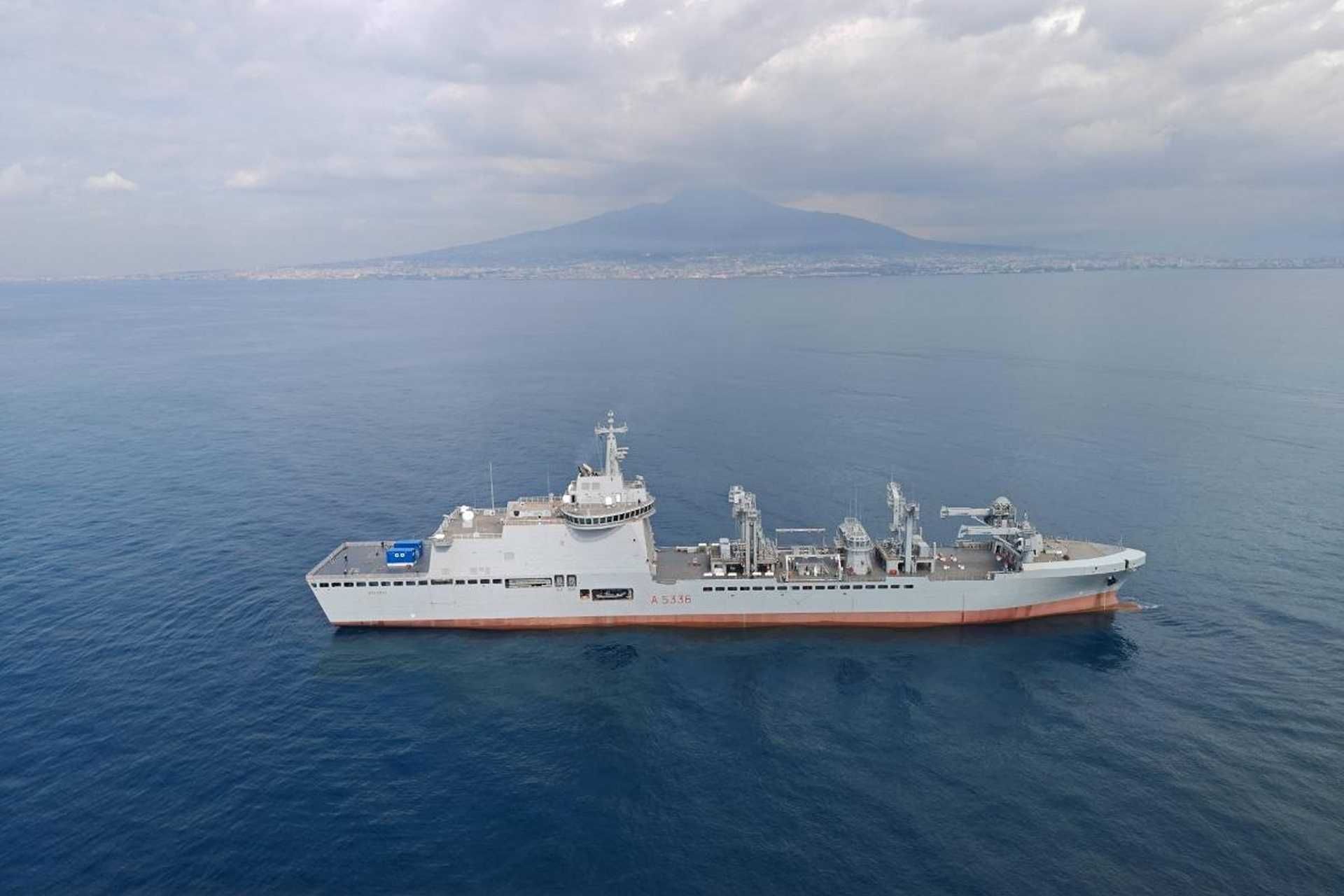
Upon completion and delivery in late 2025, the LSS Atlante will be based in Taranto and will serve alongside the LSS Vulcano in support of national and multinational maritime operations. (Picture source: OCCAR)
Sea Acceptance Trials (SAT) took place in May 2025 and covered core functionalities including propulsion, navigation, communications, and replenishment operations. These steps confirm that Atlante complies with operational requirements prior to joining the fleet. The vessel is scheduled to complete all testing by July 2025 and be delivered before the end of the year. Built at Fincantieri’s Castellammare di Stabia shipyard by a temporary consortium including Fincantieri and Leonardo, Atlante is part of a six-ship LSS programme managed by OCCAR for Italy and France. The Logistic Support Ship (LSS) Atlante (A 5336) was launched on May 18, 2024, and is a continuation of the LSS programme that began with ITS Vulcano (A 5335), delivered in March 2021.
The LSS Atlante is designed to provide logistical support to the fleet, with capabilities for transporting and transferring diesel fuel (F76), aviation fuel (F44/JP5), potable water, ammunition, spare parts, food supplies, lubricants, and up to eight ISO-standard containers. It features four abeam refueling stations and one astern station. The ship also includes maintenance workshops for at-sea repairs. A NATO Role 2 LM-standard medical facility is integrated on board, with operating rooms, radiology and diagnostic spaces, a dental clinic, and space for 17 seriously injured patients. The vessel encountered the Amerigo Vespucci training ship during trials in the Gulf of Naples, which was returning from a world tour launched in July 2023. The Vespucci, also built in Castellammare di Stabia, was launched in 1931 and symbolizes the historical continuity of Italy’s naval construction at the same site.
The LSS programme was integrated into OCCAR in 2015. France obtained Observer status in 2016 and joined fully in 2019 following several implementing agreements signed between 2017 and 2018. Four ships have been ordered by France as part of its Flotte Logistique (FLOTLOG) initiative to replace the Durance-class tankers. The first, FS Jacques Chevallier, was delivered in 2023 and commissioned in November 2024. The second, FS Jacques Stosskopf, was launched in August 2024. These ships are based on the Vulcano design but are slightly larger, with a full load displacement of 31,000 tonnes and a length of 194 meters, reflecting France’s higher aviation fuel requirements. Three additional French LSS ships are scheduled for delivery by 2029. Italian plans include a third LSS under option and a potential fourth ship, both mentioned in national defense planning documents. France’s units are being constructed at Chantiers de l’Atlantique in Saint-Nazaire, with bow sections supplied by Fincantieri.
Atlante measures 193 meters in length, displaces approximately 27,200 to 31,000 tonnes depending on configuration, and can achieve speeds of up to 20 knots using a CODLAD (Combined Diesel Electric and Diesel) propulsion system. The configuration includes two MAN 20V32/44CR diesel engines, four diesel generators, and two electric Marelli motors, enabling efficient cruising and high-speed transit. The vessel’s range is up to 7,000 nautical miles at 16 knots with an endurance of 30 days. The crew complement is 167, expandable to 235 with specialists. The ship supports operations involving two EH-101 helicopters, with a hangar and a 24-meter by 27.6-meter flight deck. Other onboard equipment includes 30-tonne stabilized cranes, two 10-meter tenders, RHIBs, and optional CB90-type boats. The ship is also equipped with navigation and helicopter landing radars, obstacle avoidance sonar, and is prepared for electronic warfare sensors and a Leonardo CMS (SADOC Mk4) integrated with Seastema’s ship management system.
Atlante’s cargo capabilities include approximately 9,000 m³ of F76 diesel fuel, 4,000 m³ of F44 aviation fuel, 800 m³ of drinking water, 220 tonnes of ammunition, 30,000 food rations, 15 tonnes of lubricants, 20 tonnes of spare parts, and a limited quantity of gasoline in barrels. The medical suite occupies roughly 800 square meters and includes two operating theatres, radiology, a dental suite, a diagnostic laboratory, and intensive care units. The ship can conduct rescue and recovery operations at sea, including seabed material retrieval, and can serve as a command center during tactical operations. The environmental design features low-pollution diesel-electric propulsion, low-emission generators, and biological effluent control systems. Atlante’s systems support both conventional military operations and non-military roles such as humanitarian assistance, civil protection, and disaster relief.
The Vulcano-class ships were conceived to replace the Italian Navy’s Stromboli-class replenishment tankers, which had been in service since the late 1970s. Funded under the 2014 Naval Law, the lead ship Vulcano was initially projected to cost €346 million, later increased to €374.6 million due to a 12-meter extension in length, and then €410 million for Atlante. Vulcano was commissioned in March 2021 and deployed to Arish, Egypt, in December 2023 to support medical operations during the Gaza conflict. The ship returned to Italy in February 2024 after treating Palestinian casualties. The design has been adapted into France’s BRF (Bâtiment Ravitailleur de Forces) series. There is also interest from Algeria, where a 2024 bilateral agreement included plans to deliver a Vulcano-type LSS and expand shipyard infrastructure in Annaba. Fincantieri may follow a model previously used for Egypt and Indonesia, where units built for the Italian Navy were diverted for export and replaced by additional orders.
Upon completion and delivery in late 2025, Atlante will be based in Taranto and will serve alongside Vulcano in support of national and multinational maritime operations. The ship is part of Italy’s Naval Act fleet renewal initiative, which includes multiple new platforms such as PPA-class patrol ships and the LHD Trieste. The LSS class supports up to five large naval units with sustained logistics and medical capacity during extended missions. The OCCAR-managed binational programme represents an example of European industrial and military collaboration, combining shared design, split construction, and long-term maintenance under a unified framework. Atlante’s trials validate its performance and confirm its alignment with operational goals. Its integration into the fleet will enhance Italy’s ability to conduct continuous operations at sea, respond to crises, and maintain interoperability with allied forces in NATO and the European Union.