
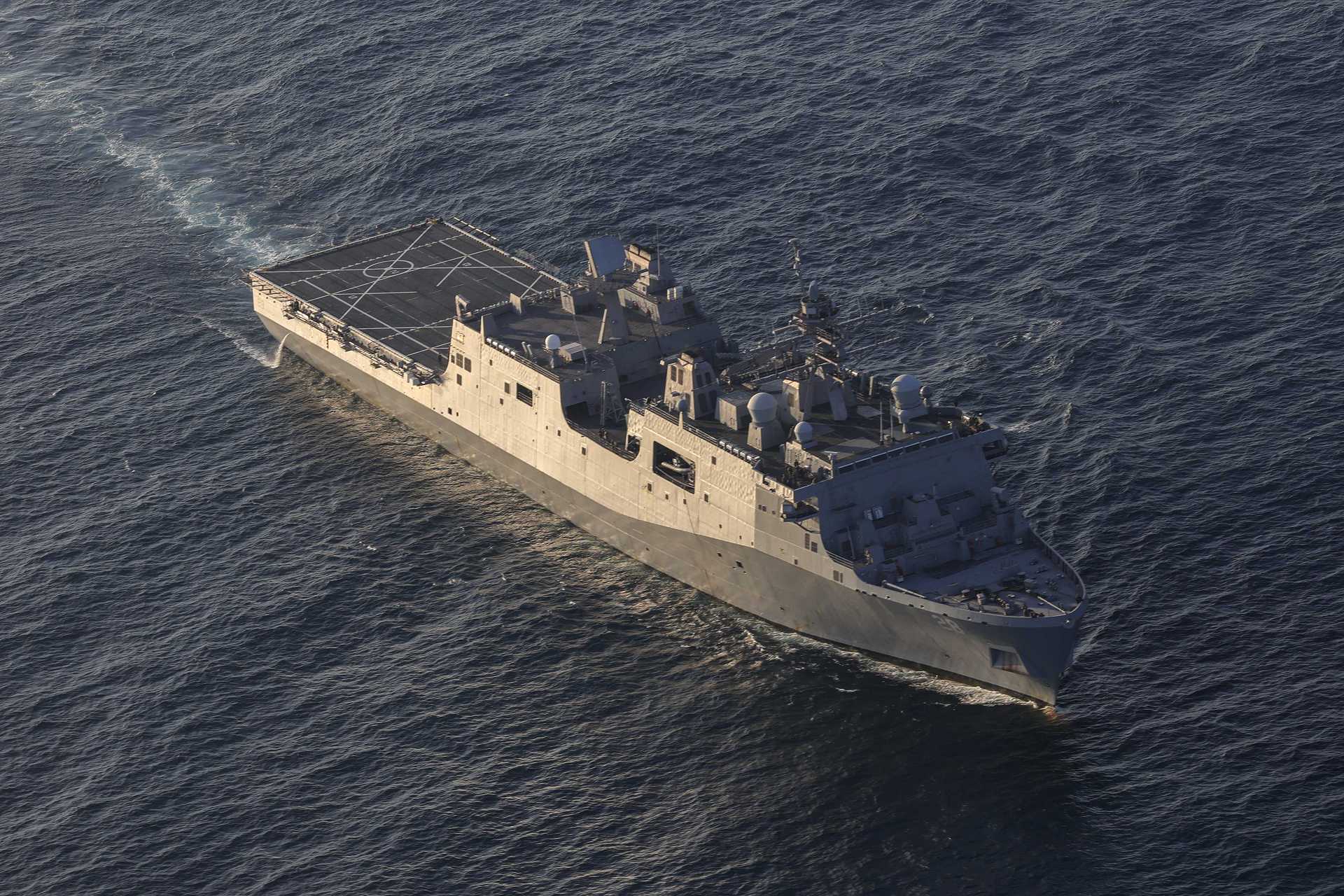










USS Fort Lauderdale amphibious transport dock Returns to Caribbean to Bolster U.S. Navy Presence Near Venezuela.
Open-source tracking on X, November 6, 2025, shows the USS Fort Lauderdale (LPD-28) reentered the Caribbean after a short logistics stop at Naval Station Mayport, Florida. This move highlights Washington’s continued maritime presence near Venezuela, backing regional interdiction and counter-narcotics operations.
Open-source intelligence on X confirms that USS Fort Lauderdale (LPD-28) has returned to the Caribbean Sea after a brief stop at Naval Station Mayport, Florida. This redeployment demonstrates growing U.S. naval activity near Venezuela, where the Pentagon uses forward-deployed maritime forces to reinforce regional presence and support interdiction against narcotics trafficking and transnational crime.
Follow Army Recognition on Google News at this link

USS Fort Lauderdale (LPD-28), a San Antonio-class amphibious transport dock, supports U.S. Navy and Marine Corps operations by deploying landing craft, helicopters, and MV-22 Ospreys. Designed for expeditionary warfare, the ship enables amphibious assaults, humanitarian missions, and maritime interdiction operations in littoral environments. (Picture source: U.S. Department of War)
While not typically used in direct interdiction, the USS Fort Lauderdale enables broader U.S. efforts against Caribbean drug cartels. As part of an Amphibious Ready Group with the 22nd Marine Expeditionary Unit, it serves as a mobile base capable of supporting a variety of missions, including airlift, reconnaissance, and the deployment of interdiction teams across wide maritime areas.
The ship’s key asset is its flexibility. Deployable landing craft enable U.S. forces to deploy specialized teams or units to remote islands or coastal zones without requiring a port. This level of mobility is vital when targeting elusive drug networks spread across island chains.
The USS Fort Lauderdale can launch MV-22 Ospreys or UH-1Y Venoms, which are frequently used for fast troop deployment, ISR (intelligence, surveillance, and reconnaissance) patrols, or coordination with Coast Guard and DEA air assets. That aviation deck also allows Fort Lauderdale to act as an at-sea launchpad for special operations or Marine FAST (Fleet Anti-Terrorism Security Team) elements, often deployed in boarding or seizure missions targeting cartel-owned or cartel-financed vessels.
The ship also serves as an advanced command-and-control node, not just a transport platform. It offers secure communications, real-time ISR fusion from airborne or partner sources, and sustained presence in contested maritime zones without a land base. This suits multi-agency missions led by Joint Interagency Task Force South (JIATF-South), which unites the U.S. Navy, Coast Guard, DEA, and partner nations to intercept drug traffickers from Venezuela, Colombia, and Central America.
Fort Lauderdale also provides critical deterrence and presence. When an amphibious ship of this scale appears off the coast of known smuggling routes, such as those near the Windward Passage, the southern approaches of Hispaniola, or the eastern coasts of Honduras, it sends a clear message. Unlike destroyers or Coast Guard cutters, the Fort Lauderdale carries the full expeditionary posture of a Marine force, capable of humanitarian response, security cooperation, or armed interdiction, depending on the mission.
This layered, mobile capability is important because smugglers use a variety of vessels to avoid detection. With patrol assets stretched thin, LPDs teamed with Coast Guard cutters provide lasting offshore coverage and rapid response.
Fort Lauderdale’s return fits a pattern of increased amphibious operations in the Caribbean over the past 18 months. Naval Station Mayport has grown into a key launch point for these missions, with logistics and deployment pipelines optimized for southern operations.
Though U.S. Southern Command has not confirmed the full scope of this latest mission, Fort Lauderdale’s capabilities are currently focused on supporting law enforcement operations, assisting foreign military partners, and providing regional humanitarian aid—key activities defense planners increasingly refer to as "gray zone" maneuver. In this complex mix, the Navy’s amphibious force serves as both a warfighting element and a high-endurance platform for sustained maritime governance in America’s southern maritime approaches.
As the fight against drug cartels expands to networks using encrypted communications, unmanned systems, narco-submersibles, and island logistics hubs, the Navy’s use of LPDs like Fort Lauderdale marks a shift. Operations now include sea-based expeditionary capabilities near cartel hubs, offering flexible response options.
For Army Recognition, the U.S. Navy Fort Lauderdale’s amphibious transport dock return signals more than a ship’s movement. It reflects a shift in U.S. naval power projection in the Western Hemisphere. We will track the deployment’s progress, possible port calls, and joint exercises with regional navies.