
Naval Defense News
- Details
- Written by: Halna du Fretay
- Category: Naval News Navy 2026
- Hits: 169










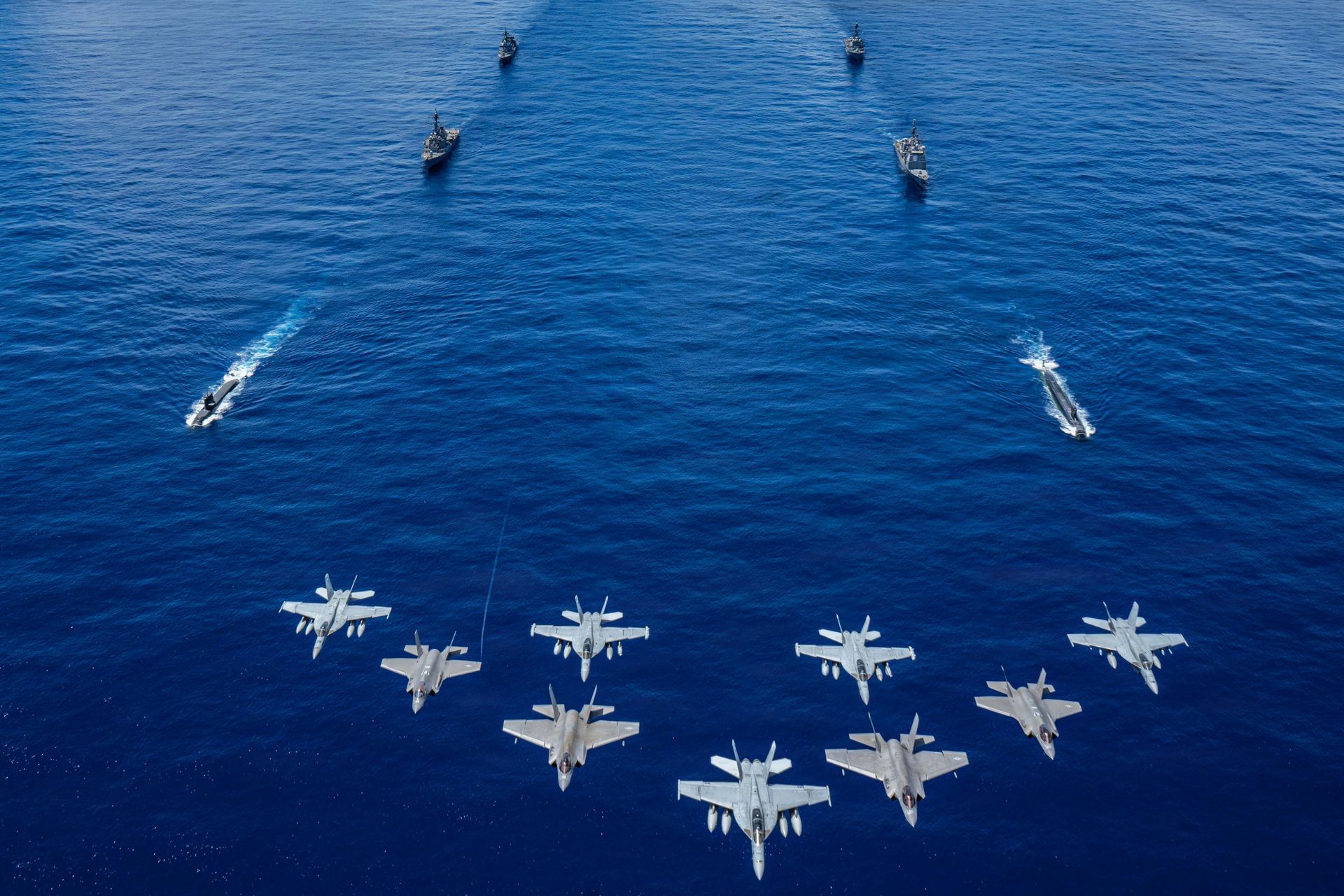
The United States and Japan deployed a large naval and air force package in the Philippine Sea as part of Exercise Valiant Shield 2026, led by the USS George Washington Carrier Strike Group and vessels of the Japan Maritime Self-Defense Force (JMSDF).
The operation reflects ongoing allied efforts to improve combat interoperability and deterrence amid increasing strategic competition across the Indo-Pacific. As tensions continue around the Taiwan Strait, the East China Sea, and the South China Sea, the exercise also demonstrates Washington and Tokyo's intent to conduct coordinated operations in an increasingly contested regional environment.
Related News: U.S. Carrier George Washington Deploys MH-60 Seahawk Helicopters Near China Flashpoints
The biennial Valiant Shield exercise brings together advanced naval, air, and joint-force capabilities, providing an opportunity to refine command-and-control procedures, integrated operations, and allied readiness across multiple warfighting domains. (Picture source: US DoD)
The U.S. Navy released imagery showing the USS George Washington Carrier Strike Group operating alongside Japanese naval vessels while U.S. Navy and U.S. Air Force aircraft carried out coordinated flight operations over the formation. The biennial Valiant Shield exercise brings together advanced naval, air, and joint-force capabilities, providing an opportunity to refine command-and-control procedures, integrated operations, and allied readiness across multiple warfighting domains.
At the center of the formation is the Nimitz-class aircraft carrier USS George Washington (CVN 73), accompanied by the Ticonderoga-class guided-missile cruiser USS Robert Smalls (CG 62), the Arleigh Burke-class guided-missile destroyers USS Shoup (DDG 86) and USS Benfold (DDG 65), and the Virginia-class fast-attack submarine USS Minnesota (SSN 783). The Japanese contingent includes the helicopter destroyer JS Kaga (DDH 184), the destroyer JS Fuyuzuki (DD 118), and the Taigei-class submarine JS Jingei (SS 515). Above the fleet, aircraft assigned to Carrier Air Wing 5 and U.S. Air Force F-35A Lightning II fighters conduct coordinated flight operations, illustrating the role of air power in modern maritime force projection.
Particular attention is focused on JS Kaga, which continues to undergo modifications to operate F-35B Lightning II short take-off and vertical landing aircraft. Once fully operational in this role, the vessel will provide Japan with a fixed-wing carrier aviation capability not seen since the Second World War. This development will expand Tokyo's ability to project air power and support operations alongside U.S. carrier strike groups across the Indo-Pacific.
The exercise illustrates how U.S. Indo-Pacific Command seeks to integrate naval, air, land, space, and cyber capabilities within a single operational framework. Since its inception, Valiant Shield has become one of the most demanding exercises in the Western Pacific, enabling participating forces to rehearse large-scale combat operations, distributed maritime maneuver, and long-range strike coordination under realistic conditions. Japanese participation also reflects the continued expansion of bilateral defense cooperation and the gradual evolution of Japan's role within regional security arrangements.
The exercise also reflects the evolution of U.S. military doctrine toward distributed maritime operations. Rather than concentrating combat power around a single carrier strike group, current concepts emphasize the integration of dispersed naval, air, submarine, and land-based assets capable of generating coordinated effects across large operational areas. Valiant Shield therefore provides a practical environment to test these concepts alongside regional partners under conditions that resemble those of a high-intensity conflict.
Several systems participating in the exercise contribute advanced capabilities. The F-35A Lightning II is equipped with the AN/APG-81 Active Electronically Scanned Array (AESA) radar and a sensor-fusion architecture capable of combining information from radar, electro-optical sensors, electronic-support measures, and external networks into a single tactical picture. Through secure data links such as the Multifunction Advanced Data Link (MADL) and Link 16, the aircraft can distribute targeting information across a joint force while maintaining a reduced observable profile.
USS George Washington remains one of the largest warships in active service. Powered by two nuclear reactors, the aircraft carrier can operate for decades without refueling and can embark more than 60 aircraft depending on mission requirements. Carrier Air Wing 5 typically includes F/A-18E/F Super Hornet fighters, EA-18G Growler electronic-warfare aircraft, E-2D Advanced Hawkeye airborne early-warning aircraft, and MH-60R/S helicopters, providing strike, surveillance, and command-and-control capabilities.
Beneath the surface, USS Minnesota represents another key element of the force package. The Virginia-class submarine is designed for anti-submarine warfare, anti-surface warfare, intelligence collection, and land-attack missions. Armed with Mk 48 heavyweight torpedoes and Tomahawk land-attack cruise missiles, it can engage targets at long range while remaining difficult to detect. On the Japanese side, JS Jingei belongs to the modern Taigei class, which incorporates lithium-ion battery technology to improve underwater endurance and operational flexibility compared with earlier diesel-electric submarines. In a high-intensity conflict in the Western Pacific, attack submarines such as USS Minnesota would likely play an important role during the initial phases of operations by collecting intelligence, tracking naval movements, protecting allied forces, and threatening high-value targets while maintaining a high degree of stealth.
Beyond the display of military assets, Valiant Shield serves primarily as an operational testing environment designed to assess the ability of allied forces to conduct complex military campaigns in a contested setting. The exercise evaluates command structures, information flows, and decision-making processes in scenarios involving forces dispersed across thousands of kilometers. In a region where a major crisis would likely involve multiple nations and several warfighting domains simultaneously, the ability to coordinate naval, air, space, and cyber assets rapidly becomes as important as the performance of the weapon systems themselves.
The presence of American and Japanese forces of this scale in the Philippine Sea carries broader strategic implications beyond the exercise itself. As tensions persist around Taiwan, the East China Sea, and the South China Sea, Washington and Tokyo seek to demonstrate their ability to assemble and employ an integrated force capable of operating across multiple domains. For China, exercises of this kind illustrate the growing ability of regional alliance networks to act collectively during a crisis. For the United States and Japan, the objective extends beyond operational readiness to reassuring regional partners, maintaining credible deterrence, and preserving a favorable balance of power in one of the world's most strategically contested regions.
Written By Erwan Halna du Fretay - Defense Analyst, Army Recognition Group
Erwan Halna du Fretay holds a Master’s degree in International Relations and has experience studying conflicts and global arms transfers. His research interests lie in security and strategic studies, particularly the dynamics of the defense industry, the evolution of military technologies, and the strategic transformation of armed forces.
Explore More Defense News:
• Land Defense News
• Naval Defense News
• Defense Aerospace News

- Details
- Written by: Administrator
- Category: Naval News Navy 2026
- Hits: 235
As China and Russia continue expanding their submarine capabilities across the Indo-Pacific, North Atlantic, and Arctic regions, the U.S. Navy has awarded Boeing an $880 million contract to ensure its P-8A Poseidon maritime patrol aircraft fleet remains ready to detect, track, and counter emerging undersea threats. The investment focuses on modernizing the training systems that prepare aircrews and maintenance personnel to operate one of the Navy's most important anti-submarine warfare and maritime surveillance assets.
Announced by the U.S. Department of Defense on June 18, 2026, the contract awarded to Boeing of St. Louis, Missouri, covers the procurement, modernization, and sustainment of P-8A Poseidon aircrew and maintenance training systems. The effort includes the development, integration, testing, delivery, and installation of new training devices, upgrades to existing simulators, associated hardware and software, spare parts, and support services needed to keep pace with evolving mission systems and aircraft configurations.
Related Topic: Boeing delivers 14th and final P-8A Poseidon to Australia for South China Sea patrols expansion
The Boeing P-8A Poseidon is the U.S. Navy's primary maritime patrol aircraft, designed for anti-submarine warfare, maritime surveillance, intelligence gathering, and long-range monitoring of naval activity across the world's oceans. (Picture source: U.S. Department of War/Defense)
Although the contract does not fund additional aircraft, it directly supports the combat readiness of a fleet that has become central to U.S. naval operations worldwide. As the Pentagon increasingly focuses on preparing for high-end maritime competition, the ability to rapidly train qualified crews and maintain operational proficiency is viewed as a critical element of deterrence and warfighting effectiveness.
The Boeing P-8A Poseidon is the U.S. Navy's primary maritime patrol aircraft and anti-submarine warfare asset. Developed from the Boeing 737-800ERX airframe, the aircraft is designed to conduct long-range surveillance, track submarines, monitor surface vessels, collect intelligence, and support maritime strike missions. Equipped with advanced sensors, sonobuoy processing systems, and secure communications networks, the aircraft provides commanders with a detailed picture of activities across vast maritime areas.
More than 130 P-8A aircraft currently support U.S. Navy operations around the world. The fleet routinely deploys from strategic locations including Japan, Guam, Hawaii, Iceland, Italy, Australia, and the United Kingdom, providing persistent maritime surveillance coverage in regions considered vital to U.S. and allied security. The aircraft also plays a key role in supporting NATO operations and multinational maritime security missions.
The contract comes at a time when China's People's Liberation Army Navy continues to expand both its surface fleet and its submarine force. Beijing is modernizing its undersea capabilities through new classes of nuclear-powered attack submarines and ballistic missile submarines designed to extend Chinese military reach across the Western Pacific. Monitoring these increasingly capable vessels has become one of the P-8A's most important operational missions, particularly in contested areas of the South China Sea, East China Sea, and broader Indo-Pacific region.
At the same time, Russia continues to invest heavily in advanced submarine programs and Arctic military infrastructure. Russian nuclear-powered submarines regularly operate in the North Atlantic and Arctic, regions that remain strategically important for NATO and transatlantic security. The P-8A has become one of the alliance's most effective tools for tracking submarine activity and protecting critical sea lines of communication linking North America and Europe.
The U.S. Navy's decision to invest heavily in training infrastructure reflects the increasing complexity of modern anti-submarine warfare. Today's maritime patrol crews must operate sophisticated sensor networks, process large volumes of acoustic and intelligence data, and coordinate with surface combatants, submarines, satellites, and other aircraft in real time. Advanced simulators allow crews to train against realistic threat scenarios while reducing costs and preserving aircraft availability for operational missions.
The modernization effort also prepares the fleet for future capability enhancements. The P-8A is expected to receive upgraded mission systems, improved networking technologies, and closer integration with unmanned systems such as the MQ-4C Triton high-altitude surveillance aircraft. Together, these assets form a growing maritime surveillance architecture designed to provide continuous awareness across thousands of miles of ocean.
Beyond training, the contract highlights a broader Pentagon procurement trend emphasizing readiness as a strategic capability. Military leaders increasingly recognize that advanced aircraft alone do not guarantee operational advantage; success also depends on the ability to generate skilled crews capable of exploiting every capability available on the aircraft.
For the U.S. Navy, the $880 million award represents far more than a sustainment program. It is a long-term investment in preserving one of America's most important maritime surveillance and anti-submarine warfare advantages at a time when both China and Russia are expanding their undersea capabilities. In a future crisis in the Western Pacific, North Atlantic, or Arctic, the ability to rapidly deploy highly trained P-8A crews could prove as decisive as the number of aircraft available, making this investment a critical component of U.S. maritime deterrence strategy.
Explore More Defense News
• Land Defense News
• Naval Defense News
• Defense Aerospace News
Written by Alain Servaes – Chief Editor, Army Recognition Group
Alain Servaes is a former infantry non-commissioned officer and the founder of Army Recognition. With over 20 years of experience in defense journalism, he provides expert analysis of military equipment, NATO operations, and the global defense industry.

- Details
- Written by: Administrator
- Category: Naval News Navy 2026
- Hits: 183
The United Kingdom has carried out its first military-led enforcement action against a vessel linked to Russia’s sanctions-evasion network, with British Royal Marines from 42 Commando boarding the tanker CMR Smyrtos after it was detected operating under a false Cameroonian flag on 14 June, 2026. The operation signals a tougher British approach to disrupting maritime channels that help finance Moscow’s war effort and expands the use of military assets in sanctions enforcement.
The boarding demonstrated a new capability that combines intelligence, surveillance, and military force with law-enforcement authorities to target vessels in the Russian shadow fleet. As Western nations intensify efforts to restrict Russia’s access to global shipping networks, these operations could strengthen maritime deterrence and increase pressure on the logistics systems that support the Kremlin’s war economy.
Related Topic: UK Royal Marines Test BvS10 Viking Amphibious Landings in Norway Across Arctic and Baltic
British Royal Marines from 42 Commando and National Crime Agency officers board the tanker CMR Smyrtos, operating under a false Cameroonian flag, during the first UK-led operation targeting a vessel suspected of supporting Russia's sanctions-evasion network linked to the war in Ukraine. (Picture source: British MoD)
The six-hour maritime interdiction operation was executed by the UK Commando Force's 42 Commando alongside specially trained officers from the National Crime Agency (NCA). Conducted in UK territorial waters and in accordance with domestic and international law, the boarding operation represents the first time British Armed Forces personnel have directly supported the enforcement of sanctions against a vessel linked to Russia's maritime sanctions-circumvention network.
The action followed a policy decision approved by Prime Minister Keir Starmer in March, which authorized British military personnel and law-enforcement officers to board and inspect shadow fleet vessels operating in UK waters when the legal conditions are met. The move provides Britain with a new enforcement mechanism against ships suspected of concealing ownership, falsifying registration details, or facilitating the transport of sanctioned Russian oil and related commodities.
The operation involved a substantial joint-force package designed to ensure maritime control, intelligence collection, and rapid-response capabilities throughout the interdiction. Aircraft from the Maritime Aviation Force supported the boarding mission, including Boeing Chinook heavy-lift helicopters, Merlin Mk4 commando helicopters, and Wildcat reconnaissance and attack helicopters. Additional surveillance and maritime domain awareness were provided by an RAF Boeing P-8A Poseidon maritime patrol aircraft operating overhead.
At sea, the Royal Navy deployed the Type 23 frigate HMS Sutherland and the Hunt-class mine countermeasures vessel HMS Ledbury to support the interdiction and maintain security around the target vessel. The combination of surface combatants, rotary-wing aircraft, maritime patrol aircraft, and specialist boarding teams demonstrates the UK's growing capability to conduct complex maritime security operations against non-traditional threats in contested legal and operational environments.
The boarding of CMR Smyrtos underscores the growing importance of maritime sanctions enforcement as part of broader economic warfare against Russia. Since the introduction of Western sanctions following Russia's invasion of Ukraine, Moscow has relied heavily on a large network of aging tankers operating under obscure ownership structures, frequently changing names, flags, and registration details to continue transporting crude oil and petroleum products to international markets.
Many of these vessels operate under what maritime analysts describe as a "shadow fleet" model, exploiting weaknesses in international shipping oversight systems. Common tactics include flag-hopping, disabling automatic identification systems, conducting ship-to-ship transfers in remote areas, and using shell companies to conceal ownership. Such methods complicate sanctions enforcement while generating revenue that can be redirected toward sustaining Russian military operations.
From a military perspective, the operation demonstrates the UK Commando Force's versatility beyond its traditional amphibious warfare role. Originally optimized for littoral strike missions, raids, and expeditionary operations, 42 Commando increasingly performs specialized maritime security tasks that bridge the gap between military operations and national security enforcement. The boarding of CMR Smyrtos demonstrates how highly trained Royal Marine boarding teams can secure, inspect, and control civilian vessels while working alongside law enforcement agencies.
The operation also reflects the growing convergence of military and economic security objectives. By physically intercepting vessels suspected of violating sanctions regimes, Britain is moving beyond passive monitoring to actively disrupt maritime networks that support adversarial states. This approach introduces additional operational risk for shadow fleet operators and may force Russia to devote greater resources to protecting or replacing vessels engaged in sanctions evasion.
Following the boarding, British authorities announced that CMR Smyrtos would be moved to a provisional anchorage off the south coast of England, where it will remain under monitoring for environmental and safety concerns. The vessel's future disposition will depend on the outcome of ongoing investigations by relevant UK authorities.
Strategically, the interdiction establishes a precedent with implications well beyond British waters. NATO members and other sanctioning states have increasingly debated stronger measures to counter Russia's shadow fleet, particularly amid growing concerns about maritime safety, environmental risks, and sanctions enforcement. By demonstrating that military assets can be legally integrated into such operations, the United Kingdom has created a model that could influence future maritime security policies across Europe and the wider Atlantic alliance.
The operation sends a broader message that sanctions enforcement is evolving from a primarily financial and regulatory effort into an increasingly operational activity supported by naval forces, intelligence assets, and specialized boarding units. For Russia, this development raises the cost and complexity of sustaining alternative maritime supply networks. For the United Kingdom and its allies, it demonstrates a willingness to deploy military capabilities not only to defend sea lines of communication but also to enforce economic measures designed to constrain Moscow's ability to finance and sustain its war against Ukraine.
Explore More Defense News
• Land Defense News
• Naval Defense News
• Defense Aerospace News
Written by Alain Servaes – Chief Editor, Army Recognition Group
Alain Servaes is a former infantry non-commissioned officer and the founder of Army Recognition. With over 20 years of experience in defense journalism, he provides expert analysis of military equipment, NATO operations, and the global defense industry.
Read more: UK Royal Marines Board Russian-Linked Oil Tanker in First Military Sanctions Enforcement

Netherlands Orders French F21 Heavyweight Torpedo for Orka Submarines to Boost NATO Undersea Warfare
- Details
- Written by: Lerouvillois
- Category: Naval News Navy 2026
- Hits: 189
Naval Group will equip the Royal Netherlands Navy’s future Orka-class submarines with the French F21 heavyweight torpedo, giving the Dutch fleet a modern undersea strike weapon from the start of the program rather than as a later upgrade. Signed with COMMIT on 16 June 2026, the contract strengthens the combat value of the Netherlands’ new Barracuda-family submarines for anti-submarine and anti-surface warfare.
The F21 brings a 533 mm submarine-launched weapon with long-range guidance, electric propulsion, and autonomous terminal attack capability. Integrated during the engineering phase, it will help the Orka class enter service with a mature torpedo system suited to contested waters, sea denial missions, and NATO undersea deterrence.
Related topic: U.S. Navy Orders First 50 Blackbeard Hypersonic Missiles for Super Hornet Fighters.
The Royal Netherlands Navy will equip its future Orka-class submarines with Naval Group’s F21 heavyweight torpedo, a 533 mm weapon designed for long-range anti-submarine and anti-surface warfare with fibre-optic guidance, autonomous acoustic homing, and a 50 km engagement range (Picture source: French MoD).
The significance of the decision is that the torpedo is being selected before submarine construction begins. That reduces later integration risk because the weapon, launch interfaces, combat management functions, crew training, magazines, handling equipment, test equipment, and safety certification can be incorporated into the design baseline before the hull and internal arrangements are frozen. For a small submarine force with only four boats planned, this sequencing matters: delays in weapon integration after delivery would reduce the number of operationally useful submarines during the transition from the Walrus class. The Dutch decision also links the future submarine’s main kinetic weapon to the same industrial supplier responsible for the submarine design, which should simplify responsibility for software interfaces, firing doctrine validation, and through-life technical support.
The F21 is a heavyweight torpedo developed under France’s Artémis program to replace the F17 torpedo. Naval Group gives its main dimensions as approximately 6,000 mm in length, 533 mm in diameter, and less than 1,500 kg in weight. Its stated performance envelope includes a 50 km range, speed settings from 25 knots or below to 50 knots or above, and operation from 10 m or less to more than 500 m depth. These figures place it in the heavyweight torpedo category used by submarines against both submerged and surface targets, rather than the lightweight torpedo category normally carried by helicopters, maritime patrol aircraft, and surface ships.
The weapon’s guidance architecture is central to its tactical value. During the launch and mid-course phase, the F21 uses a fibre-optic wire link that allows the submarine and torpedo to exchange information while the weapon is moving toward the target area. This is different from a fire-and-forget weapon because the submarine’s combat system can continue to update the engagement picture, compare onboard sonar data with torpedo sensor data, and redirect the torpedo if target classification changes. Naval Group states that if the wire is cut, the torpedo can continue autonomously on its programmed course and depth profile. In practical terms, the Dutch submarine commander retains control for as long as possible, but the weapon is not dependent on the link to complete the attack.
The F21’s terminal phase is based on its own acoustic sensors and onboard processing. Naval Group describes the torpedo as capable of operating in complex coastal environments, recognizing decoys, adapting speed, engaging distant targets, shifting to another target during a mission, and conducting another attack if the first attempt fails. Those characteristics are relevant to likely Dutch operating areas. The North Sea, Norwegian Sea, GIUK gap approaches, Baltic access routes, and North Atlantic reinforcement lanes all contain different acoustic problems: shallow water reverberation, commercial shipping noise, variable salinity, seabed clutter, and extensive use of countermeasures by modern submarines and surface combatants. A torpedo that can be guided during mid-course and then search autonomously in the terminal phase gives the firing submarine more control over engagements in these environments.
The armament effect is based on an underwater warhead rather than direct hull penetration. Open-source reporting on the French Navy’s December 2024 live firing described the F21 as carrying an insensitive explosive warhead of about 200 kg with an all-electric proximity fuze. In that trial, a French nuclear-powered attack submarine fired a combat F21 against the former patrol vessel Premier-Maître L’Her, which was destroyed and sank after impact effects from the underwater detonation. For the Royal Netherlands Navy, this means the Orka-class submarine’s principal torpedo will be able to attack submarines, frigates, amphibious ships, auxiliaries, and other surface vessels where underwater blast and structural shock are the decisive damage mechanisms.
The F21 is already qualified on French submarine classes and is operated by the French Navy’s nuclear-powered attack submarines and ballistic missile submarines, while Brazil selected it for its Scorpène submarines. The Dutch procurement will make the Royal Netherlands Navy the first NATO conventional submarine fleet to operate the F21. That distinction is operationally relevant because most NATO conventional submarine forces have relied on other heavyweight torpedo families, including the German SeaHake Mod 4 and the U.S. Mk 48 series. The Dutch choice therefore introduces another European torpedo line into NATO’s conventional submarine inventory and may create new opportunities, but also new requirements, for common exercise procedures, weapon safety rules, and logistics coordination.
For the Orka class, the F21 supports the stated Dutch requirement for submarines able to conduct intelligence collection, maritime strike, special operations support, and operations in both brown and blue water. These missions impose different weapon demands. In shallow water, the torpedo must discriminate targets against clutter and decoys; in open ocean, it must maintain endurance and search performance over greater distances; in covert surveillance, the submarine must be able to fire without closing unnecessarily inside the target’s anti-submarine warfare screen. The combination of 50 km range, wire guidance, acoustic homing, and autonomous re-attack gives the submarine commander more tactical options than a shorter-range weapon, but it does not remove the need for accurate classification, disciplined rules of engagement, and careful control of launch position.
The procurement also has an industrial and sustainment dimension. Naval Group says the Orka program is tied to a 20-year industrial cooperation plan with Dutch companies and knowledge institutes, while Dutch Defence notes that selecting the F21 early allows the weapon system to be integrated directly into the future submarine capability. The Dutch decision should be read less as a single torpedo purchase and more as a baseline design choice for the next three decades of Dutch underwater warfare. It defines the submarine’s primary kill mechanism, shapes crew training and combat-system integration, and commits the Royal Netherlands Navy to a French torpedo architecture at the start of the Orka-class life cycle.
Explore More Defense News
• Land Defense News
• Naval Defense News
• Defense Aerospace News
Written by Evan Lerouvillois, Defense Analyst.
Evan studied International Relations, and quickly specialized in defense and security. He is particularly interested in the influence of the defense sector on global geopolitics, and analyzes how technological innovations in defense, arms export contracts, and military strategies influence the international geopolitical scene.

- Details
- Written by: Lerouvillois
- Category: Naval News Navy 2026
- Hits: 284
Castelion will deliver 50 Blackbeard pre-production hypersonic missiles to the U.S. Navy under a $23.4 million order announced on June 16, 2026, giving the service its first physical weapons for handling, certification, flight testing, and early operational assessment. The award matters because it moves Blackbeard from development toward a usable carrier-air-wing strike capability.
The missiles will support continued testing and integration with the F/A-18E/F Super Hornet, with production centered at Castelion’s New Mexico manufacturing site and completion expected in 2027. For the Navy, Blackbeard could add a faster, harder-to-intercept strike option as carrier forces seek greater reach, survivability, and deterrence in contested environments.
Related topic: General Motors and Lockheed Explore Missile Parts Production to Boost U.S. Munitions Output.
Castelion’s Blackbeard hypersonic missile moves toward early U.S. Navy operational testing under a $23.4 million order for 50 pre-production weapons, supporting future F/A-18E/F Super Hornet carrier-based strike capability (Picture source: Castelion).
The delivery order should be read less as a routine procurement action and more as a production-risk-reduction event. Fifty missiles are not enough to change the Navy’s strike inventory by themselves, but they are enough to test the practical elements that often delay new munitions: container design, magazine compatibility, shipboard handling procedures, aircraft loading, captive carriage, telemetry configuration, pre-launch checks, software integration, safety certification, and logistics documentation. For carrier aviation, those details are not secondary. A weapon intended for the F/A-18E/F must be cleared for storage aboard a carrier, movement through weapons elevators, loading on the flight deck or hangar deck, carriage in a saltwater environment, and release from an aircraft operating at sea. This is why the April contract’s emphasis on hardware and software integration, system safety testing, airworthiness certification, and carrier-based operations is operationally more important than the dollar figure alone.
Blackbeard is being developed as a long-range hypersonic strike missile with a design emphasis on lower unit cost, manufacturability, and repeated flight-test iteration. Castelion has stated that the missile uses vertically integrated propulsion and guidance subsystems and is engineered from inception for industrial-rate production rather than limited demonstration quantities. The company has not publicly released a full data sheet covering range, launch weight, propulsion cycle, flight profile, or warhead mass, so those figures should not be inferred beyond the available record. What is known is that the missile is intended to travel above Mach 5, is being prepared for F/A-18E/F employment, and is part of a wider U.S. effort to produce larger numbers of precision strike weapons at prices below legacy hypersonic programs. Reuters reported in April 2026 that U.S. Navy planning documents included a projected purchase of 4,500 air-launched hypersonic missiles for the F/A-18E/F fleet over five years, with an average unit cost of about $384,000, subject to certification and procurement decisions.
The most detailed public information on the armament comes from Castelion’s SBIR portfolio rather than the Navy announcement. A Missile Defense Agency Phase II award valued at $1,985,913 covers the Compact Hypersonic Missile/Effector Reactive Material, or CHyMERA, warhead prototype and demonstration for the Blackbeard family. The entry describes a compact warhead for a common 7-inch-diameter kill vehicle, using reactive material that produces both kinetic fragmentation and incendiary/blast effects after fragment breakup inside or against a target. In operational terms, this approach is relevant because a compact hypersonic missile has limited internal volume. A reactive-material warhead seeks to compensate by making the structural case contribute to the damage mechanism, rather than relying only on conventional explosive fill and passive metal fragments. The SBIR description also notes planned arena testing against a Castelion-built solid rocket motor, a useful surrogate for evaluating damage against missile components and other dense, cylindrical target structures.
The guidance package is another area where the public record gives partial but useful indicators. A separate 2025 Phase II SBIR award, valued at $1,398,892, describes Castelion’s Ku-band Affordable Resiliently Manufactured AESA, or KARMA, seeker for a 7-inch hypersonic missile. The effort uses commercial suppliers and automotive electronics markets to reduce supply-chain risk and cost, accepting a seeker about 30 percent larger than comparable defense-industry designs in exchange for greater manufacturability. The same entry refers to near-field chamber, far-field chamber, and thermal performance testing, as well as synthetic aperture radar data collection, algorithm development, and datalink development. For a Navy strike missile, those details matter because terminal guidance against maritime targets requires target update quality, seeker survivability under thermal and vibration loads, and the ability to discriminate or refine aimpoints late in flight. A hypersonic missile that cannot update or confirm its target at the end of the engagement is less useful against moving ships than against fixed coordinates.
Tactically, a Blackbeard carried by an F/A-18E/F would add a different engagement geometry to the carrier air wing. The Super Hornet is not a penetrating stealth strike aircraft, but it is numerous, already integrated into carrier operations, and supported by existing Navy maintenance, weapons-loading, and training pipelines. A hypersonic missile launched from that aircraft could allow the carrier air wing to hold surface combatants, coastal missile launchers, air-defense sites, command nodes, and time-sensitive logistics targets at risk from outside some defensive envelopes. Compared with a subsonic cruise missile, the main tactical effect is not simply speed in isolation; it is the reduction of adversary decision time from detection to intercept attempt. That compression complicates fire-control sequencing for shipborne surface-to-air missiles and shore-based air defenses, particularly if Blackbeard is used with decoys, electronic attack, unmanned aircraft, or slower weapons arriving on different axes.
The industrial significance is concrete. Castelion says Project Ranger is a 1,000-acre New Mexico manufacturing campus supported by more than $250 million in private investment; in February 2026 the company described a $220 million self-funded investment in the same site, with 21 planned structures expected to be operational by the end of 2026 and annual output ultimately measured in thousands of Blackbeard missiles. The Department of War separately announced on May 13, 2026, that once testing and validation are complete, Castelion could receive a two-year multiyear procurement contract for at least 500 Blackbeard missiles annually, with options extending up to five years, and that the department was seeking authority and appropriations to buy more than 12,000 Blackbeard missiles over five years. Those numbers explain why the Navy’s 50-missile delivery order matters: it is the first inventory step in validating whether the proposed production model can survive contact with government certification, quality assurance, safety rules, and fleet logistics.
The award also illustrates a policy shift in U.S. munitions procurement. Instead of treating hypersonic weapons only as scarce, high-cost strategic assets, the Navy and the Department of War are testing whether a smaller entrant can deliver a missile that is fast enough to stress advanced defenses, compact enough for tactical aircraft, and inexpensive enough to buy in tactically meaningful quantities. That remains unproven until Blackbeard completes flight testing, aircraft certification, shipboard safety clearance, and production qualification. But the logic is clear: in a Western Pacific contingency, the limiting factor may be not whether the United States can build a small number of advanced missiles, but whether it can sustain strike volume after the opening phase of a campaign. For that reason, this order is important not because 50 pre-production missiles are decisive, but because they begin to test the acquisition, manufacturing, and operational assumptions behind a larger hypersonic strike inventory.
Explore More Defense News
• Land Defense News
• Naval Defense News
• Defense Aerospace News
Written by Evan Lerouvillois, Defense Analyst.
Evan studied International Relations, and quickly specialized in defense and security. He is particularly interested in the influence of the defense sector on global geopolitics, and analyzes how technological innovations in defense, arms export contracts, and military strategies influence the international geopolitical scene.
Read more: U.S. Navy Orders First 50 Blackbeard Hypersonic Missiles for Super Hornet Fighters
- Details
- Written by: Lerouvillois
- Category: Naval News Navy 2026
- Hits: 220
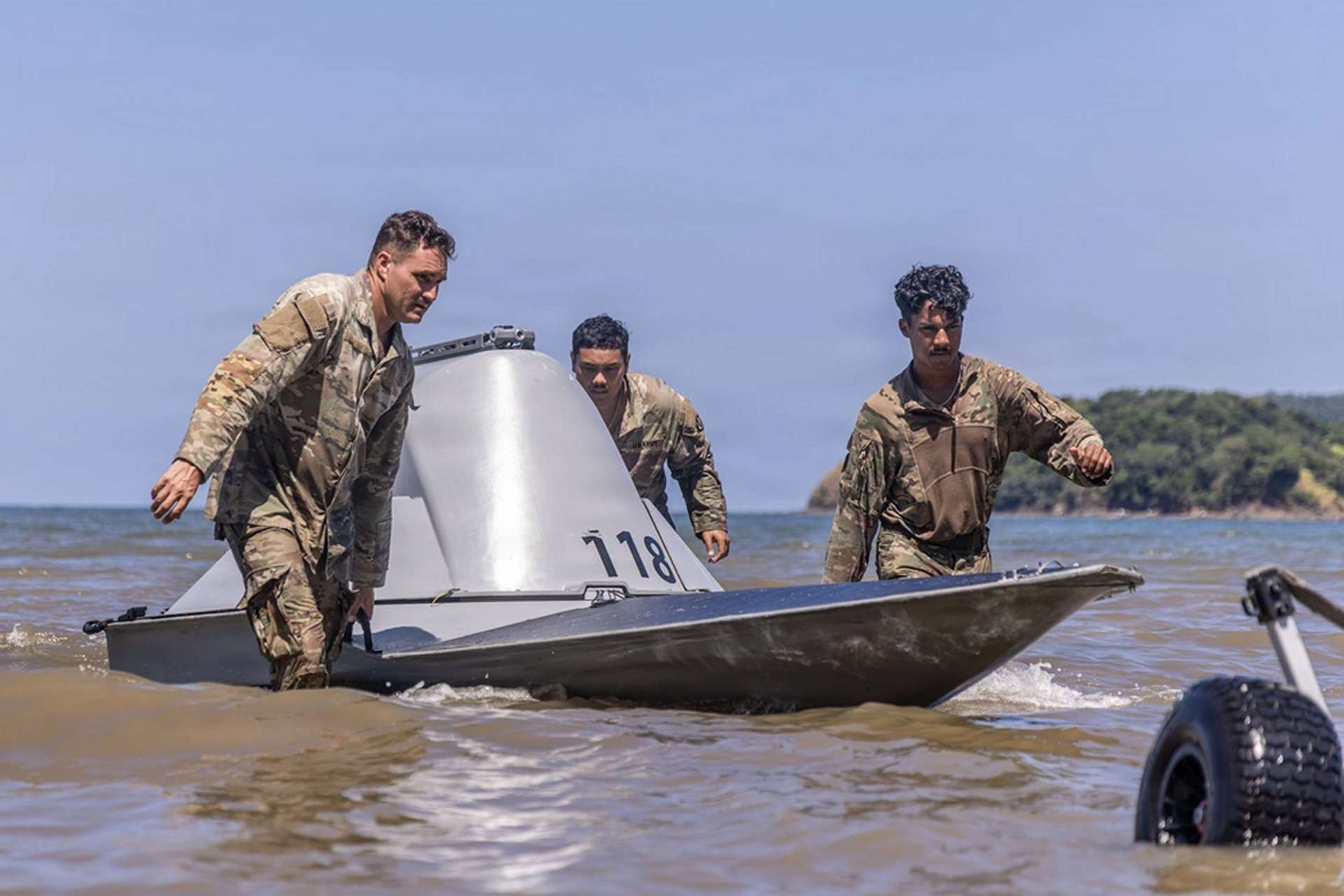
U.S. Army soldiers tested and fielded unmanned surface vessels during Exercise Salaknib 2026 in the Philippines, with DVIDS imagery posted on June 17 showing the 25th Infantry Division adding autonomous maritime sensors to an Army-led littoral security mission. The deployment matters because it extends reconnaissance and port-protection coverage while reducing the need to place soldiers on manned patrol boats.
The vessels were also used in Casiguran Sound to screen a U.S. Army logistics ship carrying Philippine Army armored vehicles and personnel over a 260-mile route. That mission shows how small unmanned systems can strengthen convoy security, improve coastal surveillance, and support distributed operations across the Indo-Pacific.
Related topic: General Motors and Lockheed Explore Missile Parts Production to Boost U.S. Munitions Output.
U.S. Army soldiers from the 25th Infantry Division tested unmanned surface vessels at Naval Base Camilo Osias in the Philippines during Exercise Salaknib 2026, demonstrating how small autonomous boats can support coastal surveillance, port security, and logistics protection in an archipelagic operating environment (Picture source: Army Recognition Group).
The Army caption does not name the vessel model, so the system should be described first as an unmanned surface vessel rather than overstated as a confirmed variant. However, the Philippine context is consistent with the MARTAC MANTAS T-12 unmanned surface vessels already supplied to the Philippines through U.S. foreign military financing and publicly identified by the Pentagon in November 2024 as a capability intended for operations across the Philippine exclusive economic zone in the South China Sea. Naval News has reported that the U.S. transfer included four MANTAS T-12 unmanned surface vessels and a larger Devil Ray T-38 unmanned surface vessel, with training support tied to Philippine maritime domain awareness requirements.
The armament question is important because these boats are not small missile craft, patrol boats, or gun-armed interceptors. No visible gun mount, missile rail, rocket launcher, or loitering-munition fixture appears in the publicly released Salaknib imagery, and the operational value of the vessel lies primarily in sensing, networking, and distributed coverage. For a T-12-type craft, the “combat load” is best understood as modular mission equipment: electro-optical and infrared cameras, communications terminals, electronic surveillance equipment, sonar or mine-countermeasure payloads, and onboard autonomy packages. In practical terms, the boat does not destroy a target by itself; it helps locate, classify, track, and report contacts so that a command post, coastal unit, aircraft, patrol craft, artillery battery, or missile unit can act on better data.
The technical baseline for the MANTAS T-12 helps explain why the U.S. Army is experimenting with it in the Philippines. The commercially listed vessel is 3.6 meters long, has a payload capacity of about 64 kg, uses an electric twin-screw powertrain, can exceed 30 knots in burst speed, cruises above 12 knots, and is advertised with a range above 100 nautical miles depending on configuration and mission profile. Its carbon-fiber catamaran hull provides a shallow draft and low visual signature relative to crewed patrol boats, while redundant communications and modular line-replaceable components make it suitable for field use by small detachments rather than only by naval technicians.
Operationally, the Salaknib mission is less about testing a single drone boat and more about evaluating whether Army intelligence and electronic-warfare units can run a maritime screen as part of a land force scheme of maneuver. In Casiguran Sound, the unmanned vessels reportedly spread across a perimeter as the Logistics Support Vessel approached port, transmitting information to personnel ashore in near real time; one soldier described the boats as escorting the LSV from about six miles out. That is a relevant distance in an archipelagic environment because the threat is often not a major surface combatant but an unidentified fast craft, a surveillance boat, a civilian vessel masking hostile intent, or a small unmanned system approaching a beach, pier, fuel point, or logistics ship.
Tactically, a swarm of small unmanned vessels changes the geometry of local security. A manned patrol boat searches sequentially, while a group of autonomous boats can hold separate sectors, maintain spacing, and create a moving sensor line ahead of a transport vessel or around a port entrance. The useful output is not only video; it is time. Earlier detection gives commanders more time to change a landing point, hold a logistics ship outside a vulnerable channel, cue an aerial sensor, warn a Philippine coastal unit, or prepare a non-kinetic response such as electronic monitoring. This is where the 125th Intelligence and Electronic Warfare Battalion’s involvement matters: the unit’s role is to turn raw signals, imagery, and position data into decision-quality information for commanders ashore.
Naval Base Camilo Osias also gives the exercise a specific strategic setting. The base, located in Santa Ana, Cagayan, was one of four additional Enhanced Defense Cooperation Agreement sites announced by the United States and the Philippines in April 2023, alongside Lal-lo Airport, Camp Melchor Dela Cruz, and Balabac Island. Cagayan faces the Luzon Strait and the waters between northern Luzon and Taiwan, while Balabac is oriented toward the South China Sea; together, these sites support a dispersed posture for logistics, sensing, and crisis response. The significance is that an Army division is practicing maritime security tasks that directly affect ground-force movement, port access, and sustainment under contested conditions.
The capability still has limits that should not be ignored. Small electric unmanned surface vessels can be affected by sea state, battery endurance, communications loss, jamming, capture, small-arms fire, and cyber intrusion. Their tactical usefulness depends on how quickly sensor data reaches a command node and whether that node is connected to forces able to respond. The Salaknib 2026 activity therefore should be read as a field evaluation of the command-and-control chain as much as a boat demonstration. It fits a broader U.S.-Philippine pattern: relatively small unmanned systems are being used to widen coverage, reduce risk to personnel, and complicate an opponent’s reconnaissance and interdiction planning without requiring the Philippines or the U.S. Army to deploy larger crewed vessels for every local security task.
Explore More Defense News
• Land Defense News
• Naval Defense News
• Defense Aerospace News
Written by Evan Lerouvillois, Defense Analyst.
Evan studied International Relations, and quickly specialized in defense and security. He is particularly interested in the influence of the defense sector on global geopolitics, and analyzes how technological innovations in defense, arms export contracts, and military strategies influence the international geopolitical scene.
Read more: U.S. Army Tests Unmanned Surface Vessels to Protect Logistics Ship in Philippine Waters

- Details
- Written by: Jérôme Brahy
- Category: Naval News Navy 2026
- Hits: 290
The Russian Navy frigate Admiral Grigorovich fired small-arms warning shots near the British-registered civilian sailing yacht Bright Future in the English Channel on June 16, 2026. The encounter occurred approximately 20 nautical miles south of the Isle of Wight within the United Kingdom's Exclusive Economic Zone during a period of heightened regional monitoring. British defense officials assessed the live-fire signaling as a non-aimed collision avoidance measure, while broader regional friction persists following the United Kingdom's maritime interdiction and seizure of the sanctioned shadow fleet tanker Smyrtos 48 hours prior.
The 4,035-tonne Russian surface combatant discharged four to five rounds of small arms following acoustic horn signals, citing a dangerous approach by the 12-meter civilian craft under restricted visibility. Discrepancies persist regarding the closest point of approach, with Russian military tracking citing a 150-meter separation while British crew accounts and naval monitoring assets reported a distance of 457 meters.
Related topic: Ukraine conducts second strike on Russian frigate Admiral Makarov within five weeks to disrupt missile attacks
On June 16, 2026, the Russian Navy frigate Admiral Grigorovich fired 4 to 5 rounds of warning small-arms fire during an encounter with the 12-meter British sailing yacht Bright Future in the English Channel. (Picture source: Telegram/Russian Navy)
As reported by the BBC on June 16, 2026, the Russian Navy frigate Admiral Grigorovich fired four to five rounds of small-arms warning fire near the 12-meter UK-registered sailing yacht Bright Future in the English Channel. The warning shots against the British yacht happened about 20 nautical miles south of the Isle of Wight and 35-40 nautical miles north of the French coast, outside the UK's 12-nautical-mile territorial sea but inside the UK's 200-nautical-mile Exclusive Economic Zone. The distance between the two vessels remains central to the incident: Russia put the closest approach at 150 meters, while the British account placed it at 457 meters, or 500 yards.
UK Prime Minister Sir Keir Starmer, speaking at the G7 summit on June 17, called the Russian action "reckless" and "deeply concerning," while accepting the Ministry of Defence assessment that the shots were warning measures linked to collision avoidance rather than aimed fire against the yacht. The timing was operationally sensitive because British forces had boarded and seized the sanctioned tanker Smyrtos on June 14, only 48 hours earlier. The Channel was already under pressure from Russian naval escort missions protecting sanctioned oil shipments, UK interdiction activity against shadow fleet tankers, and the constant movement of commercial, military, and civilian vessels through one of the world's busiest maritime routes.
A retired couple, Jane and Alan Kelvey, were sailing the yacht Bright Future when they came near Admiral Grigorovich. Their account gives a clear sequence: the Russian frigate first sounded five horn blasts, the maritime signal normally used to question whether another vessel has seen the ship or understood its intentions. The Kelveys then altered course by about two degrees to port, a small but deliberate change intended to show that they had seen the frigate and were responding. About one minute later, the frigate sounded another five horn blasts and then fired four to five rounds from small arms. The couple said the rounds were not aimed directly at them, but they also said the firing was unnecessary because the vessels were "definitely not on a collision course."
Russia gave a different sequence, saying the yacht ignored radio calls, did not respond to signal flares, and continued on a dangerous approach until it was within 150 meters of the warship. The British distance figure of 457 meters creates a different operational reading, because 500 yards is close for a frigate and a yacht, but still leaves enough space to question whether rifle fire was necessary in a crowded sea lane. The Russian frigate was not merely passing through the Channel as part of a normal transit between naval areas. During 2026, Admiral Grigorovich repeatedly operated between the Baltic approaches, the North Sea, and the English Channel, a route that links Russian Baltic oil export terminals to Atlantic shipping lanes.
In April 2026, the frigate was identified escorting sanctioned tankers, including Universal and Enigma, indicating that Moscow was willing to place a major combatant alongside commercial vessels connected to shadow fleet activity. NATO assessments linked the frigate to escort missions supporting Russian maritime sanctions-evasion networks, which means the ship's presence served an economic protection function as well as a naval one. The auxiliary vessel PM-82 reportedly provided logistical support, allowing Admiral Grigorovich to remain at sea for extended periods without returning to a major naval base. This matters because the deployment pattern looks less like a temporary Channel passage and more like a persistent naval security presence attached to tanker movements.
The Channel has therefore become a contact zone where Russian surface combatants, UK patrol vessels, French maritime security assets, ferries, tankers, fishing vessels, and recreational craft operate in the same constrained sea space. The Admiral Grigorovich frigate displaces 4,035 tonnes at full load and carries about 200 personnel, compared with a 12-meter civilian yacht operated by two retired persons. Its combat systems include Kalibr-capable vertical launch systems, Buk-derived air defense missiles, anti-submarine weapons, and a Ka-27 helicopter, making it a high-value Russian Navy combatant rather than a lightly armed patrol vessel.
Russian naval force protection practice normally treats major warships as requiring a security buffer, particularly when small craft approach at short range or when ship manoeuvrability is limited. British officials indicated that the frigate may have been drifting at the time, which would reduce its ability to manoeuvre and could make the crew more sensitive to an approaching vessel. If the ship was drifting, the Russian crew may have viewed Bright Future less as a threat and more as a collision hazard that had to be forced away quickly. The decision to use rifles rather than the frigate's heavier weapons indicates an escalation step below direct engagement, but firing near a civilian yacht in the English Channel still represents a high-risk method of signalling in a dense civilian maritime environment.
The incident also occurred after a major shift in UK policy toward Russia's shadow fleet. In March 2026, London expanded its maritime sanctions enforcement authorities and identified more than 500 vessels linked to Russian sanctions-evasion networks. In the weeks after that decision, nearly 200 sanctioned ships entered waters inside the UK's Exclusive Economic Zone, and most of those transits moved through the English Channel. The practical purpose of the policy is to reduce Russian oil export revenue that continues to support military expenditure. The operational change is that UK activity has moved beyond tracking and public identification toward boarding, interdiction, and seizure when conditions allow.
That shift changes the risk calculation for every Russian tanker movement through the Channel, because a sanctioned vessel may no longer assume that passage will only be monitored. It also increases the likelihood that Russian naval escorts and Western enforcement assets will operate in close proximity for hours or days, especially in sea lanes where a tanker cannot easily avoid UK or French surveillance. The seizure of Smyrtos on June 14, 2026, is the clearest example of this more active UK posture. Royal Marines and National Crime Agency personnel boarded the tanker in an operation involving helicopters, surface vessels, intelligence support, and law enforcement teams. The ship was carrying about 98,000 tonnes of Russian crude oil, a cargo large enough to make the seizure economically and politically significant. The operation was also the first publicly acknowledged UK-led seizure of a vessel linked to the shadow fleet.
Moscow had previously treated interdiction actions against sanctioned shipping as hostile, and Russian escort activity increased after Western governments adopted stronger measures against tanker networks. British authorities reject a direct causal link between the seizure and the warning-shot incident two days later, but the two events occurred inside the same operating area and the same sanctions enforcement cycle. The sequence shows how boarding operations against tankers can affect the behavior of nearby naval escorts even when a later encounter involves a civilian yacht rather than an interdiction team. The British military presence around the incident shows that the Russian frigate was already under observation before Bright Future entered the picture.
HMS Mersey was monitoring Admiral Grigorovich during the encounter, while HMS Tyne later sent personnel to speak with the yacht crew and check their condition. Additional Royal Navy support vessels and surveillance assets were active in the wider area, consistent with the pattern of tracking Russian naval movements from initial detection near the Bay of Biscay or the western approaches. The Channel handles hundreds of vessel movements each day, including tankers, container ships, ferries, fishing vessels, naval ships, and private yachts. This traffic density compresses decision-making time and makes small course changes more important than they would be in the open ocean.
It also means that a Russian warship under UK shadowing, a civilian yacht, fog or restricted visibility, and recent sanctions activity can quickly combine into an incident with political consequences. Persistent close monitoring by opposing navies does not require either side to seek escalation; it only requires one ambiguous movement to be interpreted through a tense operational context. The legal position is narrower than the political reaction. The incident took place beyond the UK's 12-nautical-mile territorial sea, so the Russian frigate was not inside UK territorial waters. It was inside the UK's Exclusive Economic Zone, but foreign warships retain freedom of navigation there, and warships also retain sovereign immunity under international maritime law.
That makes jurisdiction less important than proportionality. Warning shots are normally a late-stage signalling measure, used after less forceful methods such as radio calls, horn signals, visual signals, or course adjustments have failed. Russia argued that the shots were needed to prevent collision, while the UK assessment accepted that the rounds were warnings and were not aimed at the yacht. The unresolved issue is whether rifle fire was a proportionate response to a 12-meter civilian yacht at either 150 meters or 457 meters, especially when the encounter occurred in a congested civilian waterway rather than a restricted naval exercise area.
Even if London judges the action excessive, the available response is mainly diplomatic and political, because taking enforcement action against a foreign warship would raise both legal and escalation problems. The strategic meaning of the incident is that the English Channel is now part of the contest over Russia's wartime revenue base. Russia is using frontline naval combatants to protect economic activity, especially tanker movements linked to sanctioned crude oil exports. Escorting those tankers helps preserve routes from Russian Baltic terminals toward Atlantic markets, while keeping the Admiral Grigorovich deployed near Western Europe demonstrates that Moscow can maintain a naval presence outside the Black Sea despite wartime commitments elsewhere.
The UK response combines surveillance, sanctions enforcement, interdiction, law-enforcement boarding teams, and allied coordination. Neither side appears to be seeking a direct naval clash, but both sides are accepting more operational risk to defend competing objectives. The warning shots near Bright Future show the kind of friction likely to become more common: not formal fleet engagements, but tanker escorts, boarding operations, maritime inspections, close shadowing, and civilian navigation encounters under political pressure. The issue is therefore not only whether one yacht came too close to one frigate; it is the increasing overlap between economic warfare, sanctions enforcement, and naval operations in European waters.
Written by Jérôme Brahy
Jérôme Brahy is a defense analyst and documentalist at Army Recognition. He specializes in naval modernization, aviation, drones, armored vehicles, and artillery, with a focus on strategic developments in the United States, China, Ukraine, Russia, Türkiye, and Belgium. His analyses go beyond the facts, providing context, identifying key actors, and explaining why defense news matters on a global scale.
Explore More Defense News
• Land Defense News
• Naval Defense News
• Defense Aerospace News
Read more: Russian warship fires warning shots at British yacht in English Channel

- Details
- Written by: Lerouvillois
- Category: Naval News Navy 2026
- Hits: 479
Hanwha Ocean has been selected as the preferred bidder for South Korea’s KDDX next-generation destroyer program, a decision notified by DAPA on June 11, 2026, that moves the long-delayed project toward detailed design and lead-ship construction. The six-ship program will give the Republic of Korea Navy a new 6,000- to 6,500-ton surface combatant to strengthen air defense, anti-submarine warfare, strike, and escort capacity.
KDDX is intended to bridge the gap between South Korea’s KDX-II destroyers and larger KDX-III Aegis ships, adding more capable hulls without overusing the fleet’s top-tier missile-defense assets. With domestic combat systems, sensors, and vertical-launch weapons, the class reflects Seoul’s push for greater naval autonomy and a more resilient surface fleet.
Related topic: South Korea names final KDX-III Batch-II Aegis destroyer ROKS Daeho Kim Jongseo.
Hanwha Ocean's selection for South Korea's KDDX destroyer program advances a six-ship plan to field domestically designed warships with Korean radars, vertical-launch missiles, and electric propulsion, and stronger air-defense and anti-submarine capabilities for the Republic of Korea Navy (Picture source: @Foxtrot19_RADAR on X).
The procurement record is important to understanding the award: Daewoo Shipbuilding & Marine Engineering, now Hanwha Ocean, conducted the concept design in 2012; HD Hyundai Heavy Industries won the basic design contract in 2020 and completed that work in December 2023. The next phase had been expected in 2024 but was delayed by disputes over bidding rules and security penalties. South Korean reporting states that Hanwha Ocean received a final score of 93.9542 against HD Hyundai Heavy Industries’ 93.3675, a margin of 0.5867 points. HD Hyundai reportedly led in the technical score, 73.2383 to 72.5958, but its final total was affected by a 1.2-point security-related deduction linked to convictions over unauthorized handling of KDDX concept-design material.
That scoring detail is not incidental; it means the KDDX decision was shaped by both industrial competence and acquisition governance. Eight HD Hyundai Heavy Industries employees received final guilty verdicts in 2022 and one in December 2023 in cases involving KDDX-related military secrets; South Korean reporting says the additional deduction applies through December 2026, and a court dismissed HD Hyundai’s injunction request on June 5, 2026. For DAPA, the issue is not only who can build the lead destroyer, but whether sensitive naval design data can be protected in a program intended to maximize national control over hull, combat system, radar, launcher, and missile integration.
Technically, KDDX is intended to be South Korea’s first destroyer built around a largely domestic architecture rather than a foreign combat system. Public specifications remain incomplete, but current reporting describes a 6,500-ton class destroyer, with earlier open-source estimates placing full-load displacement closer to 8,000 tons, length around 155 meters, beam around 18.8 meters, and draft around 9.5 meters. The ship is expected to use an Integrated Electric Propulsion System, a first for a South Korean naval combat ship, which should reduce machinery noise compared with conventional mechanical drive and provide electrical growth margin for high-power radars, electronic warfare equipment, and later defensive systems. That matters tactically because a quieter destroyer is harder for submarines to classify and track, while additional electrical capacity reduces the risk that future upgrades will require structural redesign.
The combat system is centered on Hanwha Systems’ integrated mast with dual-band active electronically scanned array radar. The S-band radar is intended for long-range air surveillance and ballistic-missile detection and tracking; the X-band radar supports short-range air-defense control and surface target detection. This arrangement gives KDDX a different role from a simple escort destroyer. It can contribute to a fleet air picture, support missile engagement decisions, and help detect low-altitude cruise missiles flying over cluttered coastal waters. The integrated mast also reduces exposed antennas and deck clutter, which can lower radar cross-section and simplify electromagnetic management, both relevant in the Yellow Sea and East Sea, where warning times are compressed.
The armament is the core of the operational case. Reported fit includes a Mk 45 5-inch naval gun, two CIWS-II close-in weapon systems, eight anti-ship missiles likely in the SSM-700K Haeseong/C-Star family, and Korean Vertical Launch Systems in KVLS-I and KVLS-II configurations. KVLS-I gives compatibility with existing Korean naval missiles, while KVLS-II provides volume and thermal margins for larger interceptors and strike weapons. In practical terms, KDDX can be loaded according to mission: more K-SAAM missiles for local defense, more Ship-to-Air Missile-II rounds for fleet air defense, anti-submarine rockets for submarine hunting, or land-attack and anti-ship missiles for sea-control operations.
Ship-to-Air Missile-II is the most consequential new weapon in the program. DAPA signed a 330.6 billion won contract with LIG Nex1 in March 2024 to develop the missile by 2030, with a localization target above 90 percent. DAPA has not released full missile specifications, but official and industry reporting identify the weapon as a long-range ship-to-air missile for KDDX, intended to counter aircraft and cruise missiles and to reduce dependence on U.S.-supplied SM-series missiles. Reporting quotes that the missile is expected to replace SM-2 in KDDX service, use an active seeker, and receive mid-course updates; open-source estimates have cited more than 180 km range, dual-pulse propulsion, and guidance not dependent on external illuminators. Those details remain subject to confirmation, but they describe the intended tactical shift: KDDX should be able to engage multiple air threats without relying only on terminal illumination channels.
Anti-submarine warfare explains the destroyer’s relevance beyond air defense. North Korea’s submarine force is old in many areas, but Pyongyang is trying to add missile-launch capability at sea, and even limited submarine-launched cruise or ballistic missiles complicate South Korean defense planning by creating additional launch azimuths. KDDX is expected to operate hull sonar, towed-array sensors, anti-submarine rockets, torpedoes, and an embarked maritime helicopter, giving task groups a better ability to screen amphibious ships, logistics vessels, and larger missile-defense destroyers. KDDX only makes sense as part of a wider layered maritime-defense architecture, alongside KDX-III Batch II destroyers and South Korea’s broader response to North Korea’s naval missile development.
South Korea needs these destroyers for three concrete reasons. First, it is a trading state whose energy imports and exports depend on sea lines running through congested and increasingly militarized waters. Second, its navy must defend against North Korean aircraft, cruise missiles, ballistic missiles, fast attack craft, submarines, and special operations forces while also operating with U.S. and Japanese forces in missile warning and anti-submarine missions. Third, the current destroyer force is uneven: KDX-I ships are aging, KDX-II ships lack the sensor and missile depth of newer combatants, and KDX-III destroyers are too few and too expensive to cover every escort and surveillance mission. KDDX is therefore a force-density answer as much as a technology project.
The main risk is execution: Hanwha Ocean must convert a contested preferred-bidder result into detailed design discipline, combat-system integration, missile compatibility, and cost control, while LIG Nex1 must deliver Ship-to-Air Missile-II on a schedule that aligns with hull construction and fleet introduction in the 2030s. If legal challenges continue, the lead ship could lose more time, and the Navy would face a wider gap as older destroyers retire. The analytical conclusion is therefore cautious rather than celebratory: KDDX is a rational response to South Korea’s maritime threat environment and industrial policy goals, but its military value will depend on whether the lead destroyer arrives with a tested radar, certified launchers, a mature air-defense missile, and enough magazine capacity to operate under real missile saturation conditions.
Explore More Defense News
• Land Defense News
• Naval Defense News
• Defense Aerospace News
Written by Evan Lerouvillois, Defense Analyst.
Evan studied International Relations, and quickly specialized in defense and security. He is particularly interested in the influence of the defense sector on global geopolitics, and analyzes how technological innovations in defense, arms export contracts, and military strategies influence the international geopolitical scene.
Read more: South Korea Advances KDDX Destroyer Program with Hanwha Ocean for 6 New Warships

- Details
- Written by: Administrator
- Category: Naval News Navy 2026
- Hits: 394
U.S. forces disabled an oil tanker allegedly carrying Iranian crude through the Gulf of Oman using precision-guided AGM-114 Hellfire missiles, signaling a more aggressive approach to enforcing Washington’s campaign against Tehran’s energy exports. Announced by U.S. Central Command (CENTCOM) on June 11, 2026, the strike highlights the growing role of military power in disrupting maritime networks accused of supporting Iran’s oil trade.
The missiles reportedly targeted the vessel’s engine room, preventing it from continuing its voyage while limiting broader damage to the ship. The operation demonstrates how precision strike capabilities are being integrated into maritime interdiction missions, reinforcing deterrence and increasing pressure on the commercial routes that sustain Iran’s sanctioned energy sector.
Related Topic: US Navy redirects 100th cargo ship during naval blockade of Iran in Strait of Hormuz
Illustrative image showing a U.S. Army AH-64E Apache Guardian attack helicopter launching an AGM-114 Hellfire missile. CENTCOM reported that a U.S. aircraft fired two Hellfire missiles to disable the engine room of the Guinea-Bissau-flagged tanker M/T Jalveer in the Gulf of Oman on June 10, 2026, after the vessel allegedly failed to comply with U.S. directives. The image is not related to the actual operation. (Picture source: U.S. Department of War/Defense)
The engagement occurred at approximately 11:20 p.m. on June 10, 2026, ET and marks the third commercial vessel disabled by U.S. forces during the week. CENTCOM stated that M/T Jalveer was operating in the Gulf of Oman while transporting Iranian oil when it ignored repeated directives. Rather than targeting the vessel's cargo or hull, the strike was aimed specifically at the propulsion section, rendering the tanker incapable of continuing its voyage while limiting the risk of environmental damage or loss of life.
The AGM-114 Hellfire is a combat-proven precision-guided missile originally developed by the United States as an anti-tank weapon designed to destroy armored vehicles and fortified positions. Since entering service in the 1980s, the missile family has evolved into a versatile precision-strike weapon capable of engaging a broad range of targets, including armored vehicles, small boats, command posts, radar systems, and high-value mobile targets. Depending on the variant, Hellfire missiles employ semi-active laser guidance or advanced seeker technologies that provide high accuracy against stationary and moving targets while minimizing collateral damage.
Among the most likely aircraft capable of conducting such an engagement is the MQ-9 Reaper unmanned aerial vehicle. Widely deployed by the U.S. military across the Middle East, the MQ-9 combines long-endurance intelligence, surveillance, and reconnaissance capabilities with precision strike capacity. The aircraft can carry multiple AGM-114 Hellfire missiles beneath its wings and engage targets at extended ranges while remaining on station for more than 24 hours, depending on mission configuration. Its ability to continuously monitor maritime traffic and rapidly conduct precision attacks makes it particularly well-suited for interdiction missions against non-compliant vessels operating in the Gulf of Oman and surrounding waters. While CENTCOM has not disclosed the aircraft involved in the strike against M/T Jalveer, the MQ-9 remains one of the U.S. military's most frequently employed platforms for precision engagements in the CENTCOM area of responsibility.
One of the key advantages of the Hellfire missile is its compatibility with a wide range of launch platforms across the U.S. military. The weapon is most commonly associated with the U.S. Army's AH-64E Apache attack helicopter, which employs Hellfire missiles as its primary anti-armor armament. The missile is also carried by the U.S. Marine Corps' AH-1Z Viper attack helicopter, a combat aircraft designed for close air support, armed reconnaissance, escort, and maritime strike missions. In addition, Hellfire missiles are routinely deployed from MQ-1C Gray Eagle and MQ-9 Reaper unmanned aerial vehicles, providing precision strike capabilities during intelligence, surveillance, and reconnaissance operations. Several fixed-wing aircraft and naval systems can also employ Hellfire variants, making the weapon one of the most versatile precision-guided munitions in the U.S. arsenal for both land and maritime engagements.
The use of Hellfire missiles against M/T Jalveer highlights the growing role of precision-guided weapons in maritime interdiction missions. By targeting the vessel's engine room rather than its cargo tanks or structural hull sections, U.S. forces were able to disable propulsion without destroying the tanker. This approach reflects a calibrated use of force designed to stop non-compliant vessels while reducing the risk of a major oil spill, fire, or crew casualties.
Such operations require a sophisticated combination of intelligence gathering, maritime surveillance, target identification, and precision engagement capabilities. Before authorizing the strike, U.S. forces reportedly issued repeated instructions directing the vessel to comply. The decision to employ stand-off precision weapons after those warnings went unanswered illustrates how modern maritime enforcement increasingly relies on integrated surveillance and strike networks capable of responding rapidly to evolving situations at sea.
The incident also demonstrates the operational reach of CENTCOM's maritime security architecture across one of the world's most strategically important waterways. The Gulf of Oman serves as the gateway to the Strait of Hormuz, through which a substantial portion of global seaborne oil exports transits each day. Maintaining awareness and control across this region requires integrating naval forces, maritime patrol aircraft, satellites, intelligence assets, and armed aircraft capable of conducting precision engagements against identified targets.
The strike against M/T Jalveer follows two similar operations earlier in the week involving the Palau-flagged tankers M/T Marivex and M/T Settebello. According to CENTCOM, Marivex attempted to sail toward an Iranian port while Settebello was allegedly transporting Iranian oil. Their disabling indicates a sustained enforcement campaign rather than isolated incidents and suggests that U.S. forces are prepared to take direct action against vessels suspected of violating blockade measures.
According to CENTCOM, U.S. forces have disabled nine non-compliant vessels since the blockade began on April 13, while redirecting 135 ships that complied with coalition instructions. The command also reported allowing 42 humanitarian aid vessels to continue their voyages, emphasizing that enforcement measures are being applied against commercial activities linked to Iran while maintaining access for humanitarian shipments.
From a military perspective, the disabling of M/T Jalveer demonstrates how precision airpower can be employed as an alternative to more complex boarding operations. The ability to identify, track, and selectively disable commercial vessels from stand-off distances reduces risks to U.S. personnel while providing commanders with a rapid and proportionate enforcement option. The strike also highlights the flexibility of assets such as the AH-64 Apache, AH-1Z Viper, MQ-1C Gray Eagle, and MQ-9 Reaper, all of which can deliver precision-guided Hellfire missiles against maritime targets when required.
The incident further signals an evolution in the enforcement of maritime sanctions and blockades. Rather than relying exclusively on inspections and naval interception, U.S. forces are demonstrating an ability to impose immediate consequences on vessels that ignore coalition directives. The use of Hellfire missiles against M/T Jalveer underscores how precision-guided munitions, combined with persistent surveillance and maritime domain awareness, are becoming central tools in modern economic and security enforcement campaigns.
From a strategic standpoint, the operation sends a clear message about the U.S. resolve to restrict maritime activities that support Iranian oil exports. Beyond disabling a single tanker, the strike highlights the integration of intelligence, surveillance, and precision-strike capabilities into a comprehensive maritime enforcement framework that can influence shipping behavior in one of the world's most critical energy corridors. As maritime pressure on Iran's energy sector intensifies, the ability to rapidly detect, track, and disable non-compliant vessels is emerging as a key component of U.S. regional deterrence and maritime security strategy.
Explore More Defense News
• Land Defense News
• Naval Defense News
• Defense Aerospace News
Written by Alain Servaes – Chief Editor, Army Recognition Group
Alain Servaes is a former infantry non-commissioned officer and the founder of Army Recognition. With over 20 years in defense journalism, he provides expert analysis on military equipment, NATO operations, and the global defense industry.
- Details
- Written by: Nicanci
- Category: Naval News Navy 2026
- Hits: 393
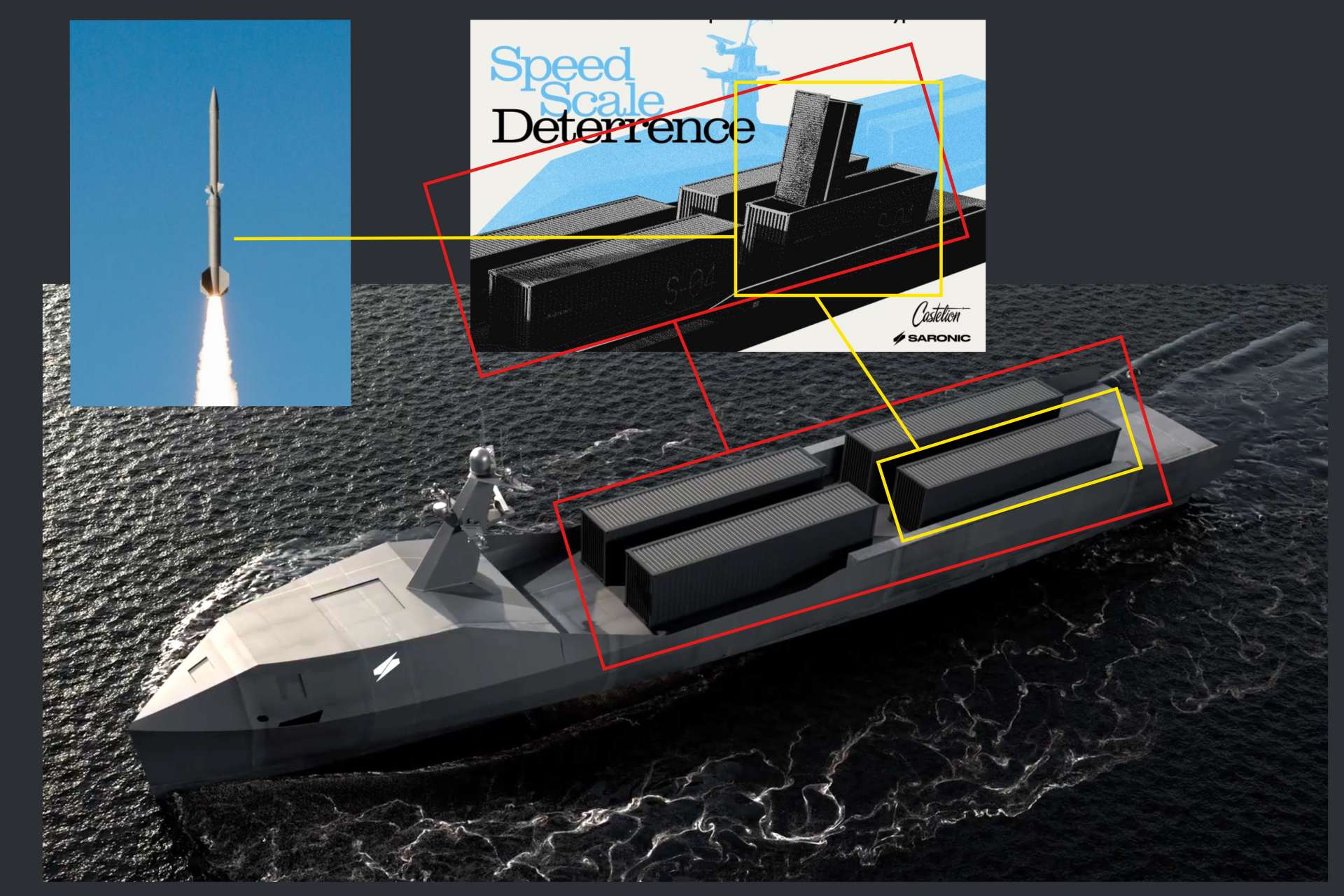
Saronic Technologies and Castelion are preparing to demonstrate a maritime hypersonic strike capability by integrating the Blackbeard missile with the autonomous Marauder unmanned surface vessel, according to company announcements released in June 2026. The planned 2027 test could give U.S. and allied forces a new way to deliver high-speed precision strikes from distributed, unmanned launch platforms, expanding combat options beyond traditional warships, aircraft, and land-based missile batteries.
Blackbeard is designed as a lower-cost hypersonic weapon built for large-scale production, while Marauder offers the range, payload capacity, and autonomy needed to operate as a forward maritime launch node. Together, they could support distributed maritime operations by increasing strike capacity, complicating enemy targeting, and extending hypersonic firepower across a wider and more survivable naval force.
Related Topic: Marauder MR-001 Medium Unmanned Surface Vessel Begins On-Water Trials To Shape Future U.S. Navy Force Structure
Saronic and Castelion are preparing a 2027 demonstration that would launch the Blackbeard hypersonic missile from the autonomous Marauder unmanned surface vessel, potentially creating a new distributed maritime strike capability for U.S. and allied forces (Picture Source: Saronic Technologies and Castelion / Edited by Army Recognition Group)
A new chapter in distributed maritime strike warfare is taking shape in the United States as defense technology firms Saronic Technologies and Castelion move toward a planned 2027 demonstration combining an autonomous surface vessel with a hypersonic missile capability. The initiative will see Castelion’s Blackbeard hypersonic strike missile integrated aboard Saronic’s 180-foot Marauder Medium Unmanned Surface Vessel (MUSV), creating a potentially disruptive launch platform capable of delivering long-range precision effects without relying on traditional crewed warships, combat aircraft, or fixed land-based missile batteries. Building on developments revealed throughout 2026 and previous Army Recognition reporting, the project highlights the growing convergence of autonomous naval systems and advanced strike weapons, a trend that could significantly expand the options available to U.S. and allied forces for distributed operations in contested maritime environments.
At the center of the initiative is Blackbeard, Castelion’s first low-cost hypersonic strike missile. The company presents the weapon as a hypersonic system designed from inception for industrial-rate production, commercial-level unit cost, and continuous flight-test iteration. This approach is intended to address a central weakness in many hypersonic programs: the difficulty of moving from technically complex prototypes to weapons available in operationally meaningful quantities. As Army Recognition reported on February 26, 2026, the U.S. Navy awarded Castelion a nearly $50 million contract to advance Blackbeard into full-scale prototypes, flight testing, and early operational fielding through November 2027, placing the program within a broader U.S. effort to field more affordable and manufacturable hypersonic strike options. Castelion has also stated that Blackbeard has already gone through more than 25 flight tests in less than two and a half years, while its production framework agreement with the U.S. Department of War calls for a guaranteed minimum of 500 missiles per year once testing and validation are complete, with a pathway toward thousands of additional missiles.
The operational relevance of Blackbeard is not limited to speed. Hypersonic weapons are intended to compress an adversary’s decision cycle, reduce warning time, and complicate interception by combining high velocity with maneuvering flight profiles that stress radar coverage, fire-control timelines, and interceptor kinematics. Army Recognition previously noted that Blackbeard has been described in U.S. Army budget language as a seeker-based hypersonic precision-fires weapon intended to engage time-sensitive moving targets and hardened targets at lower cost than comparable options. It has also been associated with dispersed launch concepts, including HIMARS-class systems and future autonomous or optionally crewed launcher families. This places Blackbeard in a tactical-operational niche between scarce high-end hypersonic systems and conventional long-range precision fires, with potential relevance for suppression of enemy air defenses, strikes against mobile launchers, attacks on hardened command nodes, and maritime targets of opportunity.
Saronic’s Marauder provides the maritime launch platform for this concept. The vessel is a 180-foot autonomous surface vessel designed to host and deliver payloads in complex maritime environments, with a maximum payload capacity of up to 150 metric tons, a range of 5,400 nautical miles with a base load, 4,100 nautical miles at maximum load, a 12-knot cruise speed, and a sprint speed above 25 knots. Its modular payload architecture, including compatibility with up to four 40-foot ISO containers or eight 20-foot ISO containers, makes it suitable for logistics, intelligence, surveillance and reconnaissance, communications relay, decoy operations, seabed monitoring, at-sea payload delivery, and potentially missile launch roles. In a hypersonic strike configuration, Marauder could act as a distributed unmanned magazine, pushing launch capacity forward while reducing risk to crewed naval assets.
The latest Saronic-Castelion announcement builds on an important platform milestone. As Army Recognition reported on June 4, 2026, Saronic launched its first Marauder Medium Unmanned Surface Vessel, designated MR-001, into the water and moved it into on-water trials after less than one year from initial design to launch. This matters because the hypersonic launch concept depends not only on missile integration but also on the ability of the unmanned vessel to prove seakeeping, autonomous navigation, command-and-control resilience, payload management, cyber protection, and safe operation in congested or contested waters. Marauder’s software-defined autonomy, with human-on-the-loop supervision, telemetry, diagnostics, subsystem monitoring, alerting, logging, historical replay, and remote intervention tools, is central to its potential role inside a wider naval command-and-control architecture.
The military significance of combining Blackbeard with Marauder lies in the creation of a mobile, unmanned, and potentially numerous maritime launch node. Current hypersonic strike concepts often depend on scarce aircraft, large surface combatants, submarines, or fixed and mobile land launchers. By placing hypersonic weapons on autonomous surface vessels, commanders could complicate adversary targeting and surveillance by dispersing launch points across a wider battlespace. This would create more azimuths of attack, more uncertain missile trajectories, and shorter reaction windows for enemy air and missile defense networks. In operational terms, the capability supports distributed maritime operations, distributed lethality, manned-unmanned teaming, and expeditionary strike concepts by separating high-value crewed platforms from the point of weapon release.
The system would also change the geometry of naval strike operations. A Marauder operating as an unmanned hypersonic launch platform could be positioned in maritime chokepoints, archipelagic waters, or forward operating areas where a destroyer, cruiser, or carrier strike group would face unacceptable exposure to anti-ship ballistic missiles, submarines, naval mines, long-range coastal defense missiles, or persistent ISR. If networked with off-board targeting assets such as maritime patrol aircraft, satellites, unmanned aerial systems, seabed sensors, crewed surface combatants, or other unmanned maritime nodes, a Blackbeard-armed Marauder could become part of a kill web rather than a stand-alone launcher. This would allow the platform to remain relatively simple in onboard sensor terms while relying on external targeting and command-and-control nodes to prosecute time-sensitive or high-value targets.
From a geostrategic perspective, the concept is particularly relevant to the Indo-Pacific, where distance, island geography, and Chinese anti-access and area-denial systems drive U.S. interest in dispersed, survivable, and scalable strike architectures. In a contingency around Taiwan, the South China Sea, the Philippine Sea, or the approaches to Guam and Japan, unmanned surface vessels carrying hypersonic weapons could add uncertainty to Chinese operational planning by expanding the number of possible launch locations beyond air bases, carriers, and known missile batteries. Army Recognition previously reported that the U.S. Navy is preparing to integrate more than 30 Medium Unmanned Surface Vessels into the Indo-Pacific by 2030, a force-structure direction that gives the Marauder-Blackbeard pairing broader strategic relevance. For Beijing, such a capability would increase the complexity of pre-emptive targeting, force allocation, maritime surveillance, and air and missile defense planning. For Washington and its allies, it could offer a way to generate strike capacity without concentrating too much combat power on a limited number of high-value platforms.
The capability also has implications beyond the Indo-Pacific. In the North Atlantic, Baltic Sea, Black Sea, Eastern Mediterranean, and Red Sea, unmanned maritime hypersonic launchers could reinforce deterrence by giving naval commanders additional options for rapid conventional strike against command nodes, air defense sites, missile batteries, naval formations, logistics hubs, or time-sensitive launchers. However, their value would depend on secure communications, resilient navigation, reliable remote or autonomous mission execution, and robust rules of engagement. A hypersonic missile launched from an unmanned surface vessel compresses decision time, making command authorization, target validation, positive control, and escalation management essential elements of the concept.
The main challenge will be turning a promising concept into a reliable operational weapon system. Launching a hypersonic missile from an unmanned surface vessel requires more than mechanical integration. It demands launch stabilization, thermal and structural protection, fire-control integration, secure datalinks, mission planning software, electromagnetic compatibility, safe weapon storage, remote arming procedures, flight-termination safety measures, and survivable command-and-control in contested electromagnetic environments. Saronic has already supported Castelion flight-test activity by operating its 24-foot Corsair autonomous surface vessel as an at-sea telemetry collection and communications node in late 2025, which indicates that the two companies are using risk-reduction steps before attempting the 2027 maritime launch demonstration. The 2027 test will be a test not only of a missile and a vessel, but of the architecture needed to connect autonomous maritime platforms with long-range precision fires.
The planned Saronic-Castelion demonstration points to a possible new phase in naval warfare: the fusion of autonomous surface vessels with hypersonic strike weapons. Blackbeard brings the promise of fast, scalable, and comparatively lower-cost hypersonic firepower, while Marauder offers range, payload capacity, modularity, autonomy, and unmanned maritime persistence. With the U.S. Navy already funding Blackbeard prototypes and fielding work through 2027, and with Marauder MR-001 now entering on-water trials, the concept is moving from industrial announcement toward practical experimentation. If successfully demonstrated and later fielded, this combination could give U.S. and allied commanders more launch points, deeper magazines, and greater operational flexibility in contested seas. Its strategic value would come not only from missile speed, but from the ability to distribute high-end strike capability across a larger, harder-to-predict maritime force.
Written by Teoman S. Nicanci – Defense Analyst, Army Recognition Group
Teoman S. Nicanci holds degrees in Political Science, Comparative and International Politics, and International Relations and Diplomacy from leading Belgian universities, with research focused on Russian strategic behavior, defense technology, and modern warfare. He is a defense analyst at Army Recognition, specializing in the global defense industry, military armament, and emerging defense technologies.
Explore More Defense News
• Land Defense News
• Naval Defense News
• Defense Aerospace News

- Details
- Written by: Nicanci
- Category: Naval News Navy 2026
- Hits: 371
A U.S. Navy LCAC carrying three Marine Corps LAV-25 reconnaissance vehicles was photographed departing the amphibious assault ship USS Boxer during operations in the South China Sea, according to imagery released by the U.S. Pacific Fleet on June 5, 2026. The deployment highlights the ability of the Boxer Amphibious Ready Group and the 11th Marine Expeditionary Unit to rapidly project mechanized combat power ashore, reinforcing deterrence and operational access in a region central to Indo-Pacific security.
The operation demonstrated the LCAC’s capacity to move armored reconnaissance vehicles directly from sea-based forces to austere coastal landing areas without relying on ports or fixed infrastructure. By combining high-speed amphibious mobility with the LAV-25’s reconnaissance and security capabilities, the mission underscores the growing importance of expeditionary maneuver, contested logistics, and distributed force employment in potential future conflicts across the littoral battlespace.
Related Topic: U.S. Marines Reinforce South China Sea Deterrence with AH-1Z Vipers at the Core of Boxer Amphibious Ready Group
U.S. Navy LCAC launched from USS Boxer carrying three Marine Corps LAV-25 reconnaissance vehicles during South China Sea operations, showcasing the ability of forward-deployed amphibious forces to rapidly project mechanized combat power ashore in a contested Indo-Pacific environment (Picture Source: U.S. Navy)
Newly released imagery from the U.S. Pacific Fleet dated June 5, 2026, shows a U.S. Navy Landing Craft, Air Cushion assigned to Assault Craft Unit 5 departing the Wasp-class amphibious assault ship USS Boxer during operations in the South China Sea. The 11th Marine Expeditionary Unit, embarked aboard the Boxer Amphibious Ready Group, was described as a persistent and combat-credible force contributing to deterrence and crisis response in the U.S. 7th Fleet area of operations. Beyond the official caption, the image carries a stronger operational message because it shows three Marine Corps LAV-25 light armored vehicles secured aboard the LCAC, turning a ship-to-shore movement into a visible demonstration of mechanized amphibious reach in one of the most contested maritime theaters of the Indo-Pacific.
The central element of the operation is the LCAC itself, a high-speed, over-the-beach amphibious surface connector designed to transport the weapons systems, equipment, cargo, and personnel of Marine Air-Ground Task Force assault elements from ship to shore and across the beach. Unlike a conventional displacement landing craft, the Landing Craft, Air Cushion rides on an air cushion, allowing it to move across water, surf zones, wet sand, mudflats, and beach gradients that could restrict other landing craft. In operational terms, this gives U.S. commanders a wider choice of potential landing areas and reduces dependence on ports, piers, or prepared coastal infrastructure. In the South China Sea, where access to fixed facilities could become politically sensitive or militarily vulnerable during a crisis, this ship-to-shore connector remains a critical tool for sea-based maneuver.
The presence of Marine LAV-25 vehicles aboard the craft gives the operation a more specific tactical meaning. The LAV-25 is not a heavy armored assault vehicle or a main battle tank; it is a light armored reconnaissance platform designed to provide mobility, observation, flank security, screening, and direct-fire support. Armed with a 25 mm M242 chain gun and machine guns, the vehicle can help secure a landing area, probe inland routes, establish observation positions, protect logistics nodes, and provide a mobile security screen for dismounted Marines. A LCAC carrying several LAV-25s therefore gives the 11th MEU an immediate mechanized reconnaissance element once ashore, enabling the landing force to move beyond the beachhead rather than remain concentrated near the shoreline.
The disembarkation from USS Boxer LHD 4 also highlights the continued relevance of Wasp-class amphibious assault ships in U.S. naval operations. Boxer is not simply a troop carrier or a helicopter platform; it is a large-deck amphibious warship built to combine aviation operations, command-and-control facilities, troop accommodation, medical support, logistics capacity, and a well deck able to launch surface connectors such as LCACs. The operation demonstrates the value of well deck operations, where Navy ship control teams, Assault Craft Unit crews, Marine vehicle crews, and landing force commanders must synchronize loading, ballasting, launch procedures, craft movement, and follow-on sustainment. In this configuration, Boxer functions as a mobile amphibious sea base able to generate surface assault, aviation support, and command functions from the maritime domain.
The South China Sea location gives the operation its geostrategic weight. This maritime space links the Western Pacific to the Indian Ocean and sits close to the First Island Chain, the Luzon Strait, Taiwan’s southern approaches, the Spratly Islands, and major sea lines of communication. It is also an area where freedom of navigation, maritime claims, military access, and allied reassurance remain central to U.S. regional strategy. Conducting LCAC operations in this theater sends a deterrence signal by showing that U.S. amphibious forces retain the ability to move combat-loaded surface connectors and Marine armored reconnaissance vehicles from ship to shore in a littoral environment where surveillance, missile threats, and access denial are major operational concerns.
The operation is also relevant to the broader problem of contested logistics. In a high-intensity Indo-Pacific crisis, fixed ports, large air bases, fuel sites, command nodes, and major logistics hubs could be exposed to missile strikes, cyber disruption, surveillance, or blockade pressure. LCAC operations offer a way to reduce dependence on established infrastructure by moving vehicles, ammunition, communications equipment, engineering support, and Marine assault elements directly from amphibious shipping to a usable stretch of coastline. This does not eliminate the difficulty of sustaining forces ashore, but it provides commanders with an important first-movement option for inserting combat power into the littoral battlespace while keeping the larger amphibious force mobile at sea.
The Boxer Amphibious Ready Group provides the wider operational framework for this capability. The formation includes USS Boxer LHD 4, the San Antonio-class amphibious transport dock USS Portland LPD 27, and the Whidbey Island-class dock landing ship USS Comstock LSD 45, with the 11th MEU embarked as a forward-deployable Marine Air-Ground Task Force. This gives U.S. commanders a distributed amphibious package able to aggregate or disperse depending on the mission. Boxer provides flagship, aviation, and well deck functions; Portland adds amphibious lift and command flexibility; and Comstock contributes additional dock landing ship capacity for surface connectors, vehicles, and sustainment flow. Together, the ARG and MEU can support missions ranging from deterrence and crisis response to tactical recovery of aircraft and personnel, maritime security, embassy reinforcement, limited raids, humanitarian assistance, and amphibious operations.
The June 5, 2026 LCAC operation from USS Boxer should be read as more than a routine training event. It shows a U.S. Navy and Marine Corps team practicing one of the most demanding aspects of expeditionary warfare: moving armored Marine reconnaissance vehicles from a well deck-equipped warship into the littoral space. By publicly showing an LCAC from Assault Craft Unit 5 carrying Marine LAV vehicles during operations in the South China Sea, the U.S. Pacific Fleet demonstrated a practical form of sea-based deterrence. In a region shaped by strategic competition, contested maritime claims, and the need to preserve operational access, the combination of USS Boxer, the Boxer Amphibious Ready Group, the 11th MEU, LCAC connectors, and Marine LAV-25 vehicles reinforces the U.S. ability to project crisis-response and ship-to-shore combat mobility across the Indo-Pacific.
Explore More Defense News
• Land Defense News
• Naval Defense News
• Defense Aerospace News
Written by Teoman S. Nicanci – Defense Analyst, Army Recognition Group
Teoman S. Nicanci holds degrees in Political Science, Comparative and International Politics, and International Relations and Diplomacy from leading Belgian universities, with research focused on Russian strategic behavior, defense technology, and modern warfare. He is a defense analyst at Army Recognition, specializing in the global defense industry, military armament, and emerging defense technologies.

- Details
- Written by: Lerouvillois
- Category: Naval News Navy 2026
- Hits: 459
USS George Washington carried out helicopter operations in the Philippine Sea on June 9–10, keeping the U.S. Navy’s only forward-deployed aircraft carrier active inside a key Western Pacific operating area. The activity matters because the carrier is already based in Japan, giving U.S. forces a persistent aviation platform close to potential flashpoints.
The operations show that the George Washington Carrier Strike Group is sustaining flight-deck readiness during its spring patrol after completing carrier qualifications on May 28, as reported by USNI. This supports rapid response, maritime deterrence, and continuous presence across the U.S. 7th Fleet area of operations.
Related topic: U.S. Navy Arleigh Burke-Class Destroyer USS Michael Murphy Launches Tomahawk Missiles in Self-Defense Strikes on Iran.
USS George Washington (CVN 73) conducted MH-60 Seahawk helicopter operations in the Philippine Sea, highlighting the U.S. Navy's forward-deployed carrier presence, rotary-wing anti-submarine and anti-surface capabilities, and operational readiness amid growing Chinese naval activity in the Western Pacific (Picture source: U.S. DoW).
The helicopter activity points specifically to Helicopter Sea Combat Squadron 12, the “Golden Falcons,” which operates the MH-60S Seahawk as part of Carrier Air Wing 5. Unlike the MH-60R, which is optimized for anti-submarine warfare with dipping sonar and sonobuoy processing, the MH-60S is configured around combat support, vertical replenishment, search and rescue, special operations support, aeromedical evacuation, and armed surface-security missions. This distinction matters because the June 10 operation was not simply a generic rotary-wing flight from an aircraft carrier. It showed the carrier strike group exercising one of the functions that allows a forward-deployed naval force to remain at sea, move supplies, recover personnel, and respond to low-level maritime threats without immediately relying on destroyer-launched missiles or fixed-wing strike aircraft.
The MH-60S is powered by two General Electric T700-GE-401C turboshaft engines and has a maximum gross weight of about 23,500 pounds. It can reach roughly 180 knots, operate up to about 13,000 feet, and fly approximately 245 nautical miles depending on payload, fuel load, weather, and mission profile. The helicopter normally operates with two pilots and two enlisted aircrew members, but its cabin can be adapted for cargo, passengers, litter patients, rescue equipment, door guns, or mission kits. For a carrier strike group, that flexibility is important because the same aircraft type can support flight operations in the morning, move parts to an escorting destroyer later in the day, and provide armed overwatch during a small-boat approach or recovery operation.
Its armament gives the carrier commander a scalable response option at short range. The MH-60S can carry M240 7.62 mm machine guns and GAU-21 .50 caliber machine guns for defensive fire and close maritime security. The GAU-21 is particularly relevant in the maritime environment because it provides more range, penetration, and stopping effect than rifle-caliber weapons against small boats, exposed equipment, and lightly protected targets. In its armed configuration, the MH-60S can also employ AGM-114 Hellfire missiles and Advanced Precision Kill Weapon System laser-guided 70 mm rockets. Hellfire gives the aircraft a precision weapon against fast attack craft or lightly protected surface targets, while APKWS provides a lower-cost guided munition with a smaller explosive effect, useful where identification, proportionality, and collateral-damage control are operational concerns.
This weapon mix is relevant to the Philippine Sea because the most probable day-to-day challenges for a carrier strike group are not limited to a high-end naval battle. U.S. forces operating in the Western Pacific may encounter suspicious vessels, unmanned surface craft, fast inshore attack boats, intelligence-collection ships, or maritime harassment around replenishment groups and allied naval units. In those conditions, an MH-60S can identify, shadow, warn, escort, or, if required, engage a contact while the carrier’s command team continues to assess intent. That buys time. It also prevents commanders from being forced too early into using larger weapons designed for higher-end combat.
The aircraft’s sensors and defensive systems are part of the capability. Armed MH-60S configurations have been associated with the AAS-44C multi-spectral targeting system, radar warning equipment, missile warning sensors, countermeasures dispensers, infrared countermeasures, and digital mapping systems. These systems allow the crew to detect, classify, track, and engage targets more effectively than with visual observation alone. They also help the helicopter survive in a littoral environment where threats may include man-portable air defense systems, heavy machine guns, small-caliber naval guns, or radar-guided systems operating from ships or coastal positions. The MH-60S is not designed to penetrate dense integrated air defense networks, but it is suitable for controlled operations around the carrier force, escort ships, logistics vessels, and lower-threat maritime zones.
The tactical value of the MH-60S is also tied to recovery and sustainment. Aircraft carriers operate through a constant cycle of launch, recovery, refueling, weapons movement, maintenance, and deck coordination. Helicopters support that cycle by moving urgent components, carrying passengers, transferring mail and equipment, evacuating casualties, and maintaining search-and-rescue coverage during flight operations. If an aircrew ejects or an aircraft goes down near the strike group, the MH-60S is often the aircraft expected to reach the survivor first. That mission is not symbolic. In wartime, the ability to recover trained pilots and aircrew has direct military value, because experienced aviators are difficult to replace and their loss affects combat endurance.
The George Washington deployment gives these helicopter operations a larger strategic meaning. The ship is homeported at Yokosuka, Japan, which places it much closer to potential crisis areas than a carrier based in San Diego, Bremerton, or Norfolk. The U.S. Navy has assessed that forward deployment in Japan reduces transit time by an average of about 17 days compared with forces sailing from the continental United States. In a Western Pacific contingency, 17 days could decide whether a carrier strike group is present during the opening phase of a crisis or arrives after the regional military balance has already shifted. This is particularly relevant around Taiwan, the Luzon Strait, the Ryukyu island chain, and the northern South China Sea, where geography compresses decision timelines and favors forces already in position.
The Philippine Sea is a critical operating area because it sits east of Taiwan and Luzon, south of Japan, and west of Guam. It offers maneuver space outside the densest concentration of Chinese coastal missile systems while still allowing U.S. and allied forces to influence events around the first island chain. For Japan, the area affects the defense of the Ryukyu Islands and access between the East China Sea and the wider Pacific. For the Philippines, it connects northern Luzon with broader U.S. and allied naval access. For Taiwan, it matters because eastern approaches could become important for surveillance, reinforcement, submarine operations, and air or naval maneuver if the western side of the island comes under heavy pressure.
Chinese naval activity has made this geography more important. The People’s Liberation Army Navy has increased operations beyond the first island chain, including carrier activity east of Taiwan and Luzon, transits through the Miyako Strait, and exercises that place Chinese surface groups in waters where U.S. and Japanese forces have long operated. Beijing’s naval expansion is not only a matter of ship numbers; it is also about learning how to operate carrier air wings, escorts, replenishment ships, submarines, maritime patrol aircraft, and command networks at a distance. U.S. carrier operations in the Philippine Sea, therefore, serve two purposes at once: maintaining day-to-day readiness and demonstrating that American naval forces can still operate in areas where China is trying to expand regular presence.
The June 10 MH-60S operation should be understood in that context. A single helicopter launch or recovery does not change the regional balance by itself, and it should not be overstated. Its significance lies in what it reveals about the operating model of a forward-deployed carrier strike group. The carrier requires armed helicopters, logistics helicopters, rescue aircraft, fighters, electronic attack aircraft, airborne early warning aircraft, destroyers, supply ships, and trained personnel working together continuously. The MH-60S is one of the practical tools that keep the system functional. In a crisis, its ability to move supplies, recover personnel, escort ships, inspect contacts, and apply measured force may shape the early tactical picture before larger combat systems are used.
Explore More Defense News
• Land Defense News
• Naval Defense News
• Defense Aerospace News
Written by Evan Lerouvillois, Defense Analyst.
Evan studied International Relations, and quickly specialized in defense and security. He is particularly interested in the influence of the defense sector on global geopolitics, and analyzes how technological innovations in defense, arms export contracts, and military strategies influence the international geopolitical scene.
Read more: U.S. Carrier George Washington Deploys MH-60 Seahawk Helicopters Near China Flashpoints

- Details
- Written by: Nicanci
- Category: Naval News Navy 2026
- Hits: 447
The U.S. Navy has reactivated Submarine Squadron 3 in Western Australia, DVIDS reported on June 10, 2026, creating a forward command element for AUKUS submarine operations at HMAS Stirling. The move strengthens allied undersea deterrence in the Indo-Pacific by giving U.S. and future UK attack submarines a more resilient support base closer to key maritime corridors.
CSS-3 will help coordinate maintenance, logistics, and operational support for Submarine Rotational Force-West before regular nuclear-powered submarine rotations begin in 2027. Its return turns AUKUS from a future acquisition plan into a working undersea warfare network that builds Australian expertise while increasing allied readiness, survivability, and reach.
Related Topic: Australian Army Creates New Littoral Manoeuvre Group for Indo-Pacific Amphibious Operations
The U.S. Navy has reactivated Submarine Squadron 3 at HMAS Stirling in Western Australia, establishing a forward command structure that will support AUKUS submarine rotations and strengthen allied undersea deterrence across the Indo-Pacific (Picture Source: U.S. Navy)
On June 10, 2026, the Defense Visual Information Distribution Service reported that the U.S. Navy had reestablished Submarine Squadron 3, or CSS-3, to support Submarine Rotational Force-West at HMAS Stirling in Western Australia. The move marks a new phase in the Australia, United Kingdom, United States AUKUS trilateral security partnership, turning the undersea component of the agreement into a forward naval command structure on Australian territory. By restoring a squadron that previously operated from Pearl Harbor, Hawaii, and was decommissioned in February 2012, the U.S. Navy is reinforcing its Indo-Pacific submarine posture while helping Australia prepare the command, logistics, maintenance, and workforce foundations required for a future sovereign conventionally armed, nuclear-powered submarine fleet.
The reactivation of CSS-3 should be read as more than the return of a former U.S. submarine squadron. It represents one of the first visible layers of a forward undersea command architecture designed to connect U.S. Navy nuclear-powered attack submarine operations, Royal Australian Navy support structures, and future UK submarine rotations into a single operational framework in the eastern Indian Ocean. The last incarnation of CSS-3 ended on February 2, 2012, when the Pearl Harbor-based Commander, Submarine Squadron 3 was disestablished during a ceremony aboard the Los Angeles-class nuclear-powered attack submarine USS Greeneville at Joint Base Pearl Harbor-Hickam.
At that time, the squadron’s attack submarines were reassigned across the Pacific submarine force: USS Jacksonville, USS Key West, and USS North Carolina moved to Submarine Squadron 1, while USS Louisville and USS Olympia were assigned to Submarine Squadron 7, and USS Chicago was assigned to Submarine Squadron 15 in Apra Harbor, Guam. This historical background gives the 2026 reactivation added operational meaning, as CSS-3 returns not as a traditional Pearl Harbor-based submarine squadron but as a forward-positioned command element at the center of AUKUS implementation in Australia.
Submarine Rotational Force-West is the core of this architecture. From 2027, U.S. and UK nuclear-powered fast-attack submarines are expected to conduct rotations from HMAS Stirling, allowing allied SSNs to operate from a forward location with access to local maintenance, logistics support, pier services, command coordination, and trained Australian personnel. This model gives the United States and its partners a more flexible undersea posture without converting the base into a permanent foreign homeport. It also reduces transit distances from distant facilities, improves operational availability, and gives allied commanders greater flexibility for anti-submarine warfare, anti-surface warfare, intelligence collection, maritime surveillance, sea-denial missions, special operations support, and protection of sea lines of communication.
CSS-3 will provide the command and coordination layer needed to make these rotations credible and sustainable. Its personnel will integrate with Royal Australian Navy counterparts to prepare maintenance, logistics, and operational support for rotational U.S. and UK submarines at HMAS Stirling. This integration will expose Australian sailors, civilian maintainers, divers, and Fleet Support Unit personnel to the standards that govern nuclear-powered submarine operations, including intermediate-level maintenance, diving support, hull services, port safety, logistics planning, emergency response procedures, and the nuclear stewardship culture required for SSN sustainment. For Australia, this is a direct path toward building national expertise; for the United States, it creates a stronger forward support network for its fast-attack submarine force.
The geostrategic value of HMAS Stirling gives the decision wider military relevance. Located on Australia’s west coast near Perth, the base provides access to the eastern Indian Ocean, the approaches to Southeast Asia, and onward routes toward the Western Pacific. This position gives allied SSNs the ability to operate across a broad maritime arc without relying only on Guam, Hawaii, Japan, or U.S. West Coast facilities. In a region shaped by long-range missiles, expanding submarine fleets, seabed infrastructure vulnerabilities, and competition for control of maritime corridors, a distributed submarine support network gives the United States and Australia greater resilience and complicates the calculations of any potential adversary seeking to track, contain, or disrupt allied undersea operations.
The establishment of Naval Support Activity Stirling adds the shore infrastructure needed to support this operational concept. NSA Stirling will provide services and programs for U.S. military personnel, civilians, contractors, and their families assigned to SRF-West, creating the administrative and quality-of-life framework required for a durable rotational presence. In parallel, Pearl Harbor Naval Shipyard and Intermediate Maintenance Facility is expected to stand up a maintenance and logistics detachment in Western Australia in mid-2026. This detachment will oversee and execute intermediate-level maintenance on U.S. submarines assigned to SRF-West while continuing to train the Australian workforce. Approximately 20 Australian civilian maintainers and 25 Royal Australian Navy divers and Fleet Support Unit personnel have already completed training at Pearl Harbor, with more than 230 additional Australians under instruction in Hawaii.
For Washington, the arrangement strengthens forward readiness by expanding repair options, improving theater responsiveness, and easing pressure on U.S. shipyards. For Canberra, it accelerates the development of a sovereign SSN support base and confirms Australia’s role as one of America’s most trusted undersea warfare partners. The AUKUS model is not limited to the future acquisition of Virginia-class submarines and the later development of SSN-AUKUS; it is creating an operational ecosystem in which Australian personnel learn aboard in-service submarines, support visiting allied SSNs, and gradually acquire the skills needed to operate, maintain, and regulate their own nuclear-powered submarine capability. This gives Australia a more active role in allied deterrence while reinforcing its position as a key maritime power in the Indo-Pacific.
The return of Submarine Squadron 3 marks a concrete shift in the implementation of AUKUS Pillar I. By linking CSS-3, NSA Stirling, Pearl Harbor Naval Shipyard support, and Royal Australian Navy workforce training, the United States and Australia are building the operational foundation for SRF-West before the first regular SSN rotations begin in 2027. This strengthens allied undersea readiness, supports Australia’s sovereign submarine ambitions, and places HMAS Stirling at the center of a long-term deterrence architecture across the Indo-Pacific.
Explore More Defense News
• Land Defense News
• Naval Defense News
• Defense Aerospace News
Written by Teoman S. Nicanci – Defense Analyst, Army Recognition Group
Teoman S. Nicanci holds degrees in Political Science, Comparative and International Politics, and International Relations and Diplomacy from leading Belgian universities, with research focused on Russian strategic behavior, defense technology, and modern warfare. He is a defense analyst at Army Recognition, specializing in the global defense industry, military armament, and emerging defense technologies.
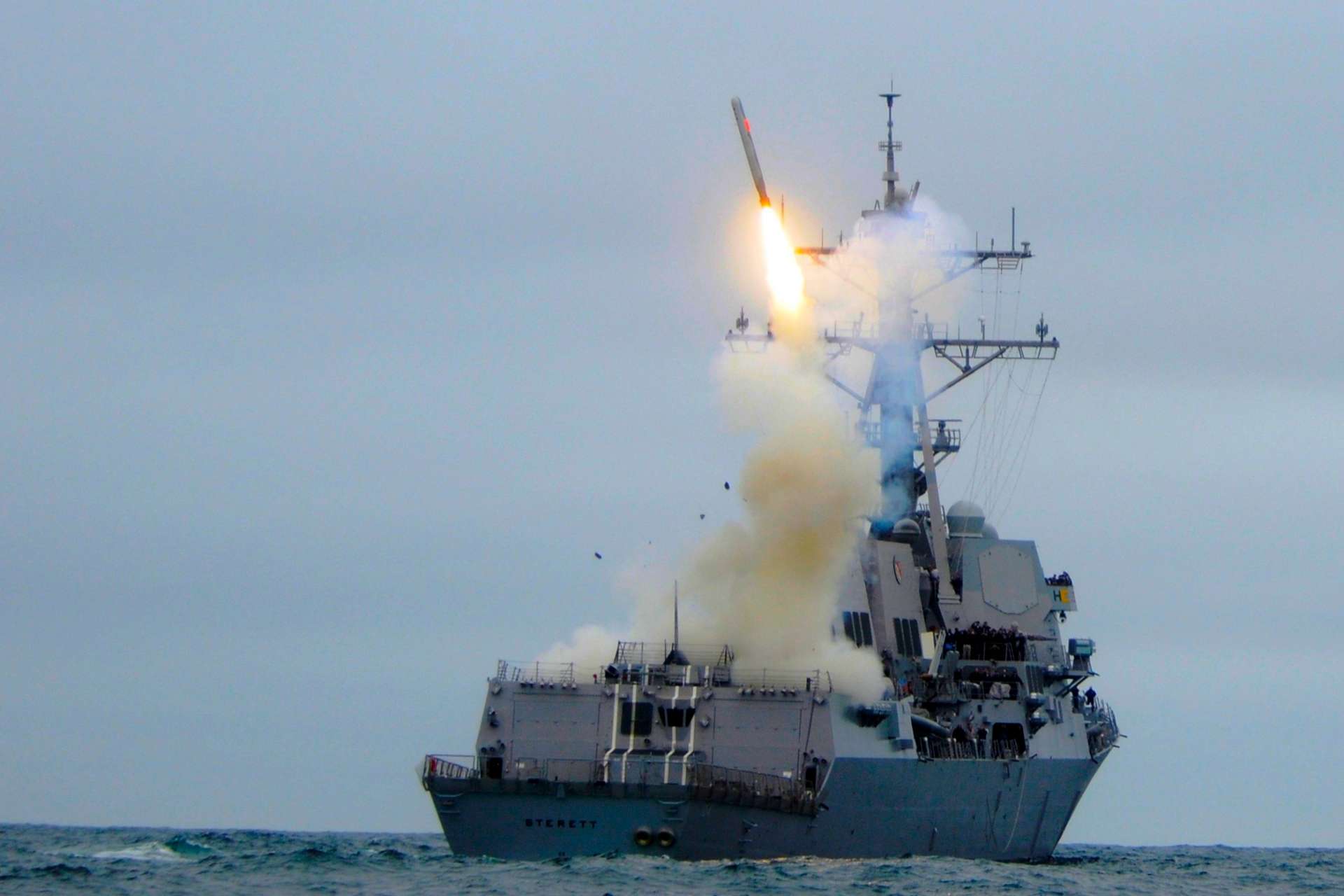
- Details
- Written by: Nicanci
- Category: Naval News Navy 2026
- Hits: 706
USS Michael Murphy launched Tomahawk cruise missiles during U.S. self-defense strikes against military targets in Iran, placing the Arleigh Burke-class destroyer at the forefront of Washington’s latest military response in the region. Announced by U.S. Central Command on June 10, 2026, the operation highlights the Navy’s ability to deliver precision firepower from the sea against threats to American forces and international shipping while reducing reliance on regional air bases and manned aircraft.
The strikes targeted Iranian surveillance, communications, and air-defense systems, demonstrating the effectiveness of long-range naval weapons in disrupting military networks that support threat detection and response. By employing Tomahawk missiles from a mobile sea-based platform, the United States reinforced the value of distributed maritime strike capabilities as a flexible tool for deterrence, force protection, and escalation management in a strategically vital theater.
Related Topic: U.S. Navy Seeks $7.3 Billion for 785 Tomahawks and 540 SM-6 Missiles to Rebuild Fleet Firepower and Stocks
The Arleigh Burke-class destroyer USS Michael Murphy launched Tomahawk cruise missiles during U.S. self-defense strikes against Iranian military targets, demonstrating the Navy’s ability to deliver long-range precision firepower from the sea while supporting regional security and protecting international shipping routes (Picture Source: U.S. Navy)
On June 10, 2026, U.S. Central Command announced that American forces had completed additional self-defense strikes against multiple targets in Iran following operations conducted on June 10. According to CENTCOM, the strikes targeted Iranian military surveillance capabilities, communication systems, and air defense sites assessed as threats to U.S. forces and international commercial shipping. The announcement highlighted USS Michael Murphy (DDG 112), an Arleigh Burke-class guided-missile destroyer, which launched Tomahawk cruise missiles in support of the operation, underscoring the continued importance of U.S. naval power in protecting American forces, sustaining freedom of navigation, and preserving maritime security across a strategically sensitive theater.
The role of USS Michael Murphy in these strikes places the destroyer at the center of the latest U.S. military response in the region. DDG 112 is not only an escort vessel or an air-defense platform; it is a multi-mission surface combatant designed to combine surveillance, command-and-control, air defense, anti-submarine warfare, anti-surface warfare, and land-attack capabilities within a single ship. In this operation, its participation demonstrated the ability of the U.S. Navy to deliver precision effects from the sea without depending solely on regional air bases or manned strike aircraft operating directly over contested areas. This reflects a core principle of modern naval warfare: the ability to use distributed sea-based firepower to impose military costs, complicate adversary planning, and maintain operational flexibility while reducing exposure of personnel and high-value aviation assets.
As an Arleigh Burke-class destroyer, USS Michael Murphy is built around the Aegis combat architecture and the Mk 41 Vertical Launching System, giving it the capacity to employ a range of defensive and offensive missiles depending on mission requirements. This flexibility is particularly relevant in the Middle East, where U.S. naval forces may be required to defend themselves, escort or protect commercial traffic, support joint operations, and strike military targets ashore. The use of Tomahawk missiles from DDG 112 illustrates how a single U.S. destroyer can contribute to a wider joint operation while remaining mobile, survivable, and integrated into a broader regional force posture. In naval terms, the ship acts as a node within a distributed maritime force, able to receive targeting data, support joint fires, contribute to air and missile defense, and deliver land-attack effects from a standoff position.
The Tomahawk cruise missile remains one of the most significant conventional strike weapons in the U.S. Navy inventory. Launched from surface ships and submarines, it is designed to strike high-value or heavily defended land targets from long range, flying at low altitude and high subsonic speed along mission-planned routes. Current Block V Tomahawk missiles include navigation and communications upgrades that preserve the ability to receive in-flight targeting updates and improve navigation performance. These characteristics make the weapon particularly suitable for targeting surveillance sites, communications nodes, and air defense infrastructure while reducing exposure for U.S. personnel. In operational terms, Tomahawk provides a standoff precision-strike capability that can be integrated into a broader suppression or disruption effort against an adversary’s command, control, communications, computers, intelligence, surveillance, and reconnaissance architecture.
The launch of Tomahawk missiles from USS Michael Murphy carries a clear strategic message. It shows that the United States can respond to threats with precision, from international waters, and at a distance that limits the immediate vulnerability of U.S. crews and aircraft. This gives Washington a controlled military option between diplomatic signaling and a broader campaign. In operational terms, the strikes also demonstrate the value of sea-based strike assets in a region where access, basing permissions, airspace restrictions, and escalation management all influence military planning. A destroyer equipped with Tomahawk missiles can remain outside the immediate range of many coastal threats while still holding critical military infrastructure at risk, giving commanders a flexible tool for deterrence, response, and calibrated force application.
Geopolitically, the operation reinforces the central role of U.S. naval forces in safeguarding freedom of navigation and supporting the security of maritime routes that remain essential to global trade and energy flows. By using USS Michael Murphy and Tomahawk cruise missiles, the United States signaled that threats to its forces or to international commercial shipping can be met with targeted military action. At the same time, the focus on military surveillance, communications, and air defense sites allows the operation to be framed as a limited and defensive response rather than a broad escalation campaign. This distinction is important because it shows an attempt to preserve deterrence while avoiding unnecessary expansion of the confrontation, using precision naval fires against military enablers rather than indiscriminate force.
The strike also highlights the importance of sustained precision-strike readiness. Tomahawk missiles continue to form a central part of the U.S. Navy’s long-range strike architecture, and recent efforts to expand missile production reflect the growing operational demand for weapons that can be launched from ships and submarines across multiple theaters. For the Navy, the value of platforms such as USS Michael Murphy lies not only in their sensors, defensive systems, and command networks, but also in their capacity to carry and launch precision weapons that can shape events ashore from the maritime domain. This ability is central to modern maritime power projection, where surface combatants are expected to operate as strike platforms, air-defense nodes, intelligence-sharing assets, and command-and-control contributors within a joint and coalition battlespace.
The June 10 operation demonstrates how U.S. sea power continues to provide national decision-makers with flexible, credible, and measured response options. The use of USS Michael Murphy and Tomahawk cruise missiles sent a firm message that American forces remain capable of acting rapidly and precisely when U.S. personnel or international shipping are placed at risk. While the situation with Iran remains politically sensitive and carries the risk of escalation, the operation showed that a single guided-missile destroyer can support deterrence, protect U.S. interests, and project precision firepower without abandoning the principle of controlled response. In a region where surveillance networks, air defense systems, maritime chokepoints, and commercial shipping routes are closely connected, the strike underlined the continuing relevance of U.S. naval forces as instruments of deterrence, assurance, and operational reach.
Explore More Defense News
• Land Defense News
• Naval Defense News
• Defense Aerospace News
Written by Teoman S. Nicanci – Defense Analyst, Army Recognition Group
Teoman S. Nicanci holds degrees in Political Science, Comparative and International Politics, and International Relations and Diplomacy from leading Belgian universities, with research focused on Russian strategic behavior, defense technology, and modern warfare. He is a defense analyst at Army Recognition, specializing in the global defense industry, military armament, and emerging defense technologies.
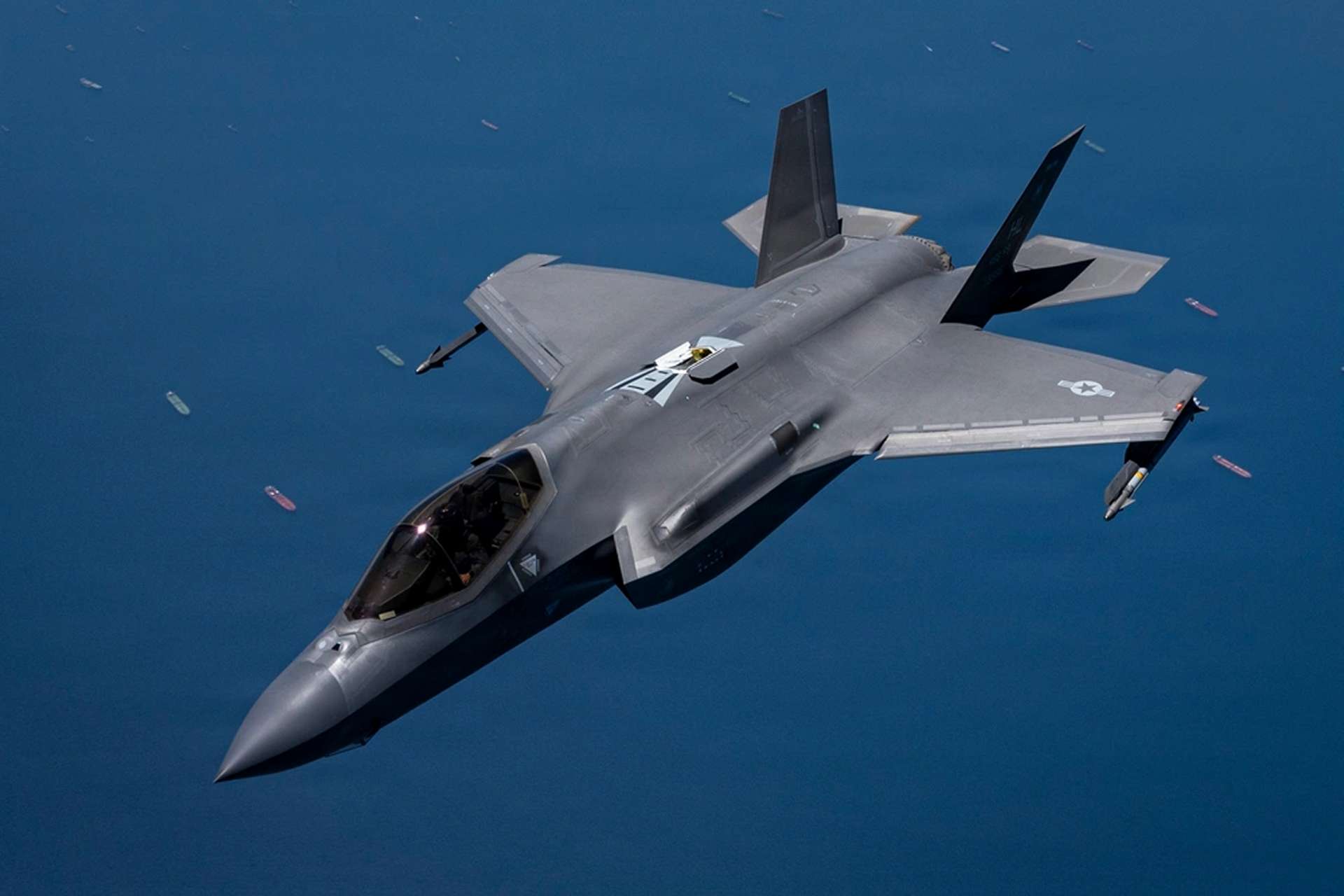
- Details
- Written by: Lerouvillois
- Category: Naval News Navy 2026
- Hits: 528
Lockheed Martin has received $153.9 million to start securing long-lead components for 11 F-35 Lightning II fighters for an unnamed Foreign Military Sales customer, the U.S. Department of War announced on June 9, 2026. The funding protects the production timeline for a fifth-generation aircraft that strengthens air superiority, strike capability, and allied deterrence.
The modification does not purchase a complete aircraft, but it funds the parts needed before final assembly can move forward without delay. Work running through December 2030 highlights the long industrial lead time behind advanced combat aircraft and the continuing demand for F-35 capability among U.S. partners.
Related topic: Poland Deploys First F-35A Husarz Fighters to Strengthen NATO Eastern Flank Air Defense.
Lockheed Martin received a $153.9 million U.S. Navy contract modification for long-lead materials supporting the production of 11 F-35 Lightning II fighters for an undisclosed Foreign Military Sales customer, helping secure future deliveries through 2030 (Picture source: U.S. DoW).
The industrial breakdown is useful because it shows which parts of the F-35 production chain are being preserved by the award. Fort Worth accounts for 59 percent of the work and remains the main final assembly and checkout site. El Segundo, California, accounts for 14 percent and is associated with major airframe and mission-equipment supply work. Warton in the United Kingdom receives 9 percent, while Cameri in Italy receives 4 percent, reflecting the continuing role of the British and Italian industrial bases in F-35 manufacturing and European sustainment. Smaller work shares are assigned to Orlando, Florida, at 4 percent; Nashua, New Hampshire, at 3 percent; Baltimore, Maryland, at 3 percent; San Diego, California, at 2 percent; and other overseas locations at 2 percent.
The notice does not identify the customer, the aircraft variant, or the production lot, and that absence should be treated as a limitation rather than filled with speculation. The 11-aircraft figure is consistent with a squadron-building increment, a training-and-conversion tranche, or a follow-on batch for a country already in the F-35 procurement pipeline. Lockheed Martin lists the F-35 partner countries as the United States, United Kingdom, Italy, Netherlands, Canada, Australia, Denmark, and Norway, and identifies Israel, Japan, South Korea, Belgium, Poland, Singapore, Finland, Switzerland, Germany, the Czech Republic, Greece, and Romania as FMS customers. Any of these FMS cases could require long-lead purchases, but the contract notice gives no basis for naming one.
Long-lead procurement is particularly important for the F-35 because the aircraft depends on components that cannot be ordered late without affecting delivery schedules. These include low-observable structural materials, precision-machined bulkheads, avionics boxes, electronic warfare hardware, radar components, cockpit equipment, actuators, landing-gear parts, and weapon-bay mechanisms. For a foreign customer, early material funding also reduces the risk that a delivery slot is lost inside a production line supporting U.S. services, original partner nations, and multiple FMS customers at the same time. Lockheed Martin and the F-35 Joint Program Office finalized Lots 18 and 19 in September 2025 for up to 296 aircraft, with deliveries from those lots beginning in 2026, showing the scale of the backlog into which this smaller 11-aircraft requirement fits.
From a combat capability perspective, the F-35’s armament is structured around the tradeoff between radar signature and payload. In a low-observable configuration, weapons are carried internally. Lockheed Martin lists a representative internal load for the F-35A as two AIM-120C/D air-to-air missiles and two GBU-31 2,000-pound Joint Direct Attack Munition guided bombs, with a maximum takeoff weight in the 70,000-pound class and Mach 1.6 speed with a full internal weapons load. For F-35B operations, the internal strike load is constrained by the short takeoff and vertical landing design, typically using 1,000-pound-class weapons rather than the larger 2,000-pound weapons carried internally by the F-35A and F-35C.
The F-35A also carries an internal 25mm GAU-22/A four-barrel cannon, while the F-35B and F-35C can use an external gun pod when required. This distinction matters tactically: the cannon is not the primary reason to buy an F-35, but it gives the conventional takeoff and landing variant an organic strafing and close-range engagement option when rules of engagement, target type, or weapons expenditure make gun employment relevant. More important for high-threat operations are the aircraft’s beyond-visual-range missiles and precision-guided bombs, because they allow the fighter to engage aircraft, radars, command posts, air defense launchers, bridges, shelters, and other fixed or mobile targets from outside many short-range threat envelopes.
The external carriage option changes the aircraft’s role after the first phase of an air campaign. Once enemy radar coverage, surface-to-air missile sites, and fighter defenses are degraded, the F-35 can carry additional weapons externally and accept a higher radar signature in exchange for more ordnance. The F-35C, for example, is described by Lockheed Martin as carrying more than 5,000 pounds internally or more than 18,000 pounds when internal and external stations are used. Leonardo also lists the F-35A weapons payload at 8,160 kg, or 18,000 pounds, with the Pratt & Whitney F135-PW-100 turbofan producing about 40,000 pounds of thrust.
The armament is tied directly to the sensor architecture. The U.S. Air Force states that the F-35’s Distributed Aperture System gives the pilot spherical situational awareness for missile warning, aircraft warning, and day/night vision, while the internally mounted Electro-Optical Targeting System provides long-range ground targeting and air-to-air detection support. The helmet-mounted display places flight, sensor, and targeting data on the visor, reducing the need to look down into the cockpit during target prosecution. The aircraft also uses tactical data links to share information with other aircraft and joint forces, which is why a relatively small 11-aircraft fleet can still contribute to a larger coalition air picture.
The most relevant operational effect is not simply that another country will receive 11 fighters. The effect is that the customer will gain an aircraft able to combine air-to-air defense, strike, electronic surveillance, and targeting support in the same sortie, provided that software standard, weapons clearances, national training, sustainment capacity, and mission-data files are available. Those conditions are important. The F-35 is heavily dependent on software, support equipment, classified mission data, and a functioning spares pipeline; without them, aircraft deliveries do not automatically translate into sustained combat availability.
The Government Accountability Office reported in September 2025 that the reduced Block 4 modernization effort is not expected to be completed until 2031 at the earliest, roughly five years later than originally planned, and that some capabilities have been deferred to future modernization work. GAO also noted that TR-3 is intended to provide improved processing and memory capacity, but software and hardware issues delayed delivery of combat-capable aircraft. For the undisclosed FMS customer, the practical question is therefore not only when the 11 aircraft leave final assembly, but what software baseline, weapons package, electronic warfare configuration, and support arrangements they have when they enter service.
The June 9 award is a modest contract by F-35 standards, but it is still operationally relevant because long-lead funding is how a foreign customer protects a future delivery line. By 2030, the value of these 11 aircraft will depend less on the contract headline and more on whether they arrive with mature software, certified weapons, trained crews, spare parts, and the mission-data infrastructure needed to use the F-35 as a combat aircraft rather than only as a procurement milestone.
Explore More Defense News
• Land Defense News
• Naval Defense News
• Defense Aerospace News
Written by Evan Lerouvillois, Defense Analyst.
Evan studied International Relations, and quickly specialized in defense and security. He is particularly interested in the influence of the defense sector on global geopolitics, and analyzes how technological innovations in defense, arms export contracts, and military strategies influence the international geopolitical scene.
Read more: U.S. Navy Funds Long-Lead Parts for 11 F-35 Fighters as Foreign Buyer Remains Undisclosed

- Details
- Written by: Lerouvillois
- Category: Naval News Navy 2026
- Hits: 498
Saronic Technologies’ 24-foot Corsair autonomous surface vessel played a direct role in rescuing two U.S. Army AH-64 Apache crew members after their helicopter went down near Oman on June 8, marking a notable operational use of an uncrewed vessel in a real-world personnel recovery mission. The incident, reported by U.S. Central Command, demonstrates how autonomous maritime systems can help accelerate rescue operations and reduce risk to manned assets in strategically sensitive waters near the Strait of Hormuz.
According to U.S. Central Command, both soldiers were recovered within approximately two hours and were in stable condition, with the Corsair retrieving the crew and transporting them to a point where a rescue helicopter could complete the extraction. The mission highlights the expanding role of autonomous surface vessels beyond surveillance and reconnaissance, underscoring their growing value for rapid response, force protection, and operational support in future maritime operations.
Related topic: U.S. Marines Test Rapid Deployment Around Cuba in Dual Sea and Shore Exercise.
Saronic Technologies' 24-foot Corsair autonomous surface vessels assisted in the recovery of two U.S. Army AH-64 Apache crew members after their helicopter went down near Oman, demonstrating how uncrewed maritime systems can support personnel recovery in the Strait of Hormuz area (Picture source: Saronic).
The operational detail that matters is the sequence. A rescue helicopter can reach an incident area quickly, but hovering over water while lowering rescue equipment can expose the aircraft to weather, sea state, small-boat interference, electronic surveillance, or hostile fire if the location is inside a contested zone. A crewed boat can recover survivors directly, but it places additional sailors inside the threat area. In this case, the uncrewed surface vessel performed the first-contact function, moving to the downed personnel and then transferring them into a safer recovery geometry for the helicopter.
Corsair’s published characteristics explain why it could perform that role. The craft is 24 feet long, carries up to 1,000 pounds of payload, has a range of more than 1,000 nautical miles, and is listed with a speed above 35 knots. Those figures are relevant to personnel recovery. A 1,000-pound payload margin provides enough capacity for two aircrew members, survival gear, flotation equipment, and reserve load. A range above 1,000 nautical miles allows the vessel to remain forward for long periods instead of operating only as a short-distance harbor craft. A speed above 35 knots gives it enough mobility to reposition quickly in a maritime incident where current, drift, fuel state, and aircraft availability all influence the recovery timeline.
The available information does not indicate that the Corsair used in the rescue was armed. That point should be treated carefully. Saronic designs its autonomous vessels around modular payloads, which can include sensors, communications equipment, electronic payloads, or other mission systems, depending on customer requirements. For the Oman recovery, the relevant capability was not armament but payload carriage, navigation, communications, and the ability to operate without placing a crew on the water at the first stage of the rescue. Its contribution was therefore tactical rather than symbolic: it changed how the recovery force managed risk.
The aircraft involved was an AH-64 Apache, a two-seat attack helicopter whose combat value is based on sensors, weapons integration, and the ability to deliver precision or suppressive fires in direct support of ground or maritime operations. The AH-64E can carry up to 16 AGM-114 Hellfire missiles, 76 2.75-inch rockets in four 19-round launchers, and 1,200 rounds for the 30 mm M230 chain gun. The gun fires at roughly 600 to 650 rounds per minute and is mounted under the nose, allowing rapid engagement of exposed personnel, light vehicles, weapons teams, and small surface targets when the crew needs immediate fire.
Each part of the Apache’s armament serves a different tactical purpose. The M230 30 mm chain gun is a close-range weapon for quick target prosecution, especially when the crew must respond faster than a missile or rocket engagement cycle allows. Hydra 70 rockets provide area effects, smoke, illumination, marking, or precision attack when fitted with guided rocket kits. Hellfire missiles provide point-target lethality against armored vehicles, fortified positions, command vehicles, radar sites, missile launchers, and fast attack craft. The exact load carried by the helicopter lost near Oman has not been disclosed, but any Apache loss removes a heavily armed reconnaissance and strike asset from the force package.
That matters in the Gulf of Oman and Strait of Hormuz environment. The strait is a narrow maritime corridor linking the Persian Gulf with the Gulf of Oman and the Arabian Sea, and it remains central to global energy flows. The operating area includes dense commercial traffic, Iranian coastal surveillance and missile forces, fast attack craft, unmanned systems, and short decision timelines. Rotary-wing aircraft can be useful in this setting because they can patrol, escort, inspect, deter, or strike small and mobile targets. At the same time, low-altitude flight over water gives crews limited options if the aircraft suffers mechanical failure, hostile action, or loss of control.
The recovery also reflects why U.S. naval forces have invested in Task Force 59 since its establishment in September 2021. The unit was created to integrate unmanned maritime systems and artificial intelligence into routine fleet operations in the U.S. 5th Fleet area, which covers the Arabian Gulf, Gulf of Oman, Red Sea, Gulf of Aden, Arabian Sea, and the chokepoints of Hormuz, Suez, and Bab al-Mandeb. This area is large, congested, and politically sensitive. It is also a test case for whether small unmanned vessels can provide persistent coverage without consuming scarce crewed ships, aircraft, and patrol craft.
From an acquisition perspective, the event is important because it gives the Navy and Congress a concrete operational use case. Small autonomous vessels are often discussed in terms of surveillance, swarm operations, decoys, or strike support. Personnel recovery is different. It is a mission commanders already understand, it has measurable timelines, and it produces a binary result: the crew is either recovered, or it is not. In this case, the uncrewed vessel contributed to a successful recovery within roughly two hours, which gives planners a real incident to examine when assessing training, basing, communications architecture, and future procurement quantities.
The event should not be overinterpreted. One rescue does not prove that autonomous surface vessels can operate reliably under heavy jamming, missile attack, cyber pressure, or complex rules of engagement. It does not answer how many vessels would be needed to maintain continuous coverage across the Gulf of Oman, how they would be maintained forward, or how they would be protected against capture. It does, however, show that a 24-foot unmanned vessel with sufficient range, payload, speed, and communications can perform a practical military support mission in an active theater.
For attack aviation, the lesson is also specific. AH-64 units operating near coastal or maritime zones may increasingly need recovery plans that include unmanned surface vessels, unmanned aerial relays, electronic warfare support, and preplanned pickup points. The Apache’s firepower remains relevant, but its survivability depends on the wider joint network around it. A downed crew over water creates a different recovery problem than a forced landing on land. The survivor is harder to secure, the position can drift, the weather has a faster effect, and the recovery force may need to operate under observation.
The Oman rescue, therefore, represents an incremental but meaningful change in how unmanned maritime systems are used. Corsair did not replace the rescue helicopter or the command-and-control structure behind the operation. It filled a gap between the crash site and the manned recovery asset. In a theater where minutes matter and exposure carries political and military cost, that gap is operationally important.
Explore More Defense News
• Land Defense News
• Naval Defense News
• Defense Aerospace News
Written by Evan Lerouvillois, Defense Analyst.
Evan studied International Relations, and quickly specialized in defense and security. He is particularly interested in the influence of the defense sector on global geopolitics, and analyzes how technological innovations in defense, arms export contracts, and military strategies influence the international geopolitical scene.
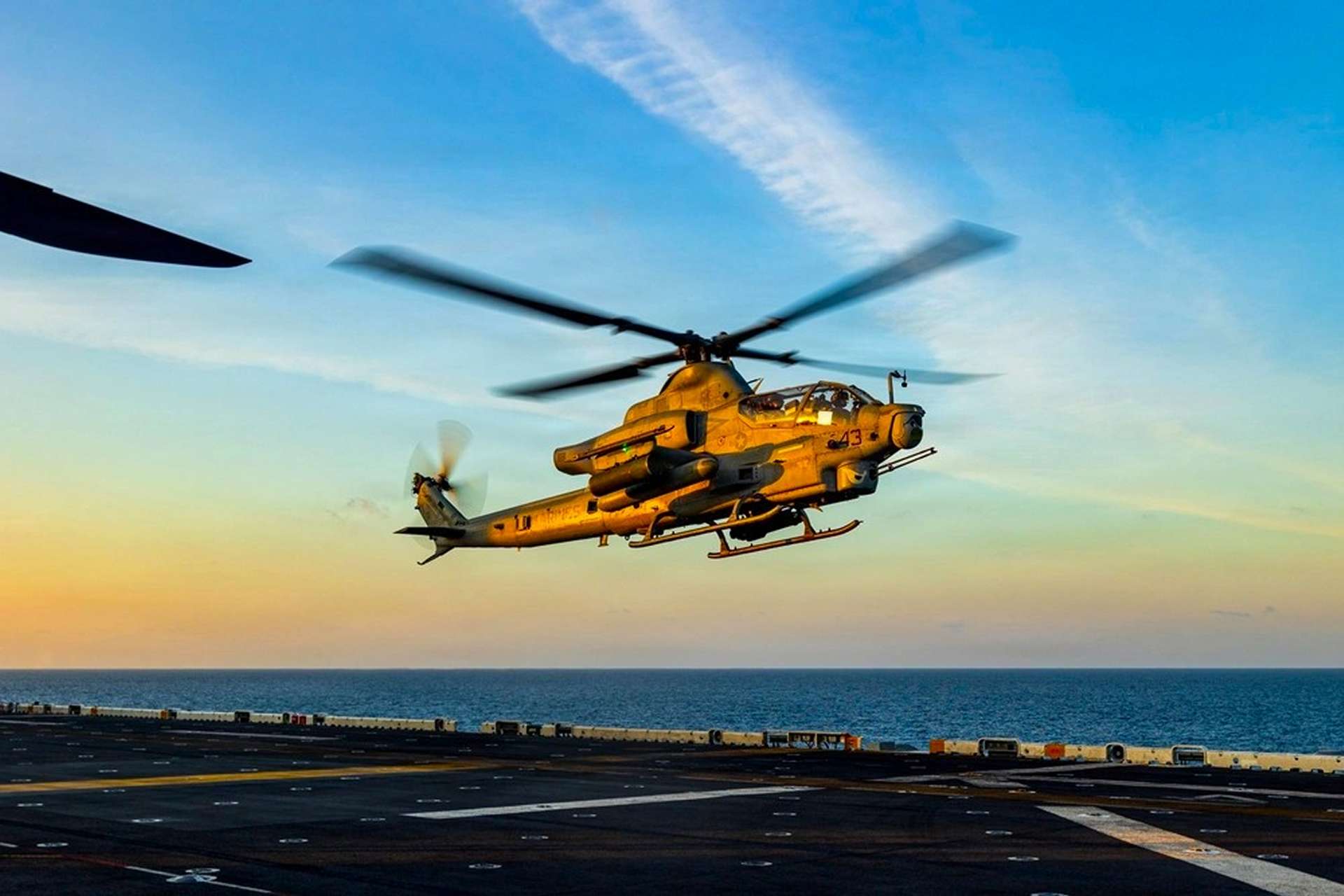
- Details
- Written by: Nicanci
- Category: Naval News Navy 2026
- Hits: 424
A U.S. Marine Corps AH-1Z Viper operating from the amphibious assault ship USS Boxer in the South China Sea highlights the combat-ready presence of the Boxer Amphibious Ready Group and the embarked 11th Marine Expeditionary Unit in a region at the center of growing strategic competition. The image, released by DVIDS on June 10 and taken during flight operations on June 6, underscores Washington’s ability to position expeditionary combat power close to potential flashpoints while reinforcing deterrence and rapid-response options across the Indo-Pacific.
The AH-1Z provides the ARG-MEU team with organic attack aviation capable of delivering close air support, armed reconnaissance, escort, and precision strikes in contested littoral environments. Combined with MV-22B Ospreys, UH-1Y helicopters, landing craft, and embarked Marines, it strengthens a mobile sea-based force designed to project power, reassure allies, and respond quickly to crises ranging from maritime confrontations to larger regional contingencies.
Related Topic: U.S. Marine Corps AH-1Z Viper Sharpens Close Air Support Role to Allied Ground Forces in Japan's Coast
A newly released U.S. Marine Corps image of an AH-1Z Viper landing aboard USS Boxer in the South China Sea highlights the forward deployment of a combat-ready amphibious force capable of deterrence, rapid crisis response, and expeditionary operations across the Indo-Pacific (Picture Source: U.S. Marines)
On June 10, 2026, DVIDS released a U.S. Marine Corps image showing an AH-1Z Viper attack helicopter landing aboard the Wasp-class amphibious assault ship USS Boxer (LHD 4) during flight operations in the South China Sea on June 6, 2026. The aircraft was assigned to Marine Medium Tiltrotor Squadron VMM-163 (Reinforced), part of the 11th Marine Expeditionary Unit embarked with the Boxer Amphibious Ready Group. Beyond a routine flight-deck activity, the image confirms the renewed operational presence of a U.S. amphibious force in one of the world’s most contested maritime regions. The deployment is relevant because it places a combat-credible Marine force close to flashpoints linked to China’s maritime posture, Taiwan-related contingencies, and territorial disputes across the South China Sea.
The presence of the Boxer Amphibious Ready Group in the South China Sea illustrates how the United States continues to use amphibious forces as a flexible instrument of deterrence in the Indo-Pacific. An Amphibious Ready Group is not simply a group of naval vessels transiting through the region. It is a sea-based expeditionary force built to carry Marines, aircraft, landing craft, command elements, and logistics assets without depending immediately on fixed bases ashore. In the case of the Boxer ARG, the force consists of the amphibious assault ship USS Boxer, the San Antonio-class amphibious transport dock USS Portland (LPD 27), the Whidbey Island-class dock landing ship USS Comstock (LSD 45), and the embarked 11th Marine Expeditionary Unit.
The AH-1Z Viper visible in the released image is one of the main combat aviation assets within this amphibious package. Designed for the U.S. Marine Corps, the AH-1Z is a twin-engine attack helicopter used for close air support, armed reconnaissance, escort, and precision strike missions. Its weapon options can include a 20 mm M197 three-barrel cannon, AGM-114 Hellfire or newer precision air-to-ground missiles, 70 mm rockets including laser-guided APKWS variants, and AIM-9 Sidewinder air-to-air missiles depending on the mission profile. Equipped with a modern electro-optical and infrared Target Sight System, the Viper can detect, identify, and engage targets in day, night, and reduced-visibility conditions, making it well suited for littoral operations where threats can emerge from coastal positions, small craft, mobile missile teams, or landing areas.
The AH-1Z is, however, only one element of a larger ARG-MEU combat system. The 11th MEU’s aviation combat element also includes UH-1Y Venom utility helicopters and MV-22B Osprey tiltrotor aircraft, giving the force a mix of attack, escort, assault support, reconnaissance, and long-range mobility. The UH-1Y can provide command support, armed overwatch, utility lift, and escort missions, while the MV-22B allows Marines to move faster and farther than conventional helicopters. Combined with amphibious landing craft, infantry forces, and logistics units, this aviation component gives the Boxer ARG the ability to move Marines from ship to shore, support raids, reinforce partners, conduct evacuation missions, or respond rapidly to a developing crisis.
From a strategic perspective, the Boxer ARG’s presence in the South China Sea sends several messages at once. For China, it demonstrates that the United States can maintain more than symbolic naval patrols in the region by deploying a mobile force with Marines, attack helicopters, tiltrotors, landing craft, and command-and-control capabilities. For allies and partners, particularly those concerned by pressure around disputed maritime features, it provides reassurance that U.S. forces remain forward-deployed and operationally active. For Washington, the ARG offers a flexible tool that sits between routine naval presence and a larger carrier strike group deployment, giving decision-makers options for deterrence, crisis management, evacuation, limited combat action, or rapid reinforcement.
The South China Sea is a particularly sensitive environment for this type of force posture. The region includes competing sovereignty claims, key maritime routes, Chinese military outposts on artificial islands, coast guard activity, maritime militia operations, and recurring friction with Southeast Asian states. In this setting, the presence of an ARG-MEU team adds a different kind of pressure to the operational environment. It does not provide the same long-range strike capacity as a carrier strike group, but it introduces a mobile amphibious force able to operate from the sea, shift position, launch aircraft, support landing forces, and remain available for missions that may fall below the threshold of open conflict.
The military value of the AH-1Z in this context lies in its ability to extend the protective and offensive reach of the amphibious force. During a crisis, Viper helicopters could escort MV-22B Ospreys, provide overwatch for landing craft, support Marine infantry ashore, monitor surface threats, or conduct precision strikes against hostile positions threatening the force. In a maritime environment, the aircraft’s sensors and weapons give commanders an organic attack capability directly available from the deck of USS Boxer, reducing immediate dependence on land-based aviation. This is particularly important in a theater where access to bases may be politically sensitive, geographically distant, or exposed to missile threats.
The deployment also reflects the broader evolution of U.S. Marine Corps expeditionary operations in the Indo-Pacific. Modern amphibious forces are expected to operate in dispersed, contested, and fast-moving environments where they may need to support sea control, protect key maritime terrain, conduct reconnaissance, and contribute to joint deterrence. The Boxer ARG gives the 11th MEU a mobile platform from which to operate across the littorals, while the combination of AH-1Z, UH-1Y, MV-22B, landing craft, infantry, and logistics units allows the force to adapt to different levels of crisis. This flexibility is central to U.S. deterrence strategy because it complicates the calculations of any potential adversary considering coercive action in the region.
At the same time, the presence of an amphibious force in the South China Sea also underlines the risks of operating close to contested littorals. Amphibious ships and embarked aircraft would face threats from anti-ship missiles, submarines, drones, mines, long-range surveillance, electronic warfare, and integrated air defense systems in the event of escalation. The deterrent value of the Boxer ARG therefore depends not only on the ships and aircraft themselves, but also on their integration with the wider U.S. 7th Fleet, allied forces, intelligence assets, surface escorts, and joint air and missile defense networks. Its strength lies in mobility and flexibility, but survivability in a high-intensity conflict would require coordinated protection across multiple domains.
The image of an AH-1Z Viper landing aboard USS Boxer is more than a visual record of flight operations. It confirms that a complete U.S. Marine expeditionary force is operating inside a strategic corridor where maritime competition, alliance commitments, and military signaling increasingly overlap. By deploying attack helicopters, tiltrotors, amphibious ships, infantry forces, landing craft, and logistics units into the South China Sea, the United States is reinforcing a deterrence posture built on readiness, mobility, and the ability to respond quickly if a local incident turns into a regional crisis. The message is clear: U.S. presence in the South China Sea remains operational, sea-based, and directly connected to the balance of power in the Indo-Pacific.
Explore More Defense News
• Land Defense News
• Naval Defense News
• Defense Aerospace News
Written by Teoman S. Nicanci – Defense Analyst, Army Recognition Group
Teoman S. Nicanci holds degrees in Political Science, Comparative and International Politics, and International Relations and Diplomacy from leading Belgian universities, with research focused on Russian strategic behavior, defense technology, and modern warfare. He is a defense analyst at Army Recognition, specializing in the global defense industry, military armament, and emerging defense technologies.

- Details
- Written by: Nicanci
- Category: Naval News Navy 2026
- Hits: 440
New Zealand is moving to close a critical gap in its undersea warfare capability after the United States approved a potential $69 million sale of MK 54 lightweight torpedoes on June 5, 2026, providing Wellington with the weapon needed to turn submarine detection into combat-ready engagement. The decision comes as strategic competition expands across the Indo-Pacific and signals a clear effort to strengthen New Zealand’s ability to counter increasingly sophisticated submarine activity across the South Pacific and Southern Ocean.
The MK 54 would equip the backbone of New Zealand’s emerging anti-submarine warfare architecture, linking P-8A Poseidon maritime patrol aircraft and future MH-60R Seahawk helicopters with a proven allied-standard engagement weapon. Beyond the torpedoes themselves, the package delivers the training, sustainment, and operational support required to build a fully functional ASW kill chain, reinforcing regional deterrence and deeper interoperability with partners such as Australia and the United States.
Related Topic: Australian Army Creates New Littoral Manoeuvre Group for Indo-Pacific Amphibious Operations
The U.S. has approved a $69 million sale of MK-54 lightweight torpedoes to New Zealand, strengthening the country's anti-submarine warfare capability by providing the key engagement weapon for its P-8A Poseidon fleet and future MH-60R Seahawk helicopters (Picture Source: U.S. 7th Fleet)
On June 5, 2026, the U.S. Department of State approved a possible Foreign Military Sale to New Zealand for MK 54 MOD 0 lightweight torpedoes and related equipment, with an estimated value of $69 million. The announcement comes as Wellington is rebuilding its maritime combat architecture around long-range patrol aircraft, future shipborne helicopters, and a renewed focus on anti-submarine warfare. While the package is modest in scale, it is strategically relevant because it strengthens the weapon layer of New Zealand’s undersea warfare posture at a time when the South Pacific is becoming more exposed to wider Indo-Pacific naval competition.
The proposed sale covers 20 MK 54 MOD 0 Lightweight Torpedoes in all-up-round configuration, together with recoverable exercise torpedoes, air-launch accessories, classified and unclassified spare parts, containers, support and test equipment, training, technical assistance, infrastructure support, exercise firing assistance, and logistics services. This composition shows that the package is not limited to the transfer of ammunition. It also includes the elements required to train crews, support live and exercise firings, maintain weapon readiness, and integrate the torpedo into New Zealand’s anti-submarine warfare procedures. For a country with limited naval mass but extensive maritime responsibilities, the sustainment and training framework around the weapon is as important as the torpedo itself.
The MK 54 is a lightweight anti-submarine torpedo designed for launch from surface ships and aircraft. Developed as the Lightweight Hybrid Torpedo, the MK 54 MOD 0 combines elements from the earlier MK 46 and MK 50 torpedo programs with commercial off-the-shelf digital signal-processing technology. The U.S. Navy describes it as a surface ship and aircraft-launched anti-submarine weapon equipped with an advanced guidance and control section and tactical software improvements intended to increase performance in challenging scenarios. The torpedo measures 106.9 inches in length, has a diameter of 12.75 inches, weighs approximately 607 pounds, and carries a 100-pound high-explosive warhead. Its purpose is not to search the ocean independently, but to serve as the terminal engagement weapon once a submarine has been detected, classified, tracked, and localized by a wider network of sensors.
The U.S. notification does not officially identify the launch platform for New Zealand’s MK 54 torpedoes. However, the reference to air-launch accessories and New Zealand’s current force modernization provide a clear operational context. The Royal New Zealand Air Force operates four Boeing P-8A Poseidon maritime patrol aircraft from RNZAF Base Ohakea, replacing the former P-3K2 Orion fleet. In anti-submarine warfare, the P-8A provides the wide-area search and tracking layer, using sensors, sonobuoys, mission systems, and tactical data processing to build a recognized maritime picture and localize underwater contacts. In this context, the MK 54 gives the maritime patrol force a credible air-delivered engagement option if a submarine contact must be prosecuted.
A second relevant platform is the MH-60R Seahawk, which New Zealand has selected as the preferred replacement for its SH-2G(I) Seasprite maritime helicopters. The New Zealand Ministry of Defence identifies the MH-60R as a maritime helicopter able to carry the Mk 54 anti-submarine torpedo, as well as AGM-114 Hellfire missiles, crew-served machine guns, and Advanced Precision Kill Weapon System rockets. If acquired, the MH-60R would give Royal New Zealand Navy surface combatants an embarked ASW prosecution capability, allowing a frigate to extend its sensor and weapon reach beyond the limits of its own hull-mounted systems. In operational terms, a shipborne MH-60R can move quickly toward a contact area, deploy sensors, refine target localization, and deliver a lightweight torpedo from a position selected to maximize engagement probability while keeping the host ship outside the immediate threat zone.
The strategic value of the MK 54 sale lies in its contribution to a complete anti-submarine warfare kill chain. New Zealand has long maintained maritime surveillance capabilities for search and rescue, fisheries protection, regional presence, and patrol of the South Pacific and Southern Ocean. The acquisition of modern lightweight torpedoes adds a harder military edge to that posture. It supports a detect-classify-track-engage sequence in which the P-8A provides long-range surveillance and initial localization, the future MH-60R could conduct shipborne prosecution and close-in localization, and the MK 54 serves as the common engagement weapon against submarine targets. This shifts New Zealand’s maritime posture from awareness alone toward a more credible ability to respond to underwater threats.
The geostrategic context explains why such a capability matters. New Zealand sits across vast maritime approaches linking the South Pacific, the Southern Ocean, Australia, Antarctica, and wider Indo-Pacific sea lanes. Its security depends on open sea lines of communication, protected undersea cables, reliable maritime trade routes, and the ability to monitor activity across a large exclusive economic zone. The South Pacific is no longer a peripheral maritime space isolated from strategic competition. Submarine operations, seabed infrastructure vulnerability, long-range naval deployments, and the activities of extra-regional powers are increasing the importance of undersea surveillance and anti-submarine warfare for countries that do not possess large fleets but still need to secure critical maritime approaches.
The sale also strengthens interoperability with New Zealand’s closest defense partners. The MK 54 is part of a U.S.-aligned anti-submarine warfare ecosystem used by allied navies and air forces, including operators of the P-8A Poseidon and MH-60R Seahawk. For Wellington, common weapons and platforms reduce the burden of training, logistics, tactics development, and exercise integration. This is especially relevant with Australia, which also operates the P-8A and MH-60R and remains New Zealand’s most important regional defense partner. A shared ASW architecture makes it easier for both countries to conduct coordinated maritime patrols, combined exercises, and coalition undersea surveillance missions across the wider Pacific.
The acquisition should also be read within New Zealand’s broader defense modernization effort. Wellington has acknowledged that distance no longer provides the same strategic insulation it once did, and recent defense planning has placed greater emphasis on readiness, infrastructure protection, maritime security, and the ability to operate with allies. The MK 54 does not give New Zealand a large offensive naval strike capability, nor does it alter the regional balance of power by itself. Its significance is more specific: it provides the terminal weapon needed to make New Zealand’s ASW surveillance network operationally credible.
The possible sale of 20 MK 54 MOD 0 torpedoes carries more weight than its limited quantity suggests. It links New Zealand’s P-8A maritime patrol fleet, its planned MH-60R helicopter capability, and its naval surface force into a more coherent undersea warfare architecture. The official notification does not assign the torpedoes to a specific platform, but the wider procurement context shows that Wellington is building the key layers of a modern ASW system: long-range detection, localized prosecution, allied interoperability, and a common lightweight torpedo for engagement. In a maritime region where strategic competition increasingly extends below the surface, this sale marks a measured but important step in New Zealand’s effort to protect its approaches, infrastructure, and role within the Indo-Pacific security network.
Explore More Defense News
• Land Defense News
• Naval Defense News
• Defense Aerospace News
Written by Teoman S. Nicanci – Defense Analyst, Army Recognition Group
Teoman S. Nicanci holds degrees in Political Science, Comparative and International Politics, and International Relations and Diplomacy from leading Belgian universities, with research focused on Russian strategic behavior, defense technology, and modern warfare. He is a defense analyst at Army Recognition, specializing in the global defense industry, military armament, and emerging defense technologies.

- Details
- Written by: Administrator
- Category: Naval News Navy 2026
- Hits: 528
The U.S. Navy’s Unmanned Undersea Vehicle Group (UUVGRU) 1 conducted advanced unmanned underwater vehicle operations during NATO’s BALTOPS 2026 exercise near Liepaja, Latvia, demonstrating a growing ability to monitor and secure contested waters amid rising concerns over Russian submarine activity and threats to critical undersea infrastructure. The deployment, reported on June 8, 2026, underscores how specialized UUV units are becoming a key component of NATO’s efforts to detect underwater threats and strengthen maritime security in the Baltic Sea.
The exercise showcased autonomous systems capable of searching, identifying, and monitoring activity beneath the surface while reducing risk to manned platforms. Their expanding operational role reflects a broader shift toward persistent underwater surveillance and autonomous maritime warfare, enhancing NATO’s ability to protect strategic seabed assets, secure critical sea lines of communication, and deter potential adversaries.
Related Topic: US Navy receives first Australian Speartooth LUUV drone for autonomous underwater strikes
U.S. Navy personnel from Unmanned Undersea Vehicle Group (UUVGRU) 1 recover an Iver3 unmanned underwater vehicle during Exercise BALTOPS 2026 in Liepaja, Latvia, on June 8, 2026. The underwater drone supports NATO efforts to enhance undersea surveillance, mine countermeasure operations, and critical maritime infrastructure protection in the Baltic Sea. (Picture source: U.S. Department of War/Defense)
BALTOPS 2026, the premier multinational maritime exercise in the Baltic Sea, provides allied naval forces with a unique opportunity to enhance interoperability and develop coordinated responses to emerging undersea threats. As concerns grow over potential sabotage of underwater communication cables, energy pipelines, and other critical infrastructure, the exercise places particular emphasis on improving seabed awareness and autonomous warfare capabilities.
The U.S. Navy's Unmanned Undersea Vehicle Group 1 serves as the service's primary operational organization responsible for integrating unmanned underwater systems into fleet operations. The unit develops tactics and operational concepts for underwater drones that support intelligence collection, mine countermeasures, anti-submarine warfare, seabed warfare, and critical infrastructure protection. As modern naval competition increasingly shifts beneath the surface, UUVGRU 1 plays a key role in expanding the Navy's ability to monitor, secure, and dominate the underwater battlespace.
One of the systems employed during BALTOPS 2026 is the Iver3 unmanned underwater vehicle, a compact autonomous underwater system designed for intelligence gathering, hydrographic surveys, seabed mapping, and mine countermeasure support missions. Developed by OceanServer Technology, the torpedo-shaped UUV can operate autonomously while carrying a range of payloads, including side-scan sonar, environmental sensors, and precision navigation systems. Its ability to conduct detailed underwater surveys in shallow and confined waters makes it particularly valuable in the Baltic Sea, where naval forces must monitor critical underwater infrastructure, identify potential hazards, and maintain persistent situational awareness without exposing personnel to unnecessary risk.
The strategic importance of these capabilities has grown considerably in recent years. NATO military planners have become increasingly focused on protecting underwater communication networks, energy pipelines, and maritime infrastructure following several incidents involving damaged subsea assets in European waters. The Baltic Sea, with its dense network of commercial shipping routes, telecommunications cables, offshore energy infrastructure, and proximity to Russia's Baltic Fleet operating areas, has emerged as a critical theater for undersea security operations.
Unlike traditional naval assets, unmanned underwater vehicles can remain submerged for extended periods while conducting persistent surveillance missions across large maritime areas. Equipped with advanced sonar systems, navigation technologies, and specialized sensor payloads, these autonomous systems can map the seabed, detect suspicious underwater activity, identify potential threats, and monitor critical infrastructure without exposing manned vessels or divers to unnecessary risk.
One of the most valuable military capabilities demonstrated during BALTOPS 2026 is the use of underwater drones to support mine countermeasure operations. Naval mines remain one of the most effective asymmetric maritime threats capable of disrupting military deployments and commercial shipping. Autonomous underwater vehicles can rapidly survey contested waters, locate mine-like objects, and classify potential threats before clearance operations begin, significantly accelerating access to strategic ports and sea lanes.
The operational utility of UUVs extends well beyond mine warfare. These systems can contribute to anti-submarine operations by supporting distributed underwater sensing networks that detect and track submarine activity. In a region where Russian submarine operations continue to represent a key consideration for NATO naval planners, persistent underwater surveillance provides an important capability for maintaining situational awareness and strengthening deterrence.
BALTOPS 2026 also serves as a testing ground for future autonomous warfare concepts. The exercise allows allied navies to evaluate how unmanned systems can be integrated into multinational command structures, intelligence networks, and maritime operations. As NATO members continue to invest heavily in autonomous technologies, establishing common operating procedures and interoperability standards becomes increasingly important for future coalition missions.
The lessons generated by UUVGRU 1 during BALTOPS 2026 are likely to influence future NATO investments in seabed warfare and autonomous maritime systems. Advances in artificial intelligence, autonomous navigation, underwater communications, and sensor fusion are transforming unmanned underwater vehicles from niche assets into core elements of modern naval power. Similar developments can be seen in NATO's broader efforts to expand autonomous maritime capabilities and strengthen the protection of critical undersea infrastructure throughout the alliance.
The deployment of U.S. Navy UUVGRU 1 in Latvia ultimately demonstrates that the future of maritime security will increasingly depend on the ability to control and understand the underwater domain. By integrating advanced underwater drones such as the Iver3 into multinational operations, NATO is expanding its capacity to protect critical infrastructure, counter emerging undersea threats, and maintain freedom of navigation in a region that has become central to European security and deterrence strategy. The growing operational role of autonomous underwater systems suggests that future maritime superiority will depend not only on control of the sea surface and airspace, but also on the ability to dominate the increasingly contested underwater battlespace.
Explore More Defense News
• Land Defense News
• Naval Defense News
• Defense Aerospace News
Written by Alain Servaes – Chief Editor, Army Recognition Group
Alain Servaes is a former infantry non-commissioned officer and the founder of Army Recognition. With over 20 years in defense journalism, he provides expert analysis on military equipment, NATO operations, and the global defense industry.

U.S. Marines Deploy VBAT Drone from USS Portland vessel to Expand Indo-Pacific Intelligence Missions
- Details
- Written by: Administrator
- Category: Naval News Navy 2026
- Hits: 511
The U.S. Marine Corps has demonstrated the VBAT vertical take-off and landing unmanned aerial system aboard the amphibious transport dock USS Portland, expanding the reach of ship-based intelligence, surveillance, and reconnaissance during expeditionary operations across the Indo-Pacific. Images released on June 9, 2026, show the aircraft preparing for launch from the vessel’s flight deck, highlighting how Marines can extend maritime domain awareness without relying on large runways or dedicated aviation infrastructure.
Operating with the Boxer Amphibious Ready Group and embarked 11th Marine Expeditionary Unit, the VBAT provides persistent surveillance and targeting support from amphibious ships operating far from shore. The capability reflects a broader shift toward distributed maritime operations, where long-endurance unmanned systems enhance situational awareness, force protection, and decision-making across vast ocean battlespaces.
Related Topic: U.S. Marines 13th Marine Expeditionary Unit Validates Urban Warfare Readiness with Fifth Generation Airpower
U.S. Department of War contractors prepare a VBAT vertical take-off and landing (VTOL) unmanned aerial system for launch aboard the San Antonio-class amphibious transport dock ship USS Portland (LPD 27) during operations in the Pacific Ocean on June 9, 2026. (Picture source: U.S. Department of War/Defense)
The demonstration reflects the U.S. Marine Corps's growing focus on integrating shipborne unmanned aerial systems into distributed maritime operations. Conducted within the U.S. 7th Fleet area of responsibility, the deployment demonstrates how compact VTOL drones can provide persistent reconnaissance and targeting support without requiring catapults, arresting gear, or dedicated runways, thereby significantly enhancing situational awareness for U.S. Marine Corps amphibious forces operating far from traditional air support infrastructure.
The VBAT, developed by Shield AI following its acquisition of Martin UAV, occupies a unique niche within the U.S. Marine Corps’ expanding family of unmanned systems. Unlike conventional fixed-wing drones that require launch and recovery equipment, VBAT combines the endurance and efficiency of a fixed-wing aircraft with the operational flexibility of a helicopter. Its distinctive ducted-fan design enables vertical takeoff and landing from confined ship decks, expeditionary bases, and austere island locations, making it particularly suited for the dispersed operations envisioned under the U.S. Marine Corps’ Force Design modernization initiative.
For U.S. Marines operating in contested maritime environments, the ability to launch a reconnaissance asset directly from an amphibious transport dock provides substantial operational advantages. The USS Portland, like other San Antonio-class vessels, serves as a critical component of amphibious ready groups tasked with crisis response, humanitarian assistance, maritime security, and potential combat operations. Embarking the VTOL unmanned aerial system extends the ship’s organic surveillance range well beyond the horizon, allowing commanders to detect surface contacts, monitor coastal activity, identify potential threats, and support landing force operations without immediately relying on higher-echelon intelligence assets.
The significance of the VBAT’s maritime deployment becomes even more apparent when viewed through the lens of the Indo-Pacific operating environment facing the U.S. Marine Corps. The vast distances of the Pacific Ocean, combined with increasingly complex security challenges, place a premium on persistent ISR capabilities. Small amphibious task groups often operate independently across enormous maritime areas, where maintaining continuous situational awareness can determine operational success. A shipborne VTOL drone capable of extended-endurance missions serves as a force multiplier, helping bridge intelligence gaps and improving decision-making speed.
The system’s value also closely aligns with emerging U.S. Marine Corps concepts, such as Expeditionary Advanced Base Operations (EABO). Under this framework, small U.S. Marine Corps units establish temporary forward positions across islands and coastal areas to support sea control, reconnaissance, and anti-ship operations. VBAT’s ability to launch from austere sites without runway requirements allows these expeditionary forces to rapidly establish their own ISR network, supporting both local situational awareness and broader fleet operations. This capability becomes increasingly relevant in potential contested scenarios where access to traditional airfields may be denied or heavily threatened.
From a technical perspective, VBAT offers endurance exceeding ten hours, depending on mission configuration, enabling long-duration surveillance missions that are difficult to achieve with many rotary-wing unmanned aerial systems. Its payload flexibility allows integration of electro-optical and infrared sensors, maritime surveillance equipment, communications relay packages, and other mission-specific systems. Such adaptability enables U.S. Marine Corps commanders to tailor the aircraft for intelligence collection, force protection, targeting support, or communications extension.
The deployment aboard USS Portland also reflects a broader trend across the U.S. Navy and U.S. Marine Corps toward expanding the operational use of unmanned systems from amphibious warships. While aircraft carriers and large surface combatants increasingly employ advanced unmanned technologies, amphibious ships are emerging as particularly attractive platforms for expeditionary drone operations due to their large flight decks, flexible mission spaces, and direct support of U.S. Marine Corps maneuver forces. The integration of systems such as VBAT demonstrates how these vessels can evolve into distributed ISR hubs that support both naval and U.S. Marine Corps operations.
The 11th Marine Expeditionary Unit’s participation further underscores the capability's operational relevance. MEUs serve as forward-deployed, rapidly deployable U.S. Marine Corps crisis-response forces capable of conducting missions ranging from evacuation operations and disaster relief to high-intensity combat. Organic airborne surveillance assets significantly increase their ability to operate independently while maintaining awareness of evolving threats and opportunities across the battlespace.
As U.S. forces continue adapting to the strategic realities of the Indo-Pacific, unmanned aerial systems such as VBAT are becoming increasingly important elements of expeditionary maritime power projection. The demonstration aboard USS Portland illustrates more than a simple flight operation; it highlights the U.S. Marine Corps’ ongoing effort to create a more distributed, resilient, and information-driven force capable of sensing, deciding, and acting faster across vast oceanic theaters. In future operations, the ability to deploy long-endurance VTOL reconnaissance aircraft directly from amphibious warships could provide commanders with a decisive advantage in maintaining maritime awareness, supporting U.S. Marine Corps maneuver forces, and strengthening deterrence throughout the region.
Explore More Defense News
• Land Defense News
• Naval Defense News
• Defense Aerospace News
Written by Alain Servaes – Chief Editor, Army Recognition Group
Alain Servaes is a former infantry non-commissioned officer and the founder of Army Recognition. With over 20 years in defense journalism, he provides expert analysis on military equipment, NATO operations, and the global defense industry.

- Details
- Written by: Administrator
- Category: Naval News Navy 2026
- Hits: 466
A U.S. Navy F/A-18E/F Super Hornet launched from the Nimitz-class aircraft carrier USS Abraham Lincoln (CVN 72) fired a precision-guided munition into the engineering and steering compartments of the Palau-flagged oil tanker M/T Marivex in the Gulf of Oman on June 8, 2026, after the vessel failed to comply with repeated instructions from U.S. forces and continued its transit toward an Iranian port. The strike immediately disabled the tanker without sinking it, preventing the vessel from reaching Iran and demonstrating the United States' ability to enforce its ongoing maritime blockade through precise carrier-based airpower.
According to U.S. Central Command (CENTCOM), Marivex was operating in international waters and was not carrying oil at the time of the engagement. The operation marked the seventh vessel disabled since the blockade against Iran was launched on April 13, 2026. CENTCOM also reported that 134 vessels have complied with redirection orders, while 42 humanitarian aid ships have been permitted to continue their voyages.
Related Topic: U.S. Military Aircraft Fires Hellfire Missile to Stop Tanker Bound for Iran’s Kharg Oil Terminal
A U.S. Navy F/A-18E Super Hornet fighter jet assigned to Strike Fighter Squadron (VFA) 151 prepares for an arrested landing aboard the Nimitz-class aircraft carrier USS Abraham Lincoln (CVN 72) on June 2, 2026. Aircraft from Abraham Lincoln's Carrier Air Wing recently conducted a precision strike against the tanker M/T Marivex in the Gulf of Oman as part of U.S. blockade enforcement operations targeting maritime traffic bound for Iran. (Picture source: U.S. Department of War/Defense)
The engagement represents one of the clearest examples to date of how the United States is combining naval power, persistent surveillance, and precision strike capabilities to enforce maritime restrictions against Iran. Rather than conducting a boarding operation or employing weapons intended to destroy the vessel, U.S. forces selected a strike profile focused on disabling the tanker's ability to navigate and continue its voyage. By targeting the engineering and steering spaces, the aircraft rendered the vessel incapable of reaching its destination while minimizing risks to the crew and surrounding commercial traffic.
The operation was carried out by an F/A-18E/F Super Hornet, the principal multirole combat aircraft of the U.S. Navy's carrier air wings. Developed by Boeing, the twin-engine fighter is designed to perform air-superiority, precision-strike, maritime-attack, close-air-support, reconnaissance, and suppression-of-enemy-air-defense missions. Powered by two General Electric F414-GE-400 turbofan engines generating approximately 44,000 pounds of combined thrust, the aircraft can exceed Mach 1.6 and operate across a wide range of maritime and land-based combat environments.
A key element of the Super Hornet's effectiveness is its advanced AN/APG-79 Active Electronically Scanned Array (AESA) radar, which enables simultaneous tracking of multiple air and surface targets. Combined with modern electronic warfare systems, infrared targeting sensors, secure communications, and networked battlefield connectivity, the aircraft can detect, identify, and engage targets with high precision while operating in contested environments. These capabilities allow carrier-based aircraft to monitor vast maritime areas and rapidly transition from surveillance to strike operations when required.
The F/A-18E/F carries one of the most versatile weapon inventories in the U.S. military. Air-to-air armament includes AIM-120 AMRAAM beyond-visual-range missiles and AIM-9X Sidewinder short-range missiles. For strike missions, the aircraft can employ Joint Direct Attack Munitions (JDAM), laser-guided bombs, AGM-154 Joint Stand-Off Weapons (JSOW), AGM-84 Harpoon anti-ship missiles, AGM-88 HARM anti-radiation missiles, and selected long-range air-to-surface weapons. An internally mounted M61A2 20mm rotary cannon provides an additional close-range engagement capability. In the case of Marivex, the aircraft employed a precision munition intended to disable critical ship systems rather than destroy the vessel outright.
The incident also highlights the USS Abraham Lincoln's operational role in the Middle East. As a Nimitz-class aircraft carrier displacing more than 100,000 tons, the vessel functions as a mobile airbase capable of projecting combat power without reliance on regional land installations. The carrier can embark more than 60 aircraft, including F/A-18E/F Super Hornets, EA-18G Growler electronic attack aircraft, E-2D Advanced Hawkeye airborne early warning aircraft, and MH-60 Seahawk helicopters.
Operating in support of U.S. 5th Fleet missions, USS Abraham Lincoln provides CENTCOM with a rapidly deployable force capable of conducting maritime security operations, precision strikes, intelligence collection, and regional deterrence missions. Its embarked air wing can maintain continuous surveillance over key shipping routes while retaining the ability to engage targets across the Gulf of Oman, Arabian Sea, and approaches to the Strait of Hormuz.
The carrier is typically accompanied by guided-missile destroyers equipped with the Aegis Combat System, creating a layered force capable of defending against aircraft, ballistic missiles, cruise missiles, surface threats, and submarines. This combination of naval aviation, surface warfare assets, intelligence platforms, and command-and-control networks enables U.S. forces to monitor maritime activity and respond quickly to emerging situations across the region.
The Gulf of Oman remains one of the world's most strategically important maritime corridors. The waterway connects the Arabian Sea to the Strait of Hormuz, through which a substantial portion of global seaborne energy exports transit each day. Maintaining visibility and control over vessel movements in this area has become increasingly important as tensions surrounding Iran continue to affect regional security and international shipping.
The disabling of Marivex illustrates how modern carrier strike groups can employ calibrated force to achieve specific operational objectives. Instead of seeking the destruction of a target, commanders can use precision-guided weapons to generate tailored effects against critical systems. Such capabilities provide policymakers with additional response options between diplomatic measures and large-scale military action.
For Iran and commercial shipping operators, the June 8, 2026, interdiction delivers a clear message about the U.S.'s willingness to enforce maritime restrictions. The operation demonstrates that CENTCOM possesses the surveillance assets, command structure, and precision strike capabilities necessary to detect, track, and stop vessels attempting to reach Iranian ports in violation of blockade measures. As enforcement operations continue, the presence of the U.S. Navy USS Abraham Lincoln and its embarked F/A-18E/F Super Hornets remains a central component of U.S. maritime power projection and deterrence across the Gulf region.
Explore More Defense News
• Land Defense News
• Naval Defense News
• Defense Aerospace News
Written by Alain Servaes – Chief Editor, Army Recognition Group
Alain Servaes is a former infantry non-commissioned officer and the founder of Army Recognition. With over 20 years in defense journalism, he provides expert analysis on military equipment, NATO operations, and the global defense industry.
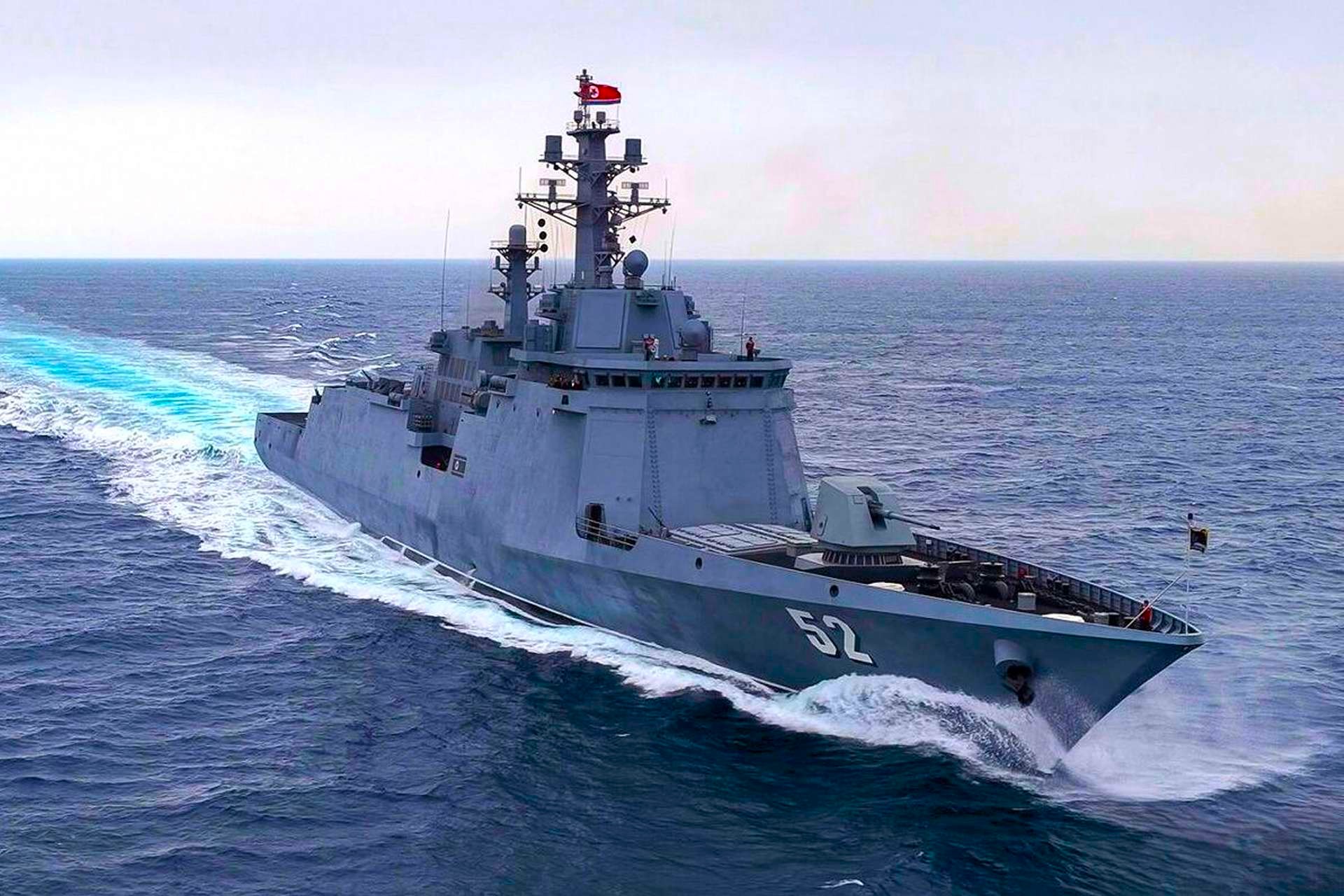
- Details
- Written by: Nicanci
- Category: Naval News Navy 2026
- Hits: 505
North Korea has begun sea trials of Kang Kon, its second Choe Hyon-class guided-missile destroyer, with the Pyongyang Times reporting on June 6, 2026, that Kim Jong Un inspected a June 4 navigation test after the ship’s earlier failed launch and repair. The trial signals Pyongyang’s push beyond coastal defense toward larger missile-armed surface combatants able to support strike, air-defense, and maritime deterrence missions.
The test appears focused on proving seaworthiness, propulsion, steering, and high-speed handling before more complex weapons and sensor trials. If North Korea can integrate the destroyer’s vertical launch system, radar suite, and combat management functions, Kang Kon could become a mobile missile platform that complicates allied tracking, widens potential strike axes, and supports Pyongyang’s stated ambition to develop future 10,000-ton-class warships.
Related Topic: North Korea Discloses Ongoing Construction of an 8,700-Ton Nuclear-Powered Strategic Submarine
North Korea's first sea trials of the Kang Kon guided missile destroyer highlight Pyongyang's efforts to validate a new class of missile-armed warships while laying the groundwork for future 10,000-ton destroyers and a more capable maritime deterrent force (Picture Source: KCNA)
On June 6, 2026, the Pyongyang Times, reported that Kim Jong Un inspected the June 4 navigation test of Kang Kon, the second Choe Hyon-class guided-missile destroyer built for the Navy of the Korean People’s Army. The event marks the first publicly reported sea trials of Kang Kon after its failed launch and repair sequence, opening a new phase in North Korea’s attempt to validate a larger missile-capable surface fleet. More than a standard shakedown, the trial highlights Pyongyang’s ambition to move from coastal naval defense toward larger surface combatants, future 10000-ton-class destroyers, unspecified underwater weapons and a more diversified maritime deterrent.
Kang Kon’s first sea trials should be read as an operational and technical validation phase, not proof that the ship has already reached full combat readiness. During the inspection, Kim Jong Un boarded the destroyer, visited combat duty spaces including the control centre, reviewed the navigation-test plan and examined the phased schedule for future tests of the warship’s weapon systems. In naval terms, such a stage normally evaluates seaworthiness, propulsion response, steering gear, helm control, high-speed manoeuvring, bridge team procedures and crew coordination before a ship moves into more complex combat-system trials. The focus on cruise and high-speed manoeuvring systems indicates that North Korea first sought to prove that Kang Kon could operate safely and predictably at sea before validating its sensors, missile-launch sequence, fire-control architecture and combat management system.
The trial also has a strong political and industrial dimension because Kang Kon had previously been damaged during a failed launch attempt in 2025 before being repaired and returned to the water. For a new destroyer, such an incident can raise questions about hull alignment, shafting, propulsion reliability, cabling, marine electronics, watertight integrity and internal compartment condition. Its return to sea serves Pyongyang’s message that the country’s shipbuilding and defense-industrial sectors can recover from technical setbacks and continue a high-priority naval program. The presence of senior figures from the Workers’ Party of Korea, the Ministry of National Defence, the Navy, the Missile Administration, the Academy of Defence Sciences, the General Armaments Bureau and the warship-building sector shows that Kang Kon is treated not only as a naval asset, but also as a national defense-industrial project.
Kang Kon is the second unit of the Choe Hyon class, a new generation of North Korean 5,000-ton-class guided-missile destroyers. The class represents a major break from a fleet historically centered on patrol craft, missile boats, submarines, coastal-defense systems and smaller surface combatants. Estimated at roughly 144 to 145 meters in length with a beam of about 16 meters, the Choe Hyon class ranks among the largest and most complex surface combatant designs ever produced by North Korea. Its configuration indicates a clear effort to move the KPA Navy toward a multi-mission destroyer model, combining strike, air-defense, anti-surface, anti-submarine and command functions within a single hull. The design has been associated with a 127 mm or 130 mm main gun, close-in weapon systems, phased-array radar elements, air and surface search radar, fire-control radars, navigation radars, hull-mounted sonar, electronic support and electronic countermeasure equipment, decoy launchers, torpedo launchers and a flight deck able to support helicopter or unmanned aerial vehicle operations. This combination suggests that Pyongyang is no longer seeking only to add larger ships to its fleet, but to develop a surface combatant able to act as a missile carrier, sensor platform and command node in a more complex maritime operating environment.
The lead ship Choe Hyon provides a useful reference for the next likely stages of Kang Kon’s validation. Previous trials of the first destroyer included demonstrations of cruise missiles, anti-aircraft missiles and firing of the shipboard gun, followed by sea activity in which the vessel operated under its own power and conducted additional sea-to-surface strategic cruise missile launches. This sequence points to a phased North Korean validation process: first proving hull integrity, propulsion response and ship-control systems, then testing individual weapons, and later attempting to demonstrate that manoeuvring, command functions, targeting procedures and strike missions can be combined at sea. Kang Kon appears to be at an earlier stage of this pathway, with the June 4 navigation test focused on manoeuvring performance, cruise operation and high-speed handling rather than confirmed live-fire activity.
The most significant technical characteristic of the Choe Hyon class is its vertical launch system (VLS). Analysis of the lead ship indicates the presence of approximately 74 launch cells arranged in a mixed forward and aft configuration. These include an estimated 44 cells likely dedicated to surface-to-air missiles and 30 larger-diameter cells assessed as capable of accommodating land-attack cruise missiles or other surface-to-surface weapons. The variation in cell sizes suggests a multi-role architecture designed to support both air-defense operations and long-range strike capabilities. For Kang Kon, the exact VLS configuration remains difficult to verify independently, which makes cautious wording essential. The ship is likely intended to follow the same missile-dense Choe Hyon-class concept, but its final cell count, launch-cell arrangement and complete weapons fit still require confirmation through clearer imagery, missile-launch activity or official technical disclosure. If fully integrated, such a configuration would give North Korea a compact surface combatant able to combine point air defense, anti-ship warfare, land-attack strike options and deterrence signaling from a single mobile platform.
This missile architecture helps explain why Pyongyang is already promoting future 10000-ton-class destroyers. A 5,000-ton hull can accommodate a significant weapons package, but it also imposes limits on internal volume, reserve buoyancy, weight distribution, stability, endurance, sensor placement, electrical generation, cooling capacity and survivability. A 10000 ton class destroyer would give North Korean naval designers far more space for additional VLS modules, larger missile canisters, deeper magazines, more powerful air-search radars, expanded command-and-control compartments, improved electronic-warfare systems and stronger damage-control arrangements. Such a vessel could separate offensive and defensive missile loads more effectively, carrying long-range strike weapons while retaining enough interceptors to improve protection against aircraft, drones, anti-ship missiles and other threats. This would mark a transition from a missile-heavy regional destroyer toward a larger maritime strike and command platform designed to carry heavier weapons, sustain more complex combat operations and contribute more directly to North Korea’s future naval deterrent posture.
The military logic behind a 10000-ton-class destroyer would likely center on heavier weapons, larger salvo capacity and deeper combat-system integration. For North Korea, extra hull volume would offer more than additional space; it would create the structural margin needed to carry longer-range cruise missiles, heavier anti-ship weapons, navalized ballistic-type systems or future strike weapons requiring larger launch cells and stronger shipboard support infrastructure. Greater displacement would also allow larger radar arrays, stronger electrical generation, improved cooling capacity, more redundant command spaces and better separation between ammunition storage, machinery rooms and combat information areas. These features are essential for a warship expected to operate in contested waters where electronic attack, missile threats, unmanned systems and long-range surveillance assets would shape the battlespace. A larger North Korean destroyer would not need to match allied Aegis-equipped warships to generate operational pressure. Its role would be to add a mobile launch platform to Pyongyang’s maritime deterrent, widen possible firing axes, increase the number of naval targets requiring continuous tracking and complicate crisis planning for South Korea, Japan and the United States.
The reference to “secret underwater weapons” adds a second dimension to this modernization drive, even though the phrase remains deliberately vague. It could refer to submarine-launched weapons, unmanned underwater vehicles, seabed-denial systems or other undersea strike concepts, but the available information does not confirm the exact system, maturity level or deployment status. Strategically, the message is that North Korea wants its future Navy to operate across both surface and subsurface domains, rather than remain confined to coastal defense and short-range sea-denial missions. Combined with Choe Hyon-class destroyers and future 10000 ton class combatants, this points toward a layered maritime deterrence model built around surface missile ships, submarines or underwater systems, coastal missile forces and possibly unmanned platforms. Such a posture would not create naval parity with allied fleets, but it could increase ambiguity, dispersal and launch-vector diversity around the Korean Peninsula and the Sea of Japan, forcing opponents to consider threats from the coastline, the open sea and the underwater domain at the same time.
Kang Kon’s first sea trials mark more than the recovery of a damaged destroyer; they illustrate North Korea’s attempt to reshape the KPA Navy into a missile-centered and deterrence-oriented maritime force. The ship’s status as the second Choe Hyon-class destroyer places it inside a program that has moved from launch ceremonies and weapon demonstrations on the lead vessel toward broader operational validation at sea. The class’s assessed combination of VLS cells, naval gun armament, close-in defense systems, radar arrays, electronic-warfare equipment, sonar, anti-submarine features and aviation support space explains why Pyongyang views larger surface combatants as platforms for strike, command, surveillance support and strategic signaling. The future 10000 ton class destroyer plan points to an ambition to carry more missile cells, larger weapons, stronger sensors, deeper magazines and more capable combat-direction systems. The decisive test will be whether North Korea can turn visible shipbuilding progress into reliable combat-system integration, weapons performance, trained crews, logistics support and sustained maintenance at sea. If that threshold is reached, Kang Kon may stand as the transitional ship that opened the way toward a larger, more heavily armed and more operationally complex North Korean surface fleet.
Explore More Defense News
• Land Defense News
• Naval Defense News
• Defense Aerospace News
Written by Teoman S. Nicanci – Defense Analyst, Army Recognition Group
Teoman S. Nicanci holds degrees in Political Science, Comparative and International Politics, and International Relations and Diplomacy from leading Belgian universities, with research focused on Russian strategic behavior, defense technology, and modern warfare. He is a defense analyst at Army Recognition, specializing in the global defense industry, military armament, and emerging defense technologies.

- Details
- Written by: Administrator
- Category: Naval News Navy 2026
- Hits: 551
The United States, Australia, and the United Kingdom have expanded the AUKUS submarine partnership with new measures to boost allied undersea warfare capabilities in the Indo-Pacific, reinforcing deterrence as China continues to grow the size and reach of its naval forces. Announced following a meeting at the U.S. Embassy in Singapore on May 30, 2026, the agreement advances Australia's path toward operating conventionally armed, nuclear-powered submarines while deepening military integration among the three allies.
Key developments include the establishment of the deployment framework for U.S. Navy Virginia-class attack submarines in Western Australia and the streamlining of arrangements for Australia's planned acquisition of three Virginia-class boats. Beyond submarines, AUKUS is also accelerating cooperation on autonomous underwater systems, artificial intelligence, cyber, quantum, and electronic warfare technologies, reflecting a broader shift toward networked and technologically advanced maritime operations.
Related Topic: UK Receives U.S. Approval for $1B SSN-AUKUS Submarine Combat System and Vertical Launch Capability
USS Virginia (SSN 774), the lead submarine of the U.S. Navy's Virginia-class nuclear-powered attack submarine fleet. Under the latest AUKUS announcements, Australia is expected to acquire three Virginia-class submarines while the United States expands its submarine presence at HMAS Stirling in Western Australia, strengthening allied undersea deterrence capabilities across the Indo-Pacific. (Picture source: U.S. Department of War/Defense)
Announced during a May 30, 2026, meeting in Singapore between Australian Deputy Prime Minister and Minister for Defense Richard Marles, U.S. Secretary of Defense Pete Hegseth, and UK Defense Secretary John Healey, the measures also include the launch of the first AUKUS Pillar II capability project focused on advanced systems for uncrewed undersea vehicles. Together, the initiatives expand allied capabilities in undersea warfare, intelligence gathering, maritime surveillance, and long-range strike operations across the Indo-Pacific theater.
AUKUS was established in 2021 to deepen military and technological cooperation between Australia, the United States, and the United Kingdom. The partnership is built around two major pillars. Pillar I focuses on delivering a conventionally armed, nuclear-powered submarine capability to Australia through the acquisition of Virginia-class submarines and the future SSN-AUKUS submarine. Pillar II concentrates on accelerating the development and deployment of advanced military technologies, including autonomous systems, artificial intelligence, cyber capabilities, quantum technologies, electronic warfare systems, and undersea warfare capabilities.
A central announcement from the Singapore meeting was confirmation that Submarine Rotational Force-West (SRF-West) remains on track to be established at HMAS Stirling in Western Australia in 2027. The initiative will host rotational deployments of U.S. Navy Virginia-class submarines and Royal Navy nuclear-powered attack submarines while simultaneously building Australia's ability to operate, sustain, maintain, and regulate its future submarine force.
The United States confirmed that it has authorized the establishment of dedicated U.S. Navy support elements for SRF-West and will begin rotating personnel to HMAS Stirling later this year. This marks a significant step toward establishing a sustained American undersea presence on Australia's western coast, creating a strategic operating location positioned between the Pacific and Indian Oceans.
The United Kingdom reaffirmed its commitment to maintaining a rotational submarine presence under SRF-West and highlighted the successful submarine maintenance period conducted earlier this year by HMS Anson, one of the Royal Navy's newest Astute-class nuclear-powered attack submarines. The maintenance activity demonstrated the growing capability of Australian facilities to support allied nuclear-powered submarine operations.
Strategically, SRF-West represents far more than a rotational deployment arrangement. Located near key maritime routes linking the Pacific, Indian Ocean, and Middle East, HMAS Stirling is emerging as a critical allied submarine hub capable of supporting sustained undersea operations across vast areas of the Indo-Pacific. The facility will expand maintenance options, improve operational availability, and strengthen allied responsiveness during regional contingencies.
Australia is backing this transformation with unprecedented defense investments. Canberra plans to spend up to AUD 8 billion on infrastructure and logistics support at HMAS Stirling. The government has also committed AUD 3.9 billion toward the new submarine construction yard in South Australia and AUD 12 billion for the Henderson Defence Precinct in Western Australia, where depot-level maintenance and contingency docking facilities will support future submarine operations.
The ministers also endorsed a revised approach for Australia's future acquisition of Virginia-class submarines. Under the proposed framework, Australia would receive three in-service Virginia-class submarines rather than a mix of newly built and previously operated vessels. The approach is intended to simplify logistics, training, maintenance requirements, and supply chain management while improving affordability and accelerating capability delivery.
The decision reflects the realities facing the U.S. submarine industrial base. American shipyards are simultaneously producing Virginia-class attack submarines and Columbia-class ballistic missile submarines, creating considerable production pressure. By transferring operational submarines, Australia can obtain a credible undersea capability sooner while reducing demands on new construction programs.

Army Recognition infographic illustrating the AUKUS partnership between Australia, the United States, and the United Kingdom, combining Virginia-class nuclear-powered attack submarines, the future SSN-AUKUS submarine, Submarine Rotational Force-West in Western Australia, and advanced undersea warfare technologies to strengthen allied deterrence and maritime security across the Indo-Pacific. (Infographic: Army Recognition Group)
The Virginia class is widely regarded as one of the world's most capable nuclear-powered attack submarines. Designed for multi-mission operations, the submarines combine advanced stealth characteristics, sophisticated sonar systems, intelligence-gathering capabilities, and powerful strike weapons. Armed with Tomahawk land-attack cruise missiles and Mk 48 heavyweight torpedoes, Virginia-class submarines can conduct anti-submarine warfare, anti-surface warfare, precision strike missions, intelligence collection, and special operations support across contested maritime environments.
For Australia, acquiring Virginia-class submarines would provide a transformational increase in military capability. Nuclear propulsion enables virtually unlimited range and significantly greater endurance than conventional diesel-electric submarines, allowing extended operations across the Indo-Pacific without the need for frequent refueling or snorkeling. The capability would dramatically enhance Australia's ability to contribute to allied deterrence and maritime security operations.
The ministers also highlighted continued progress on SSN-AUKUS, the future nuclear-powered attack submarine jointly being developed by the United Kingdom and Australia with extensive U.S. technology integration. The future submarine will eventually replace the Royal Navy's Astute-class fleet while forming the backbone of Australia's sovereign nuclear-powered submarine capability.
The United Kingdom reaffirmed investments supporting SSN-AUKUS development, including the GBP 6 billion funding package announced in 2025 to strengthen submarine construction infrastructure, workforce development, and industrial capacity. These investments are intended to ensure production capacity for one of the most ambitious submarine programs undertaken by allied nations in recent decades.

Army Recognition infographic detailing the U.S. Virginia-class nuclear-powered attack submarine, one of the world's most advanced undersea warfare systems, featuring nuclear propulsion, Tomahawk cruise missiles, Mk 48 torpedoes, advanced sonar systems, and multi-mission capabilities. (Infographic: Army Recognition Group)
The SSN-AUKUS program represents the centerpiece of the long-term submarine component of the AUKUS partnership. The design is expected to combine British submarine engineering expertise with advanced American combat systems, sensors, weapons, and nuclear propulsion technologies, creating a common undersea warfare capability that will enhance interoperability between the Royal Navy and Royal Australian Navy.
Although the final configuration is still under development, SSN-AUKUS is expected to be larger and more capable than the current Astute-class. The submarine will incorporate the Rolls-Royce PWR3 nuclear reactor, a next-generation propulsion system designed to improve safety, reliability, operational availability, and lifecycle efficiency. The reactor will allow the submarine to remain submerged for months at a time, limited primarily by crew endurance and onboard supplies rather than fuel requirements.
The future submarine is expected to integrate the U.S. Navy's AN/BYG-1 combat management system, which will also equip Australia's future Virginia-class fleet. This common architecture will simplify training and maintenance while enhancing interoperability among AUKUS partners. The submarine is also expected to carry heavyweight torpedoes, Tomahawk cruise missiles, advanced electronic warfare systems, and highly capable sonar suites optimized for detecting increasingly quiet submarine threats.
A key design objective for SSN-AUKUS is growth potential. The submarine is expected to feature expanded payload capacity and vertical launch capability, enabling future integration of advanced weapons, autonomous systems, electronic warfare payloads, and next-generation strike technologies. This modular approach will allow the submarine to evolve throughout its service life as new operational requirements emerge.
From an operational perspective, SSN-AUKUS is being designed to perform intelligence collection, surveillance, reconnaissance, anti-submarine warfare, anti-surface warfare, long-range strike missions, and special operations support. Its combination of stealth, endurance, firepower, and advanced sensors is intended to allow operations deep inside contested maritime regions where access by surface warships or aircraft may be restricted.
Beyond submarines, the most significant Pillar II announcement was the launch of the first official AUKUS Signature Project focused on advanced payloads and enabling systems for uncrewed undersea vehicles (UUVs). Deliveries are expected to begin in 2027, marking the first major capability output from the partnership's advanced technology pillar.
The project is designed to enhance the ability of AUKUS nations to protect critical seabed infrastructure, conduct intelligence, surveillance, and reconnaissance missions, support logistics operations, and perform anti-submarine warfare, anti-surface warfare, mine countermeasure, electronic warfare, and contested littoral operations. These capabilities are increasingly important as military competition extends beneath the ocean surface.
The initiative also reflects the growing importance of autonomous systems in future naval warfare. Advanced uncrewed undersea vehicles equipped with artificial intelligence and autonomous navigation technologies can provide persistent surveillance, monitor strategic waterways, detect hostile submarine activity, and operate in high-risk environments without exposing crews to danger.
Protection of critical underwater infrastructure has emerged as a major strategic concern for Western nations. Undersea communication cables, energy pipelines, and data transmission networks form the backbone of the global economy and military communications architecture. The AUKUS undersea vehicle project is expected to provide new tools for monitoring, protecting, and responding to threats against these increasingly vulnerable assets.
The three ministers also reaffirmed their commitment to expanding the AUKUS license-free environment by reducing barriers to technology transfer and defense-industrial collaboration. Efforts to narrow the list of excluded technologies are intended to accelerate innovation, improve supply chain resilience, and strengthen cooperation among defense companies across all three nations.
The industrial dimension of AUKUS is becoming increasingly important as the partnership matures. By integrating submarine production, advanced technology development, workforce training, and defense manufacturing across Australia, the United Kingdom, and the United States, AUKUS is creating a long-term strategic industrial ecosystem to support future military modernization efforts.
The latest announcements demonstrate that AUKUS is evolving into far more than a submarine acquisition program. The partnership is increasingly becoming a comprehensive military-industrial alliance focused on maintaining allied technological superiority and undersea dominance in the Indo-Pacific. Through a combination of Virginia-class submarines, the future SSN-AUKUS fleet, autonomous underwater warfare systems, and deeper industrial integration, the three nations are building a long-term capability framework designed to strengthen deterrence and preserve maritime security in an era of intensifying strategic competition.
Explore More Defense News
• Land Defense News
• Naval Defense News
• Defense Aerospace News
Written by Alain Servaes – Chief Editor, Army Recognition Group
Alain Servaes is a former infantry non-commissioned officer and the founder of Army Recognition. With over 20 years in defense journalism, he provides expert analysis on military equipment, NATO operations, and the global defense industry.
Read more: US UK Australia Fast-Track AUKUS Submarines to Counter Rising Indo-Pacific Threats
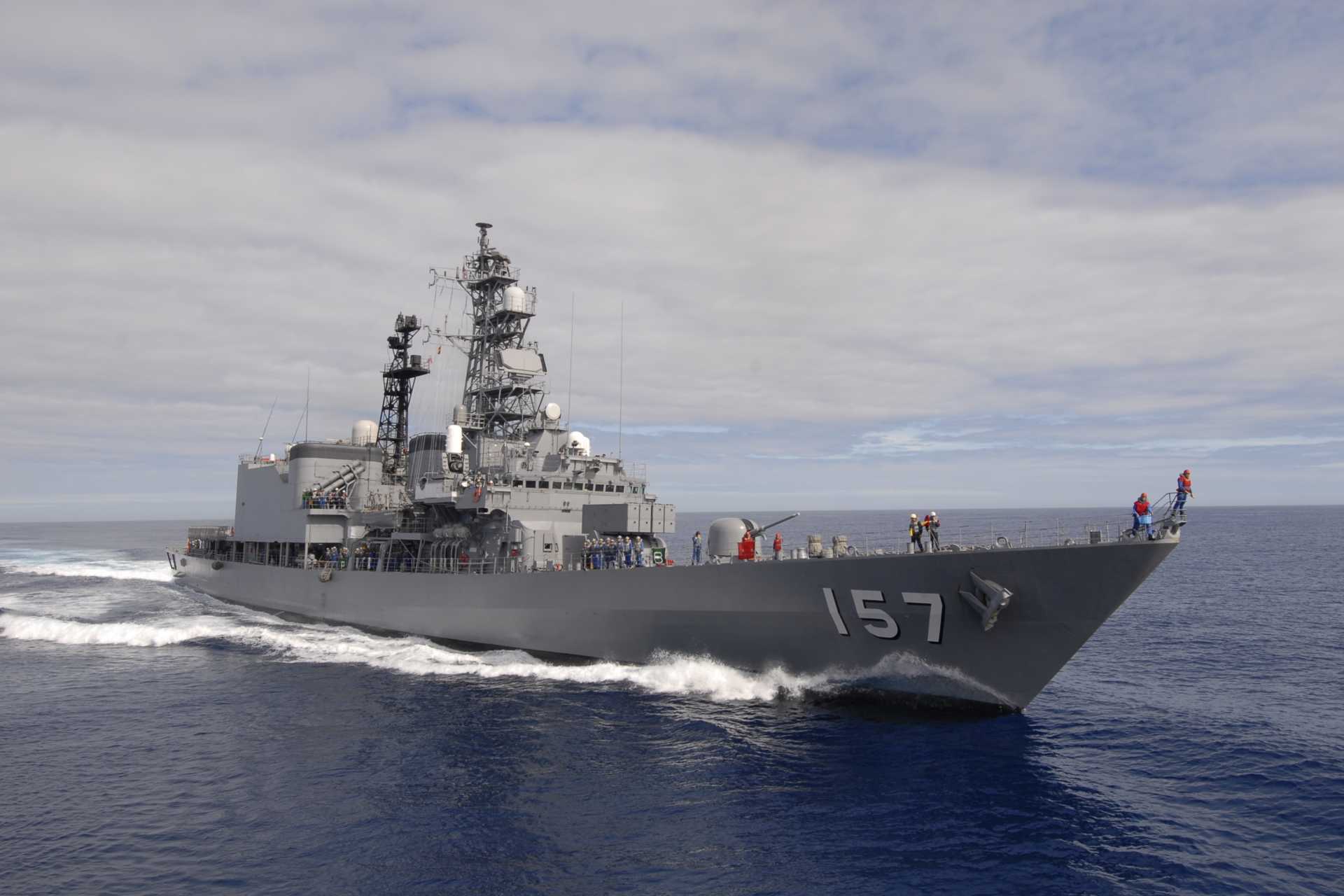
- Details
- Written by: Jérôme Brahy
- Category: Naval News Navy 2026
- Hits: 661
Japanese Defense Minister Shinjiro Koizumi and Indonesian Defense Minister Sjafrie Sjamsoeddin agreed in Tokyo to launch formal working-level negotiations regarding the potential transfer of retired Japan Maritime Self-Defense Force Asagiri-class destroyers to the Indonesian Navy. The bilateral talks focus on creating a comprehensive sustainment package covering crew education, gas-turbine maintenance, and operational integration into Jakarta's fleet architecture. This initiative follows Japan's April 2026 defense export framework revision, which eliminated historical restrictions on transferring lethal naval platforms to regional security partners.
The bilateral working group will evaluate the transfer viability of seven 3,500-ton general-purpose Asagiri-class destroyers equipped with Harpoon anti-ship missiles, Sea Sparrow surface-to-air missiles, and specialized anti-submarine warfare systems. The framework addresses whether the Indonesian Navy can absorb the 220-person crew requirement and complex combined gas-turbine propulsion maintenance cycles without overextending its highly diversified naval procurement budget.
Related topic: Japan to begin talks to export Mogami frigates to New Zealand following Australian selection
Introduced in the late 1980s, the Asagiri-class is a series of eight general-purpose destroyers operated by the Japan Maritime Self-Defense Force (JMSDF) with a strong emphasis on anti-submarine warfare. (Picture source: Japanese MoD)
On June 5, 2026, Japanese Defense Minister Shinjiro Koizumi and Indonesian Defense Minister Sjafrie Sjamsoeddin agreed in Tokyo to begin talks on the possible transfer of Asagiri-class destroyers to the Indonesian Navy, as part of a formal bilateral review covering crew education, training, maintenance, sustainment, and operational employment. The destroyer class under consideration includes seven ships operated by Japan, including one converted for training use. The talks follow a prior Japan-Indonesia defense meeting in May 2026, which itself followed Japan’s April 2026 revision of its defense export rules, which removed the previous restriction limiting transfers to rescue, transport, warning, surveillance, and minesweeping.
These destroyers would place Indonesia alongside the Philippines, Australia, and possibly New Zealand in Tokyo’s expanding naval cooperation network. For Indonesia, the issue is not only whether Japan can provide hulls, but whether the Indonesian Navy can crew, refit, arm, maintain, and employ ships of this size without adding an unsustainable burden to an already diversified naval fleet. Japan and Indonesia have not yet agreed on the number of Asagiri-class ships, a delivery sequence, a refit scope, a cost-sharing formula, or a transfer schedule, and none of those variables is secondary.
A single transferred destroyer would mainly serve as an interim capability and training asset, while several transferred ships would require a deeper Indonesian commitment to Japanese supply chains, including turbine maintenance, combat system support, as well as torpedo and missile logistics. The working group’s first agenda will therefore have to connect four separate issues that are often treated too separately: how Indonesian crews are generated, how the ships are restored before delivery, how Japanese support continues after delivery, and what missions the Indonesian Navy assigns to them.
Training is a key issue as each Asagiri-class requires about 220 personnel, and those sailors must include bridge teams, gas turbine engineers, damage control parties, radar and sonar operators, weapons technicians, communications personnel, aviation support crews, and command staff. Maintenance is equally central because a 35 to 38-year-old destroyer can absorb large sums in corrosion work, propulsion overhaul, electronics repair, combat system support, and obsolete component replacement before it becomes operationally useful. The working-level format, therefore, gives both governments a way to determine whether the transfer is a real fleet option or only an attractive offer that becomes less persuasive once life-cycle costs are counted.
The Asagiri-class destroyer gives Indonesia a ship larger and more capable than a patrol vessel or small corvette, but also older and more manpower-intensive than a modern frigate. The class is a Japanese general-purpose destroyer displacing 3,500 tons standard and 4,900 tons full load. Each ship measures 137 m in length, 14.6 m in beam, and 4.5 m in draft, while four Kawasaki/Rolls-Royce Spey SM-1A gas turbines, producing 54,000 shp through two shafts, permit a maximum speed of 30 knots. This is operationally relevant for Indonesia: 6,000 nautical miles at 20 knots and 8,000 nautical miles at 14 knots allow a ship to move between distant patrol sectors without being tied to short-range coastal operations.
The drawback is that the COGAG (combined gas turbine and gas turbine) propulsion is built around gas turbines rather than a diesel arrangement, so the Indonesian Navy would need to possess the specialist engineering skills and maintenance routines suited to such machinery. The aviation facility is a major part of the ship’s value, with a flight deck and hangar for one SH-60J/K anti-submarine helicopter, turning the destroyer into a wider anti-submarine warfare (ASW) and maritime surveillance asset. The Asagiri-class carries eight RGM-84 Harpoon anti-ship missiles in Mk 141 launchers, giving it an anti-surface role against hostile surface combatants, armed maritime formations, or ships threatening Indonesian sea lines of communication.
The gun armament consists of one OTO Melara 76 mm/62-caliber weapon, useful for surface engagement, warning fire, and limited air defense tasks against low-end aerial threats. The ship’s air defense capacity is limited to one Mk 29 launcher for eight RIM-7 Sea Sparrow surface-to-air missiles, backed by two Mk 15 Phalanx CIWS mounts for terminal defense against incoming missiles and aircraft. The anti-submarine fit is more relevant to Indonesia’s geography: the class carries a Type 74/Mk 16 ASROC launcher, two triple 324 mm torpedo tubes for Mk 46 lightweight torpedoes, an OQS-4A hull sonar, and an OQR-1 towed-array sonar.
The radar and combat system suite includes the OPS-14/OPS-24 air-search radar, the OPS-28 surface-search radar, OYQ-6/OYQ-7 combat direction systems, Link-11, electronic support measures, a jammer, chaff and decoy launchers, and torpedo decoys. In practical terms, the ship would give Indonesia a mature escort and ASW vessel centered on helicopter and torpedo operations, not a modern guided-missile destroyer. Indonesia’s geography explains why Jakarta is examining this aging destroyer. The Indonesian Navy must cover the Strait of Malacca, the Natuna Sea, the Strait of Sunda, the Strait of Lombok, and wider archipelagic sea lanes, while also managing a marine jurisdictional area of about 6.1 million km² where commercial traffic, fishing activity, submarine movements, illegal activity, and state naval presence overlap.
A smaller patrol vessel can show presence and conduct constabulary missions, but it cannot provide the same combination of endurance, helicopter operations, underwater search, missile armament, and command capacity. The Asagiri-class is most useful where Indonesia needs to keep a ship on station, escort other vessels, monitor a chokepoint, support a larger maritime security operation, or conduct ASW patrols in coordination with aircraft and other ships. The helicopter is the largest operational multiplier because it can extend the search area beyond the ship’s radar and sonar horizon, investigate contacts, support over-the-horizon surveillance, prosecute submarine contacts, and assist search-and-rescue missions.
The towed-array sonar and hull sonar combination also gives Indonesia a more serious underwater detection capability than a gun-and-missile patrol combatant, especially in a region where submarine fleets are expanding. The Harpoon missiles also matter because they give the ship a surface combat role, but the more important long-term value for Indonesia would likely be ASW training, helicopter integration, escort doctrine, and sustained operation of a larger multi-role combatant. However, the Asagiri-class destroyers entered service between 1988 and 1991, which makes them 35 to 38 years old in 2026.
Ships of that age require careful assessment of hull fatigue, corrosion, shaft condition, gas turbine hours, electrical systems, piping, fire suppression systems, magazine safety, combat system supportability, radar reliability, sonar availability, and software or hardware obsolescence. Eight Sea Sparrow missiles provide only a shallow air defense magazine, and Phalanx provides a final layer rather than a substitute for modern medium-range missiles. The 220-person crew is also a real cost because Indonesia is simultaneously absorbing new or planned frigates, submarines, patrol vessels, and domestic construction programs, each of which needs trained sailors and maintainers.
The all-gas-turbine COGAG plant gives the ship high speed, but it can increase fuel and maintenance pressure compared with diesel-based ships used for long patrols. The transfer is rational only if Japan can provide the ships in a condition that does not require excessive refit spending, if Indonesia can secure spare parts and training, and if the total cost remains below the point where a new-build frigate, corvette, or offshore patrol combatant would offer better value. The ships can fill a near-term ASW and escort gap, but they cannot be treated as a low-cost substitute for a fully modern frigate force.
Before the April 2026 defense export revision, Japan’s framework limited defense equipment transfers to rescue, transport, warning, surveillance, and minesweeping. The revised framework permits lethal equipment transfers, including destroyers, under specified conditions, while eligible recipients require agreements with Japan on classified information protection and related security arrangements. Japan and Indonesia already have the necessary agreement, which means the Asagiri case can move directly into practical examination rather than being blocked at the legal threshold.
The case also gives Japan a way to use decommissioned or soon-to-be-retired naval assets to create long-term defense relationships through sustainment, training, spare parts, dockyard work, and operational familiarity. For Indonesia, the same arrangement creates access to Japanese naval practices and ASW experience, but it also creates dependence on Japanese support for older systems that may not have large international supply pools. The broader Japanese naval cooperation has also gained momentum. The Philippines eyes Abukuma-class destroyer escorts and TC-90 aircraft, while Japan is supplying the first three of a planned 11 upgraded Mogami-class frigates to Australia.
New Zealand is another possible Mogami-class export partner, and Indonesia has also shown interest in upgraded Mogami-class frigates, but is expected to decide only after the Asagiri question is settled. Indonesia has also expressed interest in secondhand Japanese submarines, which would widen the naval relationship beyond surface ships and place Japan in a more significant position inside Indonesia’s already crowded naval procurement. On the Italian side, Indonesia is acquiring the former aircraft carrier Giuseppe Garibaldi, signed a €1.18 billion contract in 2024 for two Thaon di Revel-class multipurpose patrol vessels/frigates, and previously agreed in 2021 a package covering six FREMM frigates, two modernized Maestrale-class frigates, and logistics support, with implementation still affected by funding.
With the United Kingdom, Indonesia is building two Merah Putih-class frigates, derived from the Arrowhead 140, in Surabaya under a design-license arrangement signed in 2021. In January 2026, Babcock added an agreement for two more Arrowhead 140s, increasing the prospective class to four ships. With Türkiye, Indonesia signed for two MILGEM Istif/I-class frigates with TAIS Shipyards at IDEF 2025. Regarding submarines, Indonesia contracted the French Naval Group for two Scorpène Evolved Full LiB submarines to be built in Indonesia through technology transfer, with the contract entering into force on July 23, 2025.
This approach gives Indonesia political flexibility, multiple procurement channels, faster access to some capabilities, technology-transfer opportunities, and bargaining room with suppliers. Mirroring its air force, it also creates a fleet-management problem because each new asset brings its own engines, combat systems, weapons, training procedures, software, maintenance needs, and supplier dependencies. The deciding question is therefore not whether the Asagiri class has useful capability, because its combination of range, sonar, helicopter facilities, Harpoon, ASROC, torpedoes, and point defense is operationally meaningful for Indonesia.
The deciding question is whether the ships can be transferred with enough refit work, spare parts, training, and Japanese support to make them cheaper and faster than waiting for new ships, while not consuming the crews, budgets, and maintenance capacity needed for Indonesia’s multiple frigates, submarines, and domestic shipbuilding programs. If those conditions are met, the Asagiri class would function as an interim ASW and escort bridge for the Indonesian Navy; if they are not met, the ships would risk becoming another maintenance-heavy layer in one of the most complex naval forces globally.
Written by Jérôme Brahy
Jérôme Brahy is a defense analyst and documentalist at Army Recognition. He specializes in naval modernization, aviation, drones, armored vehicles, and artillery, with a focus on strategic developments in the United States, China, Ukraine, Russia, Türkiye, and Belgium. His analyses go beyond the facts, providing context, identifying key actors, and explaining why defense news matters on a global scale.
Explore More Defense News
• Land Defense News
• Naval Defense News
• Defense Aerospace News
Read more: Japan starts talks with Indonesia to transfer Asagiri-class destroyers to Indonesian Navy

- Details
- Written by: Nicanci
- Category: Naval News Navy 2026
- Hits: 607
Taiwan has taken a significant step toward strengthening its coastal defense network after the Altius-600M loitering munition successfully struck a maritime target during its first sea-based live-fire test, demonstrating a new capability to detect, track, and attack threats approaching the island’s coastline. The achievement, reported by the Taiwanese Military News Agency following the June 3, 2026 exercise, highlights how loitering munitions could complicate amphibious assault planning by keeping reconnaissance and strike assets airborne over likely maritime approach routes.
The test validated the complete engagement chain, including target search, identification, command authorization, and precision attack, rather than simply proving the weapon’s destructive effect. By combining surveillance and strike functions in a single platform, the Altius-600M strengthens Taiwan’s layered denial strategy and reflects the broader shift toward networked, attritable unmanned systems designed to increase survivability and operational flexibility in future maritime warfare.
Related Topic: Taiwan Tests U.S.-Made TOW and Javelin Missiles Against Maritime Targets to Refine Anti-Landing Defense Strategy
Taiwan successfully conducted the first maritime live-fire test of its Altius-600M loitering munition, demonstrating a new reconnaissance-to-strike capability designed to disrupt and complicate potential amphibious landing operations in the Taiwan Strait (Picture Source: Taiwanese Military News Agency)
On June 3, 2026, Taiwan conducted the Altius-600M loitering munition’s first live-fire test against a maritime target during a two-day unmanned aerial vehicle live-fire drill and Tianma Exercise. According to the Taiwanese Military News Agency, the system achieved a 100% hit rate in its first maritime target engagement, marking a significant step in the island’s operational use of loitering munitions. More than a single weapons trial, the event showed how Taiwan is beginning to integrate drone-based reconnaissance and precision strike into its coastal defense strategy. In a Taiwan Strait scenario, this capability could create a new layer of uncertainty for any force attempting to approach, land, or support amphibious operations near the island’s coastline.
The live-fire event was carried out by the UAV Battalion of the 21st Artillery Command under Taiwan’s Third Combat Zone, as part of a broader effort to verify the combat effectiveness of newly introduced weapons. The firing sequence described by the Taiwanese Military News Agency is particularly important because it indicates that Taiwan did not simply test the munition’s terminal strike effect. Operators completed a full engagement cycle that included aerial loitering, target search, identification, command authorization, and final attack. After receiving the firing order, the Altius-600M successfully struck the maritime target, producing the 100% hit rate reported by Taiwanese authorities. In operational terms, this matters because the system was tested as part of a complete sensor-to-shooter process, not merely as a drone carrying an explosive payload toward a preselected point.
The Altius-600M is designed to occupy a space between reconnaissance drone and precision-guided munition. Taiwan’s Third Combat Zone described the system as offering long loiter time, real-time reconnaissance, target designation, and precision strike capability, allowing it to perform surveillance, target identification, and attack missions according to battlefield needs. This combination is central to its value. A conventional missile usually requires a target to be detected and selected before launch, while a loitering munition can remain airborne, search an area, transmit information, and then strike once a target is confirmed. For Taiwan, this creates a more flexible response option in the coastal battlespace, where enemy vessels, landing craft, fast boats, command assets, or support platforms may appear briefly and move quickly through contested maritime corridors.
The operational history of the Altius-600M in Taiwan is connected to a wider U.S.-Taiwan effort to increase the island’s distributed strike and surveillance capabilities. Army Recognition Group previously reported that the United States approved a $1.1 billion Foreign Military Sale covering ALTIUS-700M and ALTIUS-600 systems for Taiwan, with the package designed to expand long-range, networked surveillance and precision-strike capacity in a contested environment. This followed an earlier U.S. approval linked to ALTIUS-600M-V loitering munition systems, placing the platform within a broader Taiwanese move toward attritable, mobile, and networked unmanned strike assets. In another Army Recognition report, the ALTIUS-600M and ALTIUS-700M were presented as systems that unify intelligence, surveillance, reconnaissance, and strike functions, with the ALTIUS-600M described as a medium-weight platform suitable for rapid deployment from airborne, ground, and surface launch options. The June 3 test appears to represent the transition from procurement and training to practical operational validation in a maritime defense scenario.
Compared with Taiwan’s use of Javelin and TOW missiles against maritime targets, the Altius-600M offers a different tactical effect. Javelin and TOW remain essential weapons for anti-landing defense, especially against amphibious vehicles, landing craft, armored targets, and forces moving from the shoreline toward inland routes. However, they are still primarily direct-engagement weapons tied to the firing team’s position, sensor picture, and engagement geometry. The Altius-600M changes the logic of the fight by placing the weapon in the air before the target is fully defined. It can loiter over a suspected approach route, search for a target, assist in confirmation, and then conduct a precision attack. This makes it useful not only as a munition, but also as a tool for delaying movement, complicating enemy planning, and forcing an attacking force to assume that threats may already be airborne before its landing craft reach the beach.
The maritime nature of the test is one of its most important aspects. Striking a sea target is more complex than attacking a fixed land objective. Maritime targets move, change orientation, produce different visual and infrared signatures, and may operate among decoys, civilian traffic, or multiple vessels. Sea state, weather, communications quality, and electronic interference can also affect detection, identification, and engagement. By conducting the first Altius-600M live-fire test against a maritime target, Taiwan appears to be evaluating the munition in a mission profile directly related to coastal interdiction and anti-landing operations. The reported success should still be understood with caution, as a controlled live-fire result does not automatically indicate performance under wartime conditions involving jamming, air defenses, camouflage, simultaneous threats, or counter-drone measures. Even so, the test provides a strong indication that Taiwan is moving the system toward realistic operational use rather than treating it as a symbolic acquisition.
The strategic implication is that Taiwan is building a more layered and distributed coastal denial architecture. A potential amphibious assault across the Taiwan Strait would require complex coordination between naval forces, landing craft, air cover, electronic warfare, logistics vessels, and follow-on ground units. Taiwan’s defense concept seeks to make that sequence slower, more visible, and more vulnerable at every stage. Coastal missiles, artillery, mines, TOW teams, Javelin teams, mobile fire-support vehicles, unmanned surface systems, and loitering munitions can each create overlapping engagement zones. Within this framework, the Altius-600M adds a reconnaissance-strike layer that can watch, wait, and attack targets when they become exposed. Its greatest value may not be the destruction of a single target, but the pressure it places on an adversary’s planning, forcing landing forces to account for small, mobile, and harder-to-detect aerial threats operating above maritime approaches.
The June 3, 2026, Altius-600M live-fire test shows that Taiwan is no longer only acquiring loitering munitions as part of a modernization program; it is beginning to integrate them into the island’s real coastal defense doctrine. The reported 100% hit rate gives the event immediate visibility, but the deeper message is operational and strategic. Taiwan is testing a system that can connect reconnaissance, target confirmation, and precision attack in a single platform, giving its ground forces a new way to contest maritime approaches before an enemy reaches the shoreline. The Altius-600M will not decide the outcome of a Taiwan Strait conflict on its own, but as part of a wider network of missiles, artillery, drones, sensors, and mobile units, it could make any amphibious movement toward Taiwan more exposed, more fragmented, and more costly.
Written by Teoman S. Nicanci – Defense Analyst, Army Recognition Group
Teoman S. Nicanci holds degrees in Political Science, Comparative and International Politics, and International Relations and Diplomacy from leading Belgian universities, with research focused on Russian strategic behavior, defense technology, and modern warfare. He is a defense analyst at Army Recognition, specializing in the global defense industry, military armament, and emerging defense technologies.
- U.S. Military Aircraft Fires Hellfire Missile to Stop Tanker Bound for Iran’s Kharg Oil Terminal
- U.S. Marine Corps Retires AV-8B Harrier II Jump Jet as F-35B Assumes Full Combat Mission
- Poland to lease HMS Sodermanland submarine from Sweden until first Saab A26 arrives
- Taiwan Tests U.S.-Made TOW and Javelin Missiles Against Maritime Targets to Refine Anti-Landing Defense Strategy