










Germany’s TDW and STARK validate LION STRIKE 110 warhead in live-fire test on VIRTUS Drone.
German defence firms TDW Gesellschaft für verteidigungstechnische Wirksysteme mbH and STARK have successfully conducted a live firing of the LION STRIKE 110 warhead integrated into the VIRTUS loitering munition during trials in Germany. The test validates the weapon as a fully integrated system and positions the programme for potential European and NATO adoption by 2026.
On 22 December 2025, TDW Gesellschaft für verteidigungstechnische Wirksysteme mbH and STARK announced via their official LinkedIn channels that they had successfully completed a live firing of the LION STRIKE 110 warhead integrated into the VIRTUS loitering munition during a test campaign in Germany. The two companies describe this firing as a key milestone in their cooperation, because it validates the interaction between the warhead, fuze and unmanned carrier as a complete weapon system and not just as separate components. TDW emphasises that the trial confirmed the effectiveness of LION STRIKE 110 against armour equipped with reactive protection, while STARK highlights that the test demonstrates a high level of system maturity. The partners state that they are working towards scalable production, with delivery capability for this configuration targeted for the end of 2026. Against the backdrop of rapid demand growth for loitering munitions, this positions the programme as a short-term candidate for operational deployment by European and NATO forces.

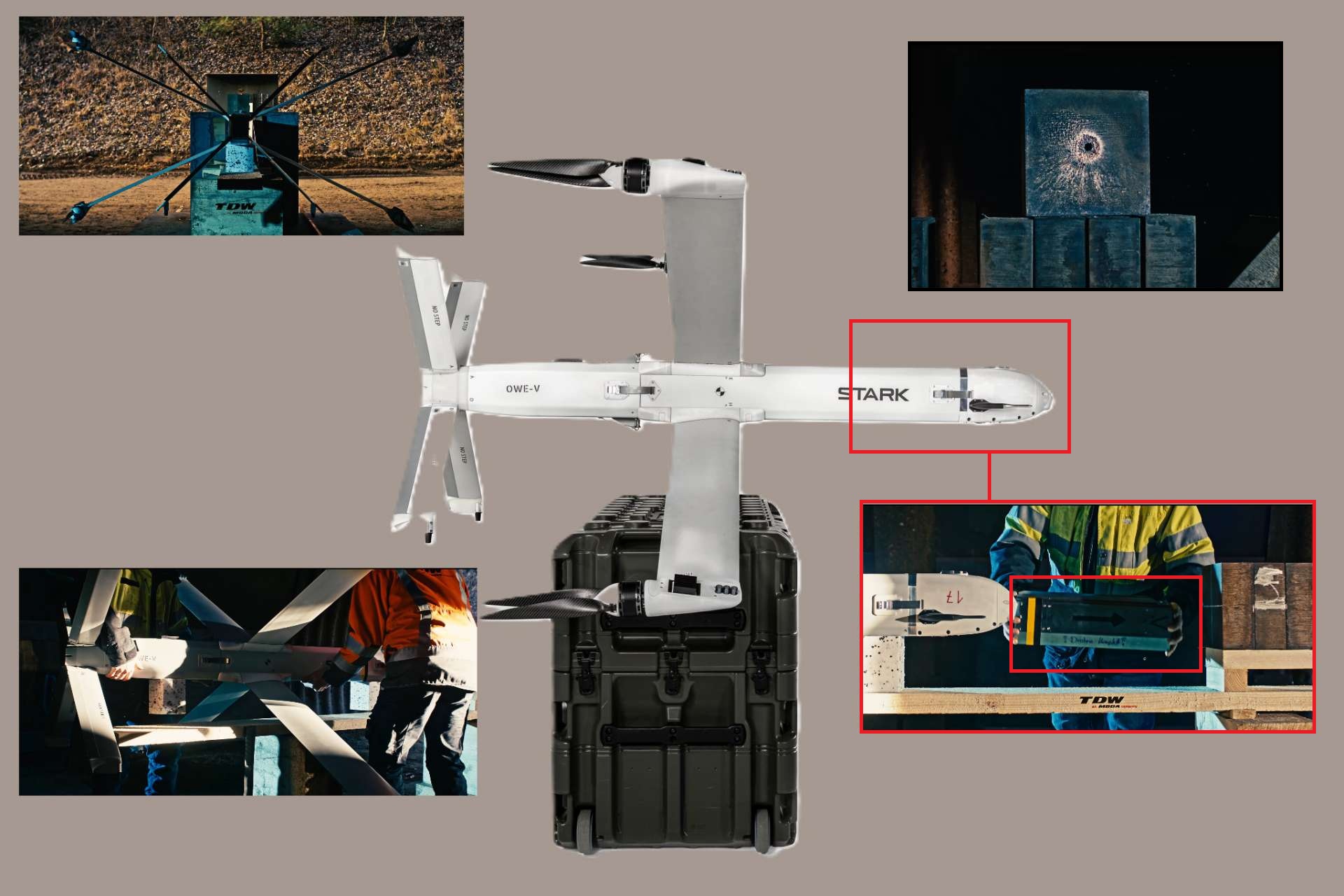
TDW and STARK have completed a live-fire test in Germany of the LION STRIKE 110 warhead integrated into the VIRTUS loitering munition, confirming full system integration and supporting a planned 2026 fielding timeline (Picture Source: STARK / TDW)
At the heart of the project is the pairing of TDW’s LION STRIKE 110 warhead with STARK’s VIRTUS loitering munition. TDW, a recognised specialist in warhead technology and an MBDA Deutschland company, presents LION STRIKE 110 as part of a new family of effectors specifically designed for contemporary battlefield threats, with particular focus on defeating heavy armour fitted with explosive reactive armour. In its LinkedIn communication, TDW stresses that the successful firing demonstrates not just nominal functioning but credible lethality against such targets. STARK, for its part, brings an unmanned “one-way effector” built around modularity: on its official material, the company describes VIRTUS as a vertically launching loitering munition that can integrate different types of warheads and be tailored to distinct mission profiles. The test therefore, validates more than a single combination; it confirms the underlying concept of a flexible effector architecture in which a dedicated anti-armour warhead like LION STRIKE 110 can be plugged into a common unmanned platform.
On the development and industrial side, STARK underlines the pace of progress. In a LinkedIn post, the company’s Director of Strategy and Partnerships, Richard Pass, states that TDW and STARK “have just conducted the first warhead live firing of any loitering munition manufacturer in Germany,” presenting the event as tangible proof of the firm’s focus on “rapid development and operational readiness.” From STARK’s perspective, the objective is clear: by 2026, VIRTUS should be available with certified warheads ready for operational employment by NATO allies. The way the two companies communicate about the programme suggests that qualification, safety clearance and integration are being organised from the outset with serial production in mind. TDW brings long experience in designing and manufacturing warheads to defence standards, while STARK positions itself as a fast-moving systems integrator able to iterate quickly on its unmanned platform. The live firing, marks a transition from concept demonstration to a more structured phase in which production lines and support chains must be prepared for potential large-scale orders.
Combining a loitering munition with a warhead optimised against reactive armour offers land forces a tool that sits between conventional artillery, missiles and direct-fire anti-tank systems. Loitering munitions can be launched from relatively modest infrastructure, remain on station over an area of interest, and then be committed in a single, precise strike when a valuable target is identified. With LION STRIKE 110 on board, VIRTUS is intended to deliver this effect specifically against heavily protected vehicles such as main battle tanks, infantry fighting vehicles or other hardened assets, reducing the need to bring crewed platforms into direct line of fire. The ability to tailor the effector to the threat, by selecting a warhead designed from the outset to defeat reactive protection, gives tactical commanders a way to engage critical targets at range while limiting collateral damage and exposure. STARK’s emphasis on modular payloads and mobile launch concepts also suggests that the system is aimed at supporting small, agile units operating in dispersed fashion, rather than only traditional heavy formations.
This live firing carries a message that goes beyond the technical success of one test event. For Germany, it illustrates how national industry is seeking to respond to renewed focus on high-intensity conflict and long-range precision effects by pairing an established warhead designer with a new, software-driven unmanned systems company. For NATO members more broadly, STARK’s explicit reference to operational use “with NATO allies” and to a 2026 delivery horizon signals an ambition to make this capability available on a timeline compatible with current rearmament efforts. Even though no specific procurement contract or budget figures have been mentioned in the public communications used here, the way TDW and STARK frame the programme clearly positions the LION STRIKE 110–VIRTUS combination as a future contender in the loitering munition segment. By demonstrating in Germany that a purpose-designed anti-armour warhead can be integrated and safely fired from a modular loitering munition, and by linking this success to plans for scalable production, the two partners are indicating that European industry intends not only to follow the global shift towards loitering munitions, but also to shape it with systems conceived from the outset for alliance interoperability and rapid fielding.
The live firing of the LION STRIKE 110 warhead from the VIRTUS loitering munition marks a clear turning point for the TDW–STARK partnership, moving their project from concept to a demonstrated weapon system that has proven both its effectiveness against reactive armour and its suitability for scalable production. By targeting delivery capability for the end of 2026 and explicitly framing the system as ready for operational use with NATO allies, the two companies are signalling that they intend this German-developed loitering munition to play a concrete role in future force structures rather than remain at the prototype stage. The combination of a dedicated anti-armour warhead from an established warhead manufacturer with a modular loitering platform from a fast-moving systems integrator underlines how industry is adapting to the growing importance of one-way effectors on the modern battlefield. For armed forces looking to expand their precision-strike options, the Schrobenhausen test sends an unambiguous message: VIRTUS equipped with LION STRIKE 110 is entering the final stretch towards becoming an operational capability that can be procured, integrated and used within a relatively short timeframe.