










South Korea’s KF-21 Boramae fighter jet to gain full air-to-ground strike capability by 2027.
South Korea’s Defense Acquisition Program Administration confirmed that the indigenous KF-21 Boramae fighter will receive full air-to-ground combat capabilities starting in 2027, years ahead of the original schedule. The accelerated timeline underscores rising confidence in the aircraft’s technical maturity and strengthens Seoul’s push for greater airpower independence.
South Korea’s domestically developed KF-21 Boramae fighter jet will enter full air-to-ground combat service beginning in 2027, significantly earlier than initially planned, according to information released by Yonhap News on December 23, 2025, citing the Defense Acquisition Program Administration. Officials said the decision reflects steady progress in flight testing, avionics integration, and weapons certification as the program transitions from development into early production.
Follow Army Recognition on Google News at this link

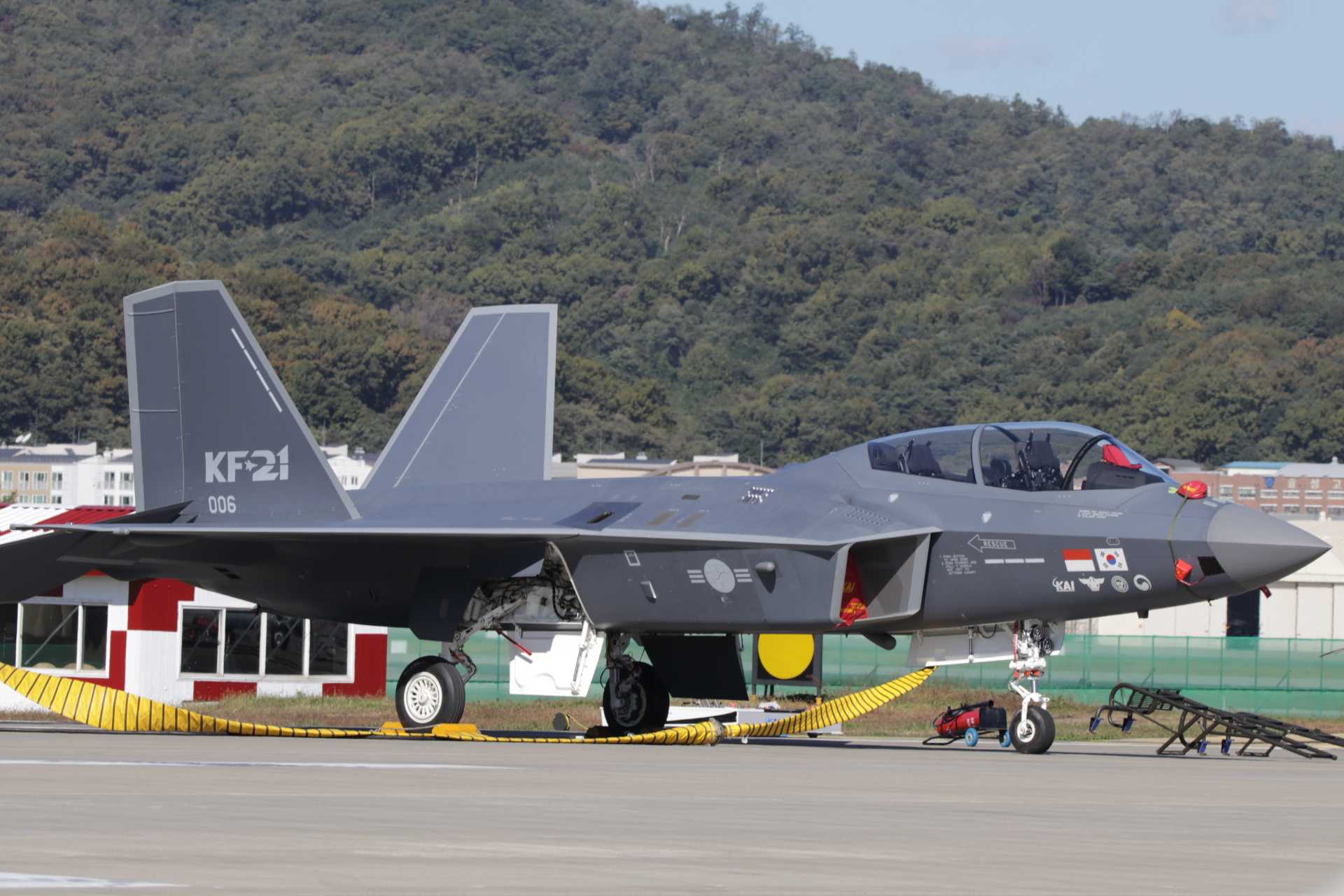
A Republic of Korea Air Force KF-21 Boramae fighter on the ground, as South Korea accelerates integration of full air-to-ground combat capability for the aircraft ahead of its original schedule. (Picture source: Army Recognition Group)
South Korea's DAPA (Defense Acquisition Program Administration) announced that the government will invest approximately 700 billion won (approximately 472 million US dollars) to conduct an extensive test-and-evaluation campaign of 10 types of air-to-ground weapons through the end of 2028. Officials familiar with the program told Army Recognition that the trials will include precision-guided bombs, stand-off strike munitions, and domestically developed smart air-to-surface weapons, many of which are produced by South Korean defense firms. The accelerated schedule is expected to deliver certified ground-attack capability roughly 1.5 years earlier than initially planned, a move DAPA says will significantly strengthen the Republic of Korea Air Force's combat power while positively influencing the KF-21’s export prospects.
The KF-21 Boramae is South Korea’s first domestically designed supersonic fighter aircraft and the centerpiece of the country’s long-term strategy to reduce dependence on foreign combat aircraft. Launched in 2015, the program was initiated to replace aging U.S.-made platforms such as the F-5 and early-generation F-4 fighters, which no longer meet modern survivability or mission requirements. Designed as a 4.5-generation fighter, the KF-21 occupies a middle ground between legacy fourth-generation aircraft and fifth-generation stealth fighters, prioritizing advanced sensors, networking, and growth potential while maintaining cost-effectiveness.
Unlike true fifth-generation aircraft such as the F-35A or F-22, the KF-21 does not rely exclusively on internal weapons bays or extreme low observability. Instead, it features reduced radar cross-section shaping, an indigenous active electronically scanned array radar, infrared search-and-track capability, and a modern mission computer built on an open architecture. This design philosophy enables faster software upgrades and weapons integration, which has directly enabled the early move toward air-to-ground capability.
In the global fighter market, the KF-21 is positioned to compete directly with other advanced 4.5-generation platforms, including the Saab Gripen E, the Eurofighter Typhoon in its latest configurations, and the upgraded F-16V. Compared with the F-16V, the Boramae offers a larger airframe and greater growth margin for future sensors and weapons. Against the Gripen E, it emphasizes higher payload capacity and twin-engine redundancy, an advantage for air forces operating over maritime or mountainous terrain. When compared with the Eurofighter Typhoon, the KF-21 appears to be a more cost-effective alternative, with fewer political restrictions on weapons integration and export use.
The timing of the announcement is closely tied to the program’s industrial progress. The first production-standard KF-21 entered final assembly in May, marking a critical transition from prototype testing to serial manufacturing. Engineers involved in the program indicated that stable flight-test results and successful validation of avionics software have reduced technical risk, allowing authorities to advance the integration of strike weapons without altering the overall development budget or timeline.
Operationally, the accelerated integration of air-to-ground capability addresses an urgent requirement for the Republic of Korea Air Force. While South Korea’s F-35A fleet provides stealth penetration and first-strike capability, the KF-21 is intended to deliver mass, persistence, and flexibility. Once equipped with certified strike weapons, the Boramae will be capable of conducting precision strikes, interdiction missions, and close air support alongside F-35As and upgraded F-15K fighters, creating a layered force structure able to respond to high-intensity conflict scenarios on the Korean Peninsula.
From an export standpoint, early demonstration of multi-role capability could prove decisive. Many potential customers cannot afford fifth-generation stealth fighters or face political constraints on their acquisition, yet still require modern sensors, networked warfare capability, and credible air-to-ground performance. By achieving strike capability ahead of schedule, South Korea is positioning the KF-21 as a mature and flexible 4.5-generation fighter ready to compete in an increasingly crowded global market.
As weapons testing accelerates toward 2027, the KF-21 program is entering a defining phase. Success would not only modernize South Korea’s combat aviation fleet but also confirm the country’s emergence as an independent designer and producer of advanced fighter aircraft, capable of offering a credible alternative to established Western platforms.
Written by Alain Servaes – Chief Editor, Army Recognition Group
Alain Servaes is a former infantry non-commissioned officer and the founder of Army Recognition. With over 20 years in defense journalism, he provides expert analysis on military equipment, NATO operations, and the global defense industry.