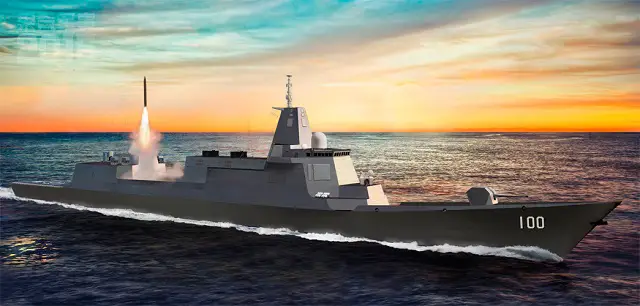
The Trump-class Guided Missile Destroyer is a next-generation multi-role surface combatant developed by the United States Navy under the strategic Golden Fleet initiative. Designed to project unmatched naval power across global theaters, it integrates hypersonic missile systems, railgun technology, advanced radar arrays, and directed-energy weapons into a modular, future-proof platform. As the most powerful surface warship ever fielded by the United States, the Trump-class stands as a cornerstone of America’s 21st-century maritime dominance doctrine.
Country users: United States







Technical Data
-
Design
The Trump-class is a planned nuclear-powered large surface combatant being developed by the United States Navy as the successor to the previously planned DDG(X) next-generation destroyer program. Current planning indicates a displacement of approximately 35,000 tons or more at full load, a length of approximately 840 to 880 feet (256 to 268 meters), a beam of approximately 105 to 115 feet (32 to 35 meters), and a crew of approximately 650 to 850 personnel. The large hull is intended to provide the internal volume, payload capacity, electrical power, cooling capacity and growth margins required for a large missile battery, hypersonic weapons, advanced sensors, directed-energy systems and future combat technologies. As the program remains at an early stage of development, the final hull form, superstructure arrangement, internal configuration and survivability features have not yet been publicly finalized and may evolve as the U.S. Navy progresses toward detailed design and construction.
-
Weapons
The Trump-class is planned to carry a large and diversified weapons suite supporting long-range strike, air and missile defense, anti-surface warfare and strategic missions. The current baseline includes 128 Mk 41 Vertical Launching System cells capable of accommodating weapons such as Tomahawk land-attack cruise missiles, Standard Missile family interceptors, Evolved Sea Sparrow Missiles and anti-submarine weapons, together with four large-diameter launch tubes accommodating up to twelve Conventional Prompt Strike hypersonic missiles. The class is also planned to support the nuclear-armed Sea-Launched Cruise Missile-Nuclear (SLCM-N). Gun armament is expected to include two 5-inch naval guns, while short-range protection is planned to include Rolling Airframe Missile systems. Current planning also provides for high-powered directed-energy weapons and an electromagnetic railgun, although these technologies remain developmental and their installation will depend on their maturity when the ships enter construction and combat-system integration.
-
Sensors, Electronic Systems, and Radars
The Trump-class is expected to employ an advanced integrated combat system capable of supporting air and missile defense, surface warfare, long-range strike and networked fleet operations. The ship is expected to incorporate an advanced air and missile defense radar, potentially derived from the U.S. Navy's SPY-6 family, together with technologies associated with the Aegis combat system, Cooperative Engagement Capability, advanced electronic warfare systems and secure tactical communications. These systems would allow the battleship to detect and track multiple threats while exchanging sensor and targeting information with other surface ships, submarines, aircraft, unmanned platforms and space-based assets. Its nuclear-powered architecture and large hull are intended to provide substantial electrical-power and cooling margins for future radar improvements, electronic warfare equipment, directed-energy weapons and increasingly demanding command-and-control systems, although the final sensor and electronic warfare configuration has not yet been publicly finalized.
-
Engine
The Trump-class is planned to use nuclear propulsion, representing a major departure from earlier concepts for a conventionally powered large surface combatant. Nuclear propulsion is intended to provide sustained high-speed endurance without dependence on conventional propulsion fuel, with current planning indicating a maximum speed exceeding 30 knots. The nuclear power plant would also provide substantial electrical-generation capacity for advanced radar arrays, electronic warfare systems, directed-energy weapons and potential electromagnetic weapon systems, while retaining additional power margins for future modernization. The exact reactor configuration, number of reactors, propulsion arrangement and electrical output have not yet been publicly disclosed and are expected to be defined as the U.S. Navy advances the ship through detailed design.
-
Aircraft and Helicopter Capability
The Trump-class is expected to incorporate aviation facilities capable of supporting helicopters and unmanned aerial systems for intelligence, surveillance and reconnaissance, anti-submarine warfare, targeting, logistics and other maritime missions. A flight deck and hangar would allow embarked aircraft and UAVs to extend the ship's surveillance and targeting reach beyond the horizon and contribute information to its long-range missile systems and wider naval force. Unmanned aircraft could also support communications relay, maritime surveillance and targeting missions as part of distributed fleet operations. The final aviation complement, hangar configuration and specific aircraft or unmanned systems to be embarked have not yet been publicly confirmed and should therefore be considered subject to further development.


Photo Gallery